
The CyberAgent case study published by OpenAI on April 9, 2026
On April 9, 2026, the OpenAI official blog published a case study titled "CyberAgent moves faster with ChatGPT Enterprise and Codex." It details how CyberAgent, which operates three distinct business divisions in advertising, media, and gaming, leverages ChatGPT Enterprise and Codex to scale AI adoption securely.
In early April 2026, OpenAI also transitioned Codex pricing to pay-as-you-go while lowering the per-seat rate to $20, accompanied by reports that active developers using Codex surpassed 2 million weekly, a sixfold increase compared to January. Across the enterprise landscape, this marks the turning point where AI adoption has transitioned from Phase 1 (experimentation) to Phase 2 (integration into core operations).
This article adapts CyberAgent's official case study into a blueprint that mid-market businesses (50–500 employees) can replicate, breaking it down into an actionable 90-day roadmap.
Three adoption principles drawn from CyberAgent's case study
Analyzing OpenAI's case study alongside CyberAgent's public statements on AI strategy reveals three core adoption principles applicable regardless of organizational size.
Principle 1 — "Distributing to everyone" does not equal "adoption on the ground"
Many organizations declare victory simply by distributing ChatGPT Enterprise licenses company-wide, but CyberAgent segmented use cases by business unit and deployed operational leaders to guide day-to-day adoption. The governing principle here is treating distribution and habituation as entirely separate initiatives.
Principle 2 — Prioritize "decision-making speed" as the top KPI
A major lesson of 2026 is that measuring AI ROI solely by metrics like "time required to draft one article" quickly reaches a ceiling. CyberAgent established upstream metrics like "time to decision" and "lead time from concept to publication" as primary KPIs—a mindset readily adopted by mid-market organizations.
Principle 3 — Do not isolate coding AI from business AI
A pivotal theme running through the case study is managing Codex (development) and ChatGPT Enterprise (business workflows) under a unified contract and governance model. When IT and engineering teams procure these separately, data access and audit logs become fragmented, doubling administrative overhead.
Recent developments in coding AI are also highlighted in our Comprehensive Comparison of Cursor 3 and Claude Code and Rubber Duck Mode in GitHub Copilot CLI, illustrating the seamless continuity between developer AI and enterprise workflows.
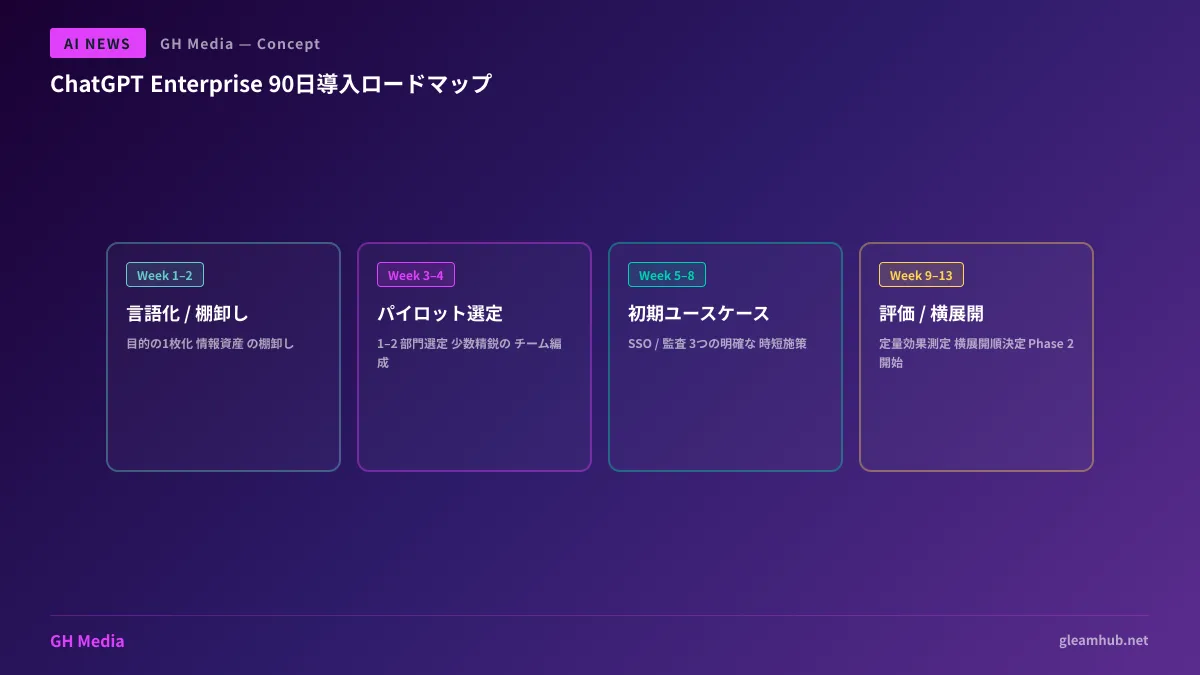
90-day implementation roadmap (Week 1 to Week 13)
Here is a concrete 90-day implementation plan tailored for mid-market businesses, designed to start moving even before finalizing your ChatGPT Enterprise contract.
Weeks 1–2: Articulating purpose and auditing current assets
- Draft a one-page summary in an executive kickoff defining "what we aim to transform with AI." Moving forward without clarity here will derail subsequent steps.
- Audit departments to identify tasks where AI should and should not be introduced.
- Inventory current SaaS platforms and information assets (if data locations are unknown, future integrations will stall).
Weeks 3–4: Selecting pilot departments and building an agile core team
- Limit the pilot to 1 or 2 departments (company-wide rollouts from day one consistently fail).
- Build a team uniting three key stakeholders: an operational champion, an IT systems representative, and an executive sponsor.
- Define the pilot duration, success metrics, and rollback criteria.
Weeks 5–8: Contract execution and deploying the first three use cases
- Execute the ChatGPT Enterprise contract. IT verifies SSO, data retention configurations, and audit log access permissions.
- Implement three distinct use cases within the pilot department that deliver measurable time savings.
- Centralize prompt assets in a company-wide repository (such as an internal portal, Notion, or Confluence).
Weeks 9–12: Evaluation and preparing broader rollout
- Aggregate quantitative results (time savings, decision lead times) and qualitative feedback from the pilot department.
- Determine rollout sequence for subsequent departments, prioritizing teams demonstrating high engagement.
- Prepare an executive presentation on pilot results alongside budget requests for the upcoming quarter.
Week 13: Phase 2 company-wide kickoff
- Transform learnings from the pilot into an onboarding knowledge base for the broader organization.
- Begin designing a unified governance model to integrate developer tools like Codex.
Governance design without failures — 5 initial items for IT systems teams
To help mid-market IT departments roll out ChatGPT Enterprise with confidence, there are five key policies that prevent future friction when decided up front.
| # | Item | Items to decide |
|---|---|---|
| 1 | Data retention policy | Whether to configure OpenAI to not retain enterprise data (standard rule: do not retain) |
| 2 | SSO / IdP Integration | Which to integrate with: Okta, Entra ID, or Google Workspace |
| 3 | Log Auditing for Prompts and Outputs | Who can view which conversation logs; balancing this with labor and HR risks |
| 4 | Publishing Scope for Custom GPTs | Layered architecture across company-wide, departmental, and individual tiers |
| 5 | Clear Documentation of Prohibited Tasks | Handling of personal information, performance evaluations, legal advice, and more |
Among these, items 3 and 4 are areas that require revising internal company rulebooks rather than simply configuring settings. While our ChatGPT Business Use Guide covers AI usage policies along with prompt examples, during the organizational rollout phase, we feel that establishing the rules first ultimately proves faster.
How to demonstrate ROI — three KPIs that resonate with executives
The annual cost of ChatGPT Enterprise is by no means low. To keep securing continuous budget approval from executive leadership, simply stating that "things became convenient" is insufficient; you must speak in numbers. We recommend the following three KPIs that mid-sized companies can realistically track.
- Reduction rate in task execution time (e.g., month-over-month time spent on drafting meeting minutes, initial proposals, job descriptions, etc.)
- Decision-making lead time (e.g., average number of days from planning proposal to publication sign-off)
- First-contact resolution rate for inquiries (e.g., percentage of inquiries where the initial response was completed solely by AI in internal helpdesks or customer support)
In particular, items 2 and 3 are KPIs that are easy to link directly to business outcomes. When you can connect beyond "saved time" to "revenue and customer satisfaction," executives become able to articulate the rationale for ongoing investment themselves. We also introduce case studies of companies that have made significant DX progress in 10 DX Success Stories of Small and Medium-Sized Enterprises, so please refer to it.
Conclusion
- In April 2026, OpenAI published CyberAgent's ChatGPT Enterprise × Codex case study. Its three core principles—separating distribution from adoption, using decision-making velocity as a KPI, and placing development AI and operational AI under unified governance—are applicable to mid-sized companies as well.
- Conduct implementation via a 90-day roadmap in the order of pilot → evaluation → horizontal rollout. An immediate company-wide deployment from day one will inevitably fail.
- IT systems departments must determine five items prior to contract signing: data retention, SSO, log auditing, custom GPT publishing scopes, and prohibited tasks.
- Communicate ROI to executive management not just through "time savings," but through "decision-making lead time" and "first-contact resolution rate."
At GleamHub, we provide one-stop support ranging from implementation design for ChatGPT Enterprise and internal guideline formulation to custom development of operational AI applications. If you are in charge at a mid-sized enterprise and want to move past "AI that was rolled out but never used," please feel free to consult with us.


