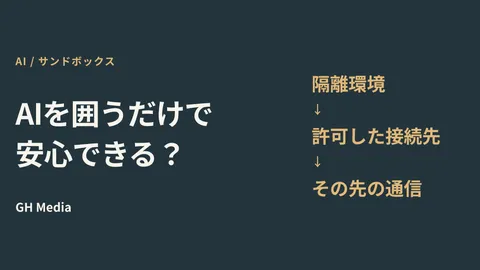
The question of whether ChatGPT can be adopted company-wide has entered a new phase in 2026. OpenAI's release of the Privacy Filter (automatic masking of personal information) and Trusted Access for Cyber (access restricted to approved networks paired with the cyber-specific GPT-5.4-Cyber) represents an effort to deliver answers at the product layer for AI governance that was previously left to individual teams.
These additions are not merely convenient features; they establish the prerequisites for executives to approve enterprise AI usage. This article outlines guidelines for designing custom AI governance architectures anchored by Privacy Filter and Trusted Access for Cyber.
Why AI governance has become an executive priority
As enterprise AI adoption expands, the following challenges inevitably arise:
| Discussion point | Past approach | 2026 approach |
|---|---|---|
| PII entry | Asking employees "please do not enter sensitive data" | Automatic masking enforced at the product level |
| Network boundaries | Standard access directly from personal PCs | Strictly limited to approved IPs and VPNs |
| Model selection | General-purpose models for all use cases | Specialized models (Cyber, Bio, etc.) segregated by use case |
| Audit logs | Obtained through custom individual agreements | Provided as standard with third-party audit compliance |
| Data training | Required manual opt-out verification | Default opt-out standardized |
A shift is underway from reminding humans to be careful to preventing exposure directly at the product layer. Privacy Filter and Trusted Access are prime examples of this evolution.
Mirroring the MCP governance advancements covered in Post-Linux Foundation Transition of MCP — Enterprise MCP Governance Design (2026), OpenAI is likewise moving to enforce control at the product level.
Overall architectural picture
The standard AI governance architecture we propose consists of the following four layers:
- Identity & Network Plane: Connection perimeters secured via IdP, VPN, and Trusted Access
- Data Plane: Personal data masking enforced through Privacy Filter and DLP
- Model Plane: Selecting models by use case (general-purpose / Cyber / Bio / industry-specific)
- Audit Plane: Audit logs, usage logs, and third-party audit compliance
The key is that you can "govern all of these under a single policy." Adopting them piecemeal ultimately creates loopholes in frontline operations.
Three scenarios frequently encountered in custom projects
Scenario A: Approving AI use in financial and healthcare industries
A project aimed at "enabling employees to use ChatGPT for business operations in an industry with stringent compliance requirements." It blocks inflows of personal data via Privacy Filter, restricts connection sources via Trusted Access, and consolidates usage logs into SIEM.
- Timeline: 3 to 5 months
- Benefit: Shifts the stance from "strictly prohibited" to "permitted under specific conditions"
- Caution: Establish a tripartite consensus process among Legal, Audit, and IT teams at the outset
Scenario B: Introducing GPT-5.4-Cyber into cybersecurity operations
A project introducing GPT-5.4-Cyber as a dedicated model for SOC and CSIRT operations. It leverages AI assistance to accelerate incident analysis, threat intelligence curation, and log triage.
- Timeline: 2 to 3 months
- Benefit: Drastically reduces initial incident response time
- Caution: Define the boundary of responsibility between "AI-generated suggestions" and "human judgment" from day one
Scenario C: Global governance across international branch offices
A project to "govern AI usage in alignment with diverse regional data regulations (such as GDPR, APPI, and HIPAA) across international locations." This is achieved by tailoring Privacy Filter rules by region and segmenting connection boundaries using Trusted Access.
# ai-governance-policy.yaml の例
regions:
  - id: jp
    privacy_filter:
      mask: [my_number, address, phone]
      block: [credit_card]
    trusted_access:
      allow_networks: ['vpn-jp', 'office-jp']
    allowed_models: ['gpt-5.5', 'gpt-5.4-cyber']
  - id: eu
    privacy_filter:
      mask: [name, email, address, phone]
      block: [health_data, financial_data]
    trusted_access:
      allow_networks: ['vpn-eu']
    allowed_models: ['gpt-5.5-eu']
By enabling "policy management as code," operations can incorporate version histories, reviews, and automated testing.
Implementation steps (4 phases)
| Phase | Period | Objective |
|---|---|---|
| 1. Formulate AI usage policy | 3–4 weeks | Build consensus across Legal, IT, and business units |
| 2. Configure Privacy Filter and Trusted Access | 3–4 weeks | Tenant configuration + validation in pilot departments |
| 3. Integrate audit logs with SIEM | 2–3 weeks | Log aggregation + dashboard setup |
| 2. Company-wide rollout and training | 2–3 months | Usage guidelines + training |
Whether you can clearly define the "operational scope where AI use is permitted" in Phase 1 largely dictates success. Neither "allow everything" nor "ban everything" is realistic; creating an approval matrix by business task category is essential.
5 common pitfalls
1. Over-relying on Privacy Filter detection accuracy
While Privacy Filter is powerful, 100% accuracy is not guaranteed. High-stakes workflows should be designed with human review in the loop.
2. Over-concentrating Trusted Access on VPNs
Concentrating all approved network access solely into VPNs degrades the user experience for remote workers. Incorporate coexistence with ZTNA (Zero Trust Network Access) right from the planning stage.
3. Rigid model selection
Specialized models like GPT-5.4-Cyber are potent, but they can carry higher costs compared to general-purpose models. Without early cost projections across different use cases, monthly billing disputes will arise.
4. Insufficient discussion on log retention periods
A trade-off between audit requirements and storage costs inevitably surfaces. A three-tier retention design (90 days / 1 year / 7 years) is practical.
5. Lack of preparation for third-party audits
In audits like ISO 27001 and SOC 2, providing audit trails of AI governance has become standard. Designing the system from day one to automatically generate standardized audit reports is the safest approach.
Combining this with the network controls outlined in Client Guide 2026: Building Private Networks Connecting People, Nodes, and AI Agents with Cloudflare Mesh establishes a robust, two-tier governance model across Network and AI.
Comparison with competing stacks
| Competitor | Relationship with Privacy Filter and Trusted Access |
|---|---|
| Microsoft Purview + Copilot | Strong for DLP within M365; Privacy Filter is needed for direct ChatGPT interactions |
| Google Cloud DLP + Workspace Intelligence | Strong within GCP and Workspace; separate controls are needed for ChatGPT usage |
| On-premises/dedicated DLP (Symantec / Forcepoint) | Strong at the network layer; Privacy Filter provides finer-grained context for AI |
In our client engagements, the pattern that meets the least adoption resistance is "keeping existing DLP in place while rolling out Privacy Filter and Trusted Access ahead of other measures exclusively for ChatGPT governance."
Conclusion: The era of designing compliance on the premise of using AI
Historically, AI governance tended to bias toward "preventing use." Privacy Filter and Trusted Access for Cyber are mechanisms that flip that mindset toward "how to govern under the assumption that AI will be used." Companies that master this will quickly pull ahead in AI-driven operational productivity.
If you are looking to enable company-wide ChatGPT adoption or approve AI use in finance or healthcare, feel free to reach out via our contact form.