
"AI crawlers that are supposed to be blocked by robots.txt are somehow hitting us with millions of requests every day"—this is a cry of frustration heard increasingly often from corporate site and owned media operators.
AI Labyrinth, announced by Cloudflare on its official blog, represents an offensive defense against this problem. Rather than blocking crawlers, it is built on the concept of luring them into a "maze" composed of AI-generated dummy pages to waste their compute resources, and is offered as an opt-in feature for all customers, including those on the Free plan.
In this article, we break down AI Labyrinth's architecture, SEO considerations, honeypot side effects, and how it benefits SMB corporate sites and owned media from the perspective of implementation practitioners.
Why a "Maze" Now? The Sheer Scale of Unauthorized Scraping Crawlers
Cloudflare has announced that its network receives over 50 billion AI crawler requests per day, accounting for approximately 1% of all traffic.
Conventional countermeasures have relied on the following three tiers:
- Explicitly specifying "Disallow" in robots.txt
- Blocking on a per-User-Agent basis (such as GPTBot, ClaudeBot, PerplexityBot)
- Blocking suspicious traffic via IP reputation and WAF rules
However, all of these either assume that the crawler will behave properly or are reactive measures that detect and immediately block traffic. They provide no fundamental deterrent against crawlers that ignore rules or spoof their User-Agent.
The novelty of AI Labyrinth lies in its shift in incentive design: it imposes costs on misbehaving crawlers by returning "fake fruits".
How AI Labyrinth Works: The Pre-Generation Pipeline with Workers AI + R2
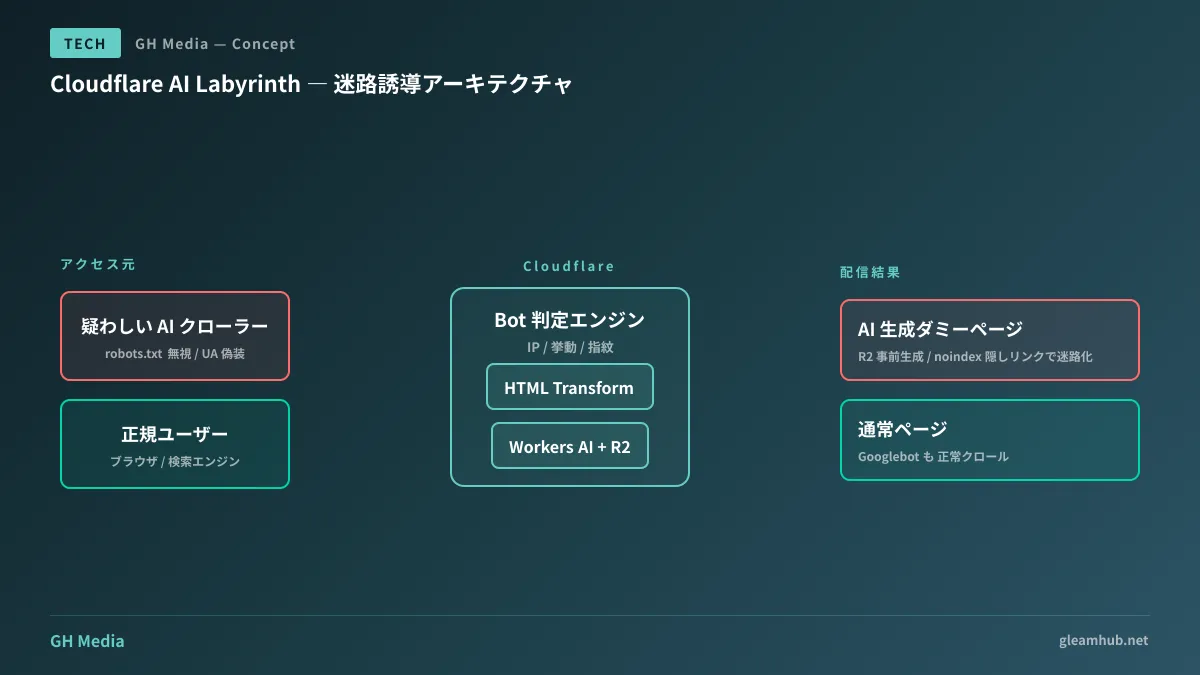
According to the official blog, the architecture is structured as follows:
1. Pre-Generation of Dummy Pages
- Mass pre-generation of HTML pages on diverse topics using Workers AI open-source models
- Rather than generating content dynamically on each request, delivering it at high speed by caching it in R2 object storage
- Generated content is already sanitized against XSS
The decision not to generate pages in real time was made to keep latency and inference costs down. Running LLM inference for every single crawler request would cause defense costs to skyrocket.
2. Injection of Hidden Links
- Injecting invisible links into existing pages using Cloudflare's HTML transformation capability
- Hidden from human visitors via CSS and HTML attributes
- Preventing search engines from indexing using directives equivalent to
<meta name="robots" content="noindex, nofollow">
This point is critical. Because it is designed not to break SEO, it does not impede crawling by Google or Bing.
3. Crawler Identification and Redirection
- Showing links to the labyrinth only to suspicious crawlers
- Serving standard pages to legitimate users, Googlebot, and other verified agents
- The moment a crawler follows a hidden link, it can be classified as automated access with high confidence
4. Side Effects as a Honeypot
- Human users do not navigate multiple levels deep into meaningless AI-generated pages
- Sessions that drill several levels deep (typically 4 levels or more) are almost certainly bots
- This behavioral data serves as training material for Cloudflare's machine learning models, continually improving detection accuracy
Activation Steps: A Single Toggle in the Dashboard
A key feature of AI Labyrinth is that it can be enabled without code changes or DNS configuration modifications.
- Select the target domain in the Cloudflare dashboard
- Navigate to Security → Bots
- Turn on the AI Labyrinth toggle
With just this, hidden links are automatically injected for suspicious crawlers identified by Cloudflare. Because it is available even on the Free plan, the practical approach is to first test it in a staging environment and observe the impact.
Note that more granular controls (such as configuring behavior per bot category or integrating custom rules) are expanded on the Pro plan and above.
How It Benefits SMB Corporate Sites and Owned Media
Here we analyze its value from the operational perspective of managing SMB websites in custom development and in-house support contexts.
Benefit 1: Mitigating Content Misappropriation Risk
As discussed in our article Building Enterprise RAG with Multimodal Embeddings and Rerankers, a company's proprietary primary information is a differentiating asset for marketing. Having that data scraped without permission and incorporated into competitors' LLM responses is becoming an unignorable risk for executives.
While AI Labyrinth is not a technology that provides 100% prevention, it serves as an effective deterrent by forcing attackers to incur non-trivial costs.
Benefit 2: Improving WAF Operational Precision through Bot Visibility
AI Labyrinth logs record which crawlers traversed how deep into the labyrinth. This information offers higher resolution in intent detection than traditional WAF logs.
Combined with Operational Procedures for Risk Assessment with GitHub Code Security, it elevates security operations by addressing both sides of the coin: code-level vulnerability management and traffic-level bot behavior monitoring.
Benefit 3: Evaluation Criteria for Cloud Provider Selection
As detailed in Accelerating Cloud Selection Optimized for AI Agents with the Full Cloudflare Service CLI, Cloudflare offers CDN, WAF, Workers, and R2 as a one-stop solution.
The fact that advanced edge-level defenses like AI Labyrinth can be used starting from the Free plan serves as a compelling rationale to position Cloudflare as the primary candidate in SMB client projects. When comparing with AWS CloudFront or Fastly, "how much it would cost to build equivalent bot defenses with other vendors" is a comparison metric you should definitely include in proposals.
Four Operational Points to Keep in Mind
| Dimension | Important precautions |
|---|---|
| SEO | While the vendor protects pages with noindex, monitor Search Console for several weeks after enablement to check for erroneous crawl warnings |
| Analytics Tools | Ensure that tags are not embedded in dummy pages so that traffic to them does not contaminate GA4 data |
| Core Web Vitals | Injecting hidden links slightly increases HTML transfer size. Compare LCP/INP impact using PageSpeed |
| Legal and PR | State your operational policy in your privacy policy or bot policy to prevent misinterpretation that you are returning false information to AI bots |
The last point in particular is an item that should be formalized as part of website operational policies in the generative AI era. In addition to robots.txt, disclosing your stance on AI training via ai.txt and publishing per-User-Agent handling establishes a coherent, transparent position toward both search engines and LLM providers.
Conclusion: The Option of "Offensive Defense"
AI Labyrinth is a feature that symbolizes a shift from passive blocking to active cost imposition.
- It serves as a deterrent to lower the risk of having your content scraped without authorization for generative AI training
- Its SEO-preserving design makes it easy to integrate into existing corporate site and media operations
- It delivers network effects, acting as a honeypot that continuously refines detection accuracy
- It can be evaluated starting from the Free plan, keeping verification costs low
In the field of SMB site operations and custom development, the safest approach is to first monitor on a small test site for 2 to 4 weeks to confirm there is no negative impact on SEO or Core Web Vitals before applying it to production. For companies publishing an increasing volume of original content on their owned media, adoption priority is high.
From "blocking crawlers" to "trapping them in a maze"—options for AI countermeasures at the infrastructure layer have expanded once again.


