In the "How did you hear about us?" field on contact forms, people write "ChatGPT told me," rather than search or social media. The count is not high yet. Meanwhile, Search Console impressions are flat. While total inbound volume remains unchanged, the breakdown of discovery channels is quietly shifting.
In this environment, consultations asking "how to prepare for AI" have grown. Then, on August 11, 2026, OpenAI launched ChatGPT advertisements across multiple countries, including Japan. The introduction of ads means it has begun operating as a user acquisition channel.
However, jumping straight to the question of "whether to run AI ads" leads to misguided decisions, as the line between what is now possible and what remains impossible is remarkably clear.
Understand exactly what has launched
Here is an overview of the facts.
- Testing began in the US on February 9, 2026, and expanded to Japan, the UK, Mexico, Brazil, and South Korea on August 11, 2026
- Ads appear not inside answers, but in clearly labeled slots at the bottom of the chat interface
- The target audience consists of logged-in users on the Free plan and the lower-priced Go plan; ads do not appear for Plus, Pro, Business, or Enterprise subscribers
- Ad targeting relies on conversation topics, chat history, and past ad interactions
- Ads reportedly do not influence actual answer content
- Targeting data remains within ChatGPT and is not shared with advertisers
The final three points are the most critical in practice. You cannot pay for your company to be recommended inside answers. All you can buy is the ad placement below the response.
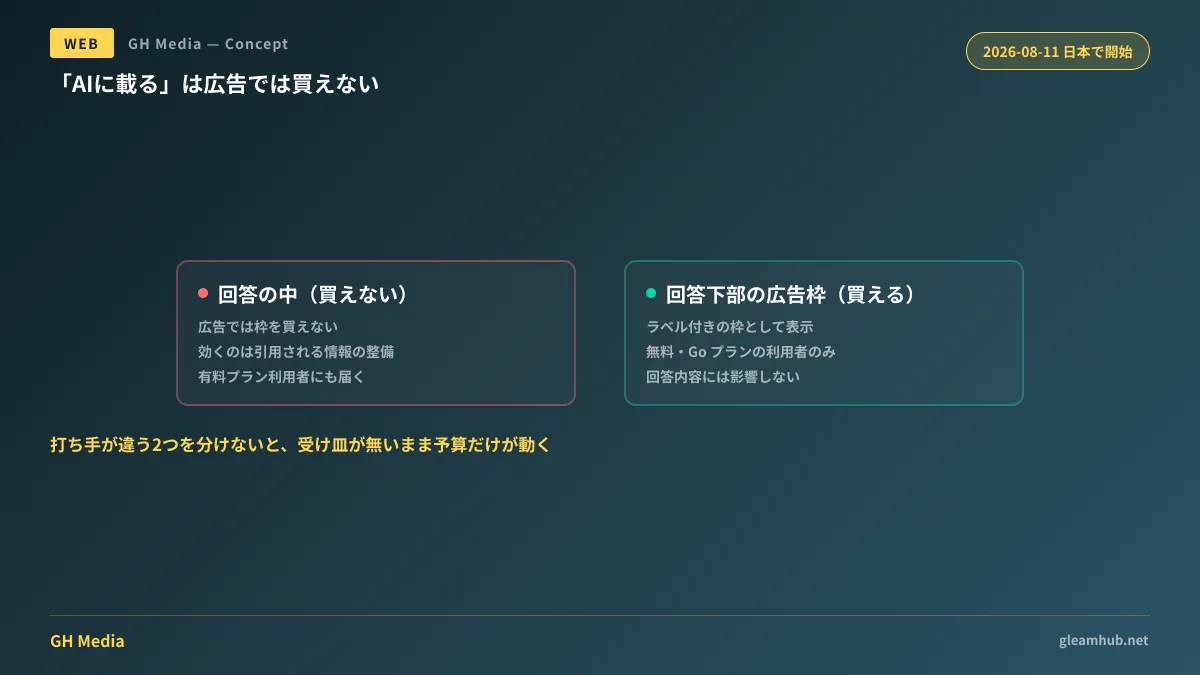
Buyable vs. non-buyable spaces require different tactics
Because many inquiries conflate these two areas, let us separate them.
| Mentioned within answers | Ad slot below answers | |
|---|---|---|
| Can it be bought? | No | Yes (pilot rollout) |
| Effective approach | Ensuring citable information exists across the web | Campaign setup and budget |
| Results timeline | Slow; cumulative | Fast; stops when spend stops |
| Target audience | Reaches paid plan users as well | Free and Go plan users only |
The fact that corporate decision-makers are more likely to use paid plans is crucial if your goal is B2B procurement evaluations. Because ad placements only display to users on Free and Go plans, relying solely on ads structurally misses this segment.
On the other hand, getting mentioned within answers cannot be bought, making the required effort a direct continuation of existing best practices: ensuring your company's information exists on the web in structured, easily referenced formats. The principles discussed in Structured Data and AI Search and SEO Strategies in the AI Overview Era apply directly. Related moves by Google are summarized in How Google AI Mode Affects SEO.
Websites must first prepare the landing experience
Whether through advertising or answer citations, visitors ultimately land on your own website. Yet all too often, sites are unprepared to receive them.
Visitors arriving via AI behave differently from those coming from search: they arrive after already receiving an explanation. Having grasped an overview and compared options within ChatGPT before visiting your site, forcing them to browse through homepage introductions and service overviews sequentially does not fit their intent. What they want to confirm typically comes down to these three points:
- Do you truly offer this? (AI explanations can be outdated or inaccurate)
- Terms and scope (supported regions, scale, prerequisite environments)
- Next step (whom to contact, and how)
Whether these three points can be verified immediately on the landing page significantly affects the conversion rate of AI-driven visits into inquiries. Conversely, the first step in AI readiness is not launching ads, but auditing your landing page content.
Furthermore, if you cannot measure this traffic, you cannot assess performance. As unreferrable traffic increases, relying on self-reported fields—such as "How did you hear about us?" on forms—is essential to see the full picture. For tracking gaps, see Gaps in Website Conversion Measurement; for search visibility, consult Platform-Specific Properties in Search Console.
What to verify before shifting budget
If you are considering running ads, reviewing these three points first will prevent wasted spend.
Do your prospective customers use the Free plan?
Because ad delivery reach is restricted, running ads will yield no impressions if your target demographic does not align. In B2B, if key contacts use company-provided Business accounts, ad slots will not reach them.
How much AI-driven traffic do you currently receive?
If you start with ads when organic AI referrals are near zero, traffic vanishes the moment you pause spending. You will not build lasting equity unless you develop citation readiness in parallel.
Factor in the testing phase
Specifications and placements are subject to change. For most SMBs, there is little justification yet for reallocating existing ad budgets to invest early. First-step preparation of your landing experience, followed by evaluating placements once the channel stabilizes, offers far more predictable ROI.
Comprehensive guidance on B2B lead generation architecture can be found in B2B Lead Generation Guide.
What to do next
Try asking ChatGPT about your company name and core services. Is the returned explanation factually accurate? Does it contain outdated information or services you no longer offer? If this foundation is flawed, running ads will only be undercut by the answer content itself.
Next, select the primary landing page where AI referrals arrive and verify whether the three key questions (availability, scope/terms, next steps) can be answered instantly. If improvements are needed, optimizing this page is your fastest path forward.
GleamHub provides support for landing page restructuring and website redesigns tailored for AI-driven traffic through our Website Production and Redesign Consultations. Because priorities vary depending on your current traffic mix and offerings, please consult with us individually. Feel free to reach out via Contact Us.