
Have you ever been told in a meeting with a development agency: "We leverage AI, so we can keep your costs down"? If so, exactly how much is saved? Compared to what? Pressing on these questions almost always leads to vague answers.
On September 4, 2026, GitHub released a research preview of "Project HydraFusion." Designed to route between multiple AI models within a single workflow, it was reported on TerminalBench 2.1 to reduce estimated model usage costs by 67% compared to Claude Opus 5 while increasing accuracy by 4.9 percentage points.
Looking strictly at the headline figures, it sounds compelling. However, on other benchmarks released at the same time, quality was slightly inferior. The fact that both outcomes exist within the very same announcement provides the most practical insight for assessing AI development costs.
The concept of not committing to a single model
Conventional AI coding involved choosing which model to use upfront and executing all tasks with it. While selecting a high-capability model improves quality, you pay high unit rates even for trivial tasks.
This new architecture dynamically constructs its execution path whenever a task arrives. The chosen execution patterns generally fall into three types:
| Approach | Description | Best suited for |
|---|---|---|
| Standalone | Completed entirely with a single model | Simple, unambiguous tasks |
| Staged | A lightweight model drafts output, then a quality gate decides whether to escalate to a higher-tier model | Tasks where difficulty cannot be predicted in advance |
| Cross-critique | A model from a different lineage critiques the draft, followed by a single revision | Tasks where oversights would be fatal |
The key takeaway is that premium pricing is isolated strictly to tasks that warrant it. This mirrors human engineering teams, where only complex decisions are escalated to senior members.
Never look at just one benchmark metric
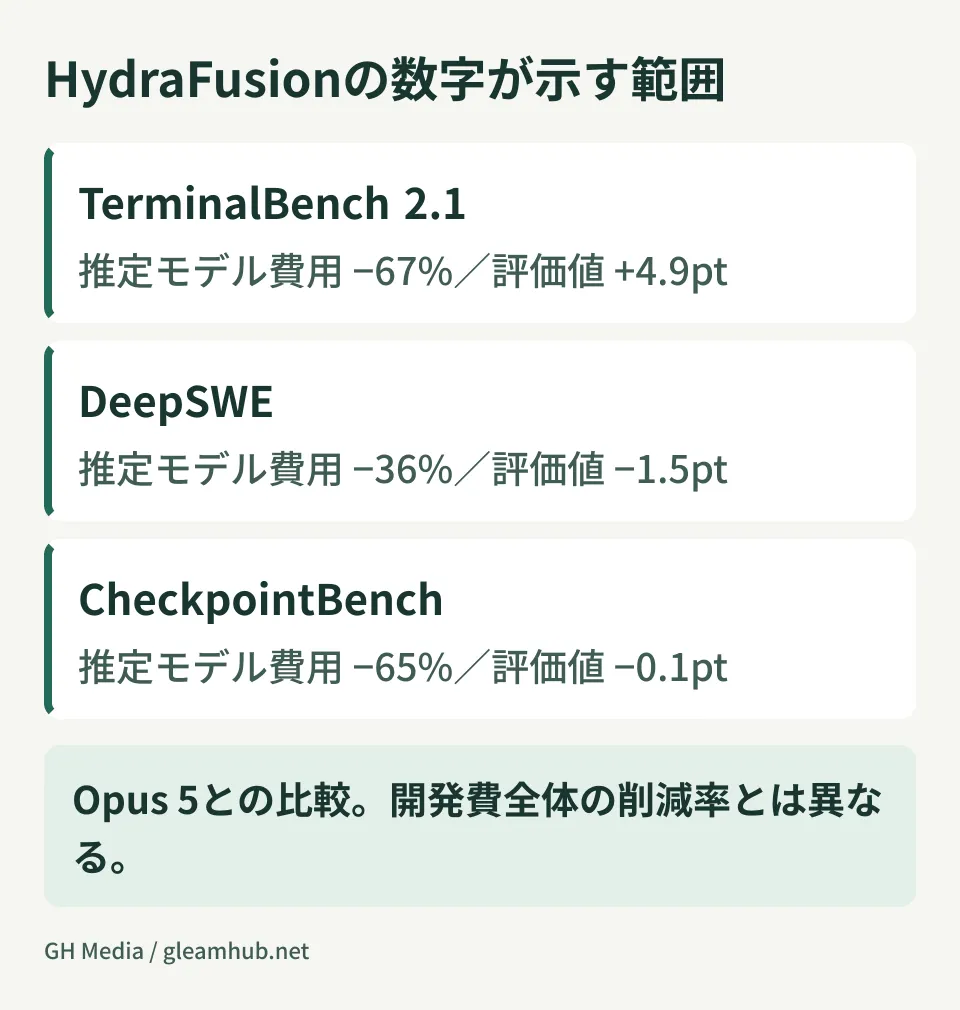
Here is the crux of the matter. The reported results are as follows:
| Benchmark | Estimated usage cost difference | Accuracy difference |
|---|---|---|
| TerminalBench 2.1 | 67% reduction | +4.9 points |
| DeepSWE | 36% reduction | -1.5 points |
| CheckpointBench | 65% reduction | -0.1 points |
The comparison baseline for all tests is Claude Opus 5. These represent offline evaluations under fixed benchmark conditions, not overall development cost savings encompassing developer labor, requirements definition, reviews, and ongoing maintenance. Given potential margins of error and task-specific quirks, minor point discrepancies should not be interpreted as definitive real-world superiority or inferiority.
In other words, while costs dropped across all three benchmarks, quality improved on only one. The remaining two showed a trade-off where costs fell significantly at the expense of a slight drop in quality.
This does not mean the approach failed. Depending on use case and acceptance criteria, this trade-off can be well worth considering. The tolerable margin for quality degradation is vastly different when building an internal administrative portal versus implementing payment processing logic.
Problems arise when clients are told only about the '67% reduction' without understanding where those trade-offs were made. If the cost savings stemmed from settling for lightweight models, you risk accepting delivery without knowing where those compromises were applied.
What clients and in-house engineering leads should ask
When told costs will be controlled using AI, what you should verify is not unit rates, but the scope of application.
First: which specific tasks were delegated to lightweight models? Whether lightweight models were applied uniformly across everything or restricted solely to routine boilerplate drastically changes your risk profile.
Second: what constitutes the quality gate? Any architecture that progressively escalates tasks to higher-tier models relies on criteria to decide whether escalation is necessary. Whether that threshold is test suite passage or model self-evaluation is critical. Architectures relying exclusively on self-evaluation end up delivering cheap results with undiscovered bugs.
Third: where does human code review fit in? Models critiquing each other is not a substitute for human code review. Critiquing models are prone to the same categories of oversights. We detailed the types of feedback that truly matter in human reviews in Do Not Take 'We Review Code' at Face Value in Client Projects.
Note that billing for this system follows standard rates based on the token consumption of the models used. In short, savings stem from architectural design in how models are utilized, not from negotiated discounts. This point is frequently misunderstood.
If testing in-house, determine comparison criteria upfront
If your company has in-house engineers who want to experiment, this capability is available as an experimental feature in Copilot CLI under research preview. Because it is accessible across all plans, the barrier to testing is low.
However, if you do not establish comparison criteria before testing, you will not reach a conclusive takeaway. A common pitfall is running different tasks across setups and walking away with a vague impression that "it seemed somewhat faster."
At a minimum, ensure the following three conditions are aligned:
- Run the exact same task against the exact same baseline codebase. Running a second pass on code already modified by a prior execution changes the baseline conditions
- Evaluate completion using test suites rather than human intuition. Code that appears to work but fails in practice is the most common outcome
- Record token consumption. Because billing is based on standard rates for models used, savings rates fluctuate based on your company's specific task workflows
If your team spends significant time managing AI operational overhead, there may be areas that should be addressed before optimizing model routing. We categorized those operational boundaries in Are You Spending Six Hours a Week Babysitting AI?
When "cheap to build" ends up expensive later
Before concluding our discussion on costs, there is one final point to add.
Even if development phase costs drop, if the resulting codebase is low quality, you will pay for it down the road. The phenomenon where code rapidly generated by AI becomes unmodifiable six months later was discussed in When 80% AI-Written Code Rots in Six Months, and the fact that deprecating code also incurs costs was covered in Why Systems Built Fast with AI End Up Expensive Later.
The metric to watch is not AI usage fees during the development phase, but total expenditure over two years. That figure includes maintenance overhead and the probability of having to rewrite the system.
What to do next
If you utilize AI coding internally, check whether all tasks are currently handled by the exact same model. If premium high-cost models are assigned even to routine boilerplate, there is room to lower costs through multi-model routing. However, compare options including routing operational costs. You can begin designing model allocation strategies today without switching tools.
If you outsource development, ask once for the breakdown behind 'AI-driven cost savings.' A partner that answers at the task level is deliberately architecting their model routing. If their response is merely "Because we use the latest AI," their reasoning is based on impressions rather than data.
At GleamHub, we provide guidance on AI-integrated development workflows, model cost engineering, and legacy code quality audits through our Development, AI, and Automation consulting services. Because optimal architectures depend on requirements, we provide customized estimates. Please contact us via Contact Us.
Sources
- Project HydraFusion: Frontier quality via multi-model orchestration — The GitHub Blog
- [Research Preview] HydraFusion is live in GitHub Copilot CLI — GitHub Community Discussions
- GitHub Offers 'Project HydraFusion' in Research Preview to Cut Costs via Multi-Model Routing in Copilot CLI — gihyo.jp
- GitHub’s HydraFusion cuts AI coding costs in every benchmark. It only matches quality in one. — VentureBeat