If you run tsc --noEmit in CI, the wait for type checking adds up with every pull request. Switching to bun check, the type checker built into Bun, might make it faster, but what CI owners want to confirm first is "Does it report the same errors?" and "Does the job reliably fail when there are errors?"
Bun is a JavaScript runtime that Anthropic acquired in December 2025. Version 1.4.3, released on October 10, 2026 (UTC), added bun check for type checking and the --check flag, which type-checks before running, building, or testing (according to the release notes on the Bun blog; the repository documentation was also added in the 1.4.3 tag and is not present in the 1.4.2 tag). In this article, we ran Bun 1.4.3 and tsc from TypeScript 7.0.2 against the same project in the editorial team's test environment and lay out the information needed to decide on a replacement.
The overall changes in Bun 1.4 (the rewrite in Rust) and whether to adopt it for business systems are covered in our article on Bun 1.4.
What the bun check command does
The Bun documentation (docs/runtime/check.mdx) describes bun check as follows.
- It reads
tsconfig.jsonand "reports the same errors astscfrom TypeScript 7" (the same errors astscin TypeScript 7). It uses all CPU cores - The exit code is
1if there are errors and0if there are none. "It never writes files" - The
typescriptpackage is not needed.lib.*.d.tsis built into Bun. You can see which version it matches withbun -p process.versions.typescript - The replacement mapping includes
tsc --noEmittobun check,tsc --noEmit && bun testtobun test --check, and so on. You still usetscto generate.d.ts
Running bun -p process.versions.typescript with the 1.4.3 executable returned 7.0.2. The latest version of typescript on npm is also 7.0.2. The defaults that changed in TypeScript 6 and 7 (such as strict being enabled by default and types being empty) apply to bun check as well, so for projects still using TypeScript 5 settings, the first step is to work through the migration to TypeScript 7.
The release notes on the Bun blog say that bun check passes the entire TypeScript 7.0.2 conformance test suite. They also include the results of comparing output with tsc on 72 open-source repositories with deliberately broken configurations: out of 1,103 configurations (286,267 errors in total), only one (vuejs/core) produced mismatched output. On speed, they say it is "3x to 6.4x faster than tsc 7.0.2" on real projects such as VS Code and Next.js on a 16-core Apple silicon Mac. The "more than 3x faster" in news coverage comes from these figures. In this article, we also present the editorial team's measurements, taken under different conditions.
Results of running it side by side with tsc 7.0.2
The test environment was Linux (x86_64, 4 cores) with Node.js v22.22.0. Bun was @oven/bun-linux-x64@1.4.3 from npm (1.4.3+c6da4a4d3), compared against tsc from typescript@7.0.2. We tested on a small three-file project with strict enabled.
| Condition | bun check(1.4.3) | tsc —noEmit(7.0.2) |
|---|---|---|
| No errors | Exit code 0 | Exit code 0 |
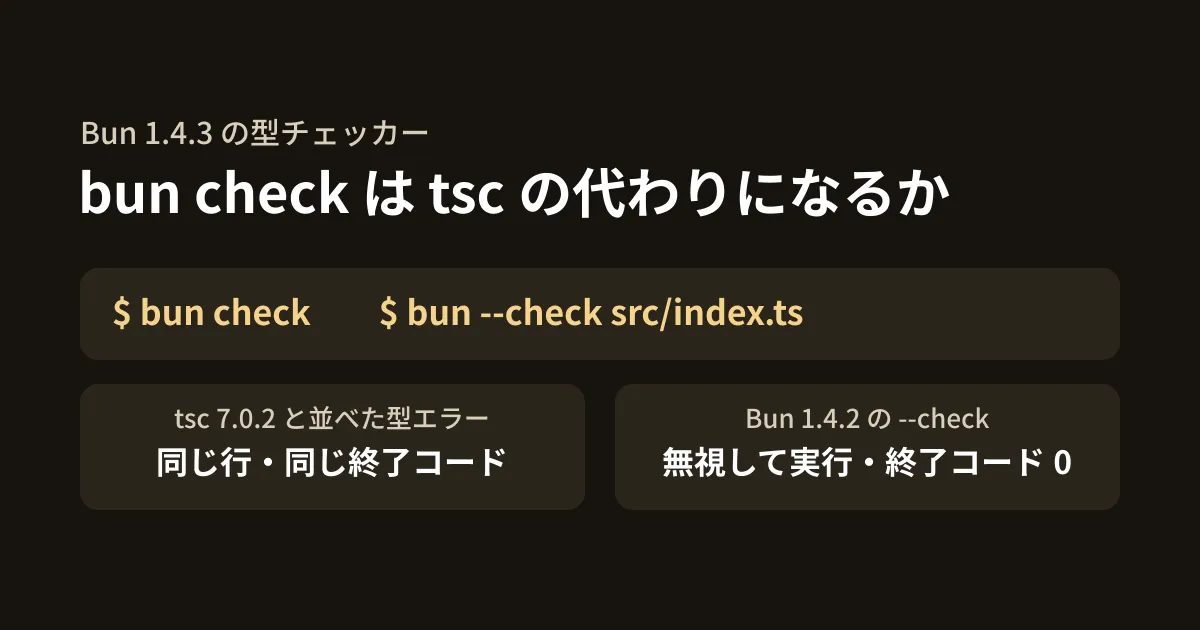
| Two type errors (TS2322 and TS7006) | Same two lines, exit code 1 | Same two lines, exit code 1 |
Removed options (baseUrl and moduleResolution: node) | TS5102 and TS5108, exit code 1 | TS5102 and TS5108, exit code 1 |
No files match include | TS18003, exit code 1 | TS18003, exit code 2 |
File names specified (src/index.ts) | Checks using tsconfig.json, exit code 1 | TS5112 (does not read the config file), exit code 1 |
outDir specified without rootDir | No errors, exit code 0 | TS5011, exit code 2 |
In the piped standard output, the two type error lines showed no difference between tsc and diff. The summary line goes to standard error. The output also matched when we introduced one type error into the 2,000-file synthetic project described below.
The exit codes for TS18003 differ (1 and 2), but both are nonzero, so the CI job fails either way. The differences in content appear in the last two rows of the table. Using tsconfig.json when file names are passed is behavior the documentation describes as "intentional." On the other hand, with a configuration that specifies outDir but does not set rootDir, tsc reported TS5011 (an error asking you to specify the common source directory explicitly with rootDir), while bun check reported nothing. It appears that bun check, which does not write output, does not perform this check on output layout (the editorial team's assessment). In projects that also build with tsc, the tsc build may fail even when bun check passes.
About 2.6x faster on the editorial team's synthetic project
We measured speed on a 2,000-file synthetic project generated by the editorial team (each file imports the two preceding files and includes generic classes and mapped types, with no type errors). After one warm-up run each, we ran bun check and tsc --noEmit alternately 10 times each and measured the time from start to finish.
bun check: median 573 ms (min 506, max 739)tsc --noEmit: median 1,502 ms (min 1,319, max 1,834)
Under these conditions, it was about 2.6x faster at the median. With the thread count set to 1, bun check --threads 1 took about 1.5 to 1.6 seconds and tsc --noEmit --singleThreaded about 2.4 to 2.6 seconds (5 runs each). These values come from measuring one project in a 4-core test environment, and results vary with the amount of code, the complexity of the types, and the number of cores on the CI runner. The conditions differ from the 3x to 6.4x on the Bun blog (16-core Mac, real projects), and our results do not verify those figures. The difference may be smaller on CI runners with fewer cores, so measure your own repositories the same way before deciding.
Also, as the documentation states, bun check does not write .tsbuildinfo and checks the whole project every time ("No cache to save or restore"). Make sure your comparison is fair against CI setups that rely on incremental in tsc.
Pitfalls to check before adding it to CI
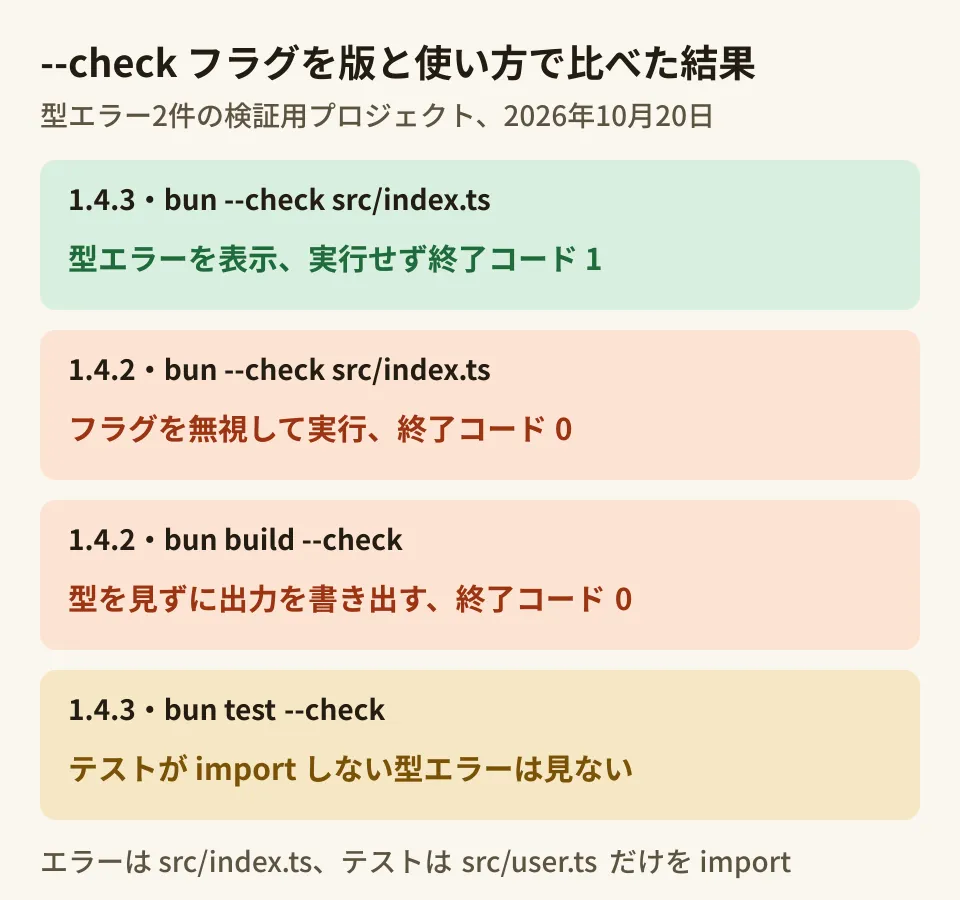
The results of the --check flag varied by version and usage as follows.
Older Bun versions silently ignore --check
When we ran bun --check src/index.ts with Bun 1.4.2, the file with type errors ran as is, and the exit code was 0. bun test --check also passed the tests without type checking, and bun build --check wrote the output files as is. bun check itself fails in 1.4.2 with "Script not found "check"", so you will notice, but you will not notice with the --check flag. Pin the Bun version to 1.4.3 or later, both in CI and locally, before using it.
bun test --check only covers what the tests import
As the documentation states, bun test --check checks "The test files and everything they import." Even if src/index.ts had type errors, the tests passed with exit code 0 in 1.4.3 as long as the tests did not import that file. When we introduced a type error into src/user.ts, which the tests import, the tests did not run and the exit code was 1. It does not replace type checking of the whole project, so keep bun check as a separate step in CI.
If package.json has a check script, something else runs
If package.json has a script named check (such as a linter), bun check runs that script. The documentation on the main branch and the official site's documentation as of October 20 (bun.com/docs/runtime/check) list --no-script, which forces the type checker, but it is not in the 1.4.3 tag's documentation or executable. When we ran bun check --no-script in 1.4.3, --no-script was passed as an argument to the script, the script succeeded, and the exit code was 0. In 1.4.3, using bun --check (the form without specifying files) as the documentation describes type-checked the whole project.
Environment variables change the output format
If any of AGENT=1, CLAUDECODE=1, or REPL_ID=1 is set, bun check outputs errors in <error file=...> tag format. Our test environment had CLAUDECODE=1, so the first run was not in tsc format. We confirmed that adding --no-pretty fixes the output to the single-line format. Also, when we set GITHUB_ACTIONS=true and ran it locally, in addition to the single-line output, it printed ::error file=... lines, which the documentation says are used for pull request annotations (we have not confirmed how they appear on GitHub).
How to proceed with the replacement (suggestions from the editorial team)
- Pin the Bun version: Specify
1.4.3or later inbun-versionofoven-sh/setup-bun@v2. If you leave it atlatest, there may be periods when the documentation and the executable's features (such as--no-script) are out of sync - Run both side by side for a while: Add
bun check --no-prettywhile keeping the existingtsc --noEmit, and compare for several weeks whether the error lines and exit codes match. The documentation asks you to report it as a Bun bug if you get errors that differ from TypeScript 7'stsc - Split out tsc's roles and keep it: Keep
tscfor generating.d.tsand for builds that useoutDir. Even ifbun checkpasses, mistakes in build settings (TS5011 in this case) are only caught on thetscside
# .github/workflows/typecheck.yml(並行運用の例。GitHub Actions上では未実行)
jobs:
  typecheck:
    runs-on: ubuntu-latest
    steps:
      - uses: actions/checkout@v4
      - uses: oven-sh/setup-bun@v2
        with:
          bun-version: 1.4.3
      - run: bun install --frozen-lockfile
      - run: bun check --no-pretty
      - run: bun x tsc --noEmit  # devDependencies の typescript。一致を確かめる期間だけ残す
Conclusion
Start by running bun -p process.versions.typescript locally to check which TypeScript version Bun matches, then compare the output and exit codes of bun check --no-pretty and tsc --noEmit on your own repositories using diff. Once you have confirmed they match, pin the version and add it to CI alongside the existing check. Avoiding a setup that leaves type checking solely to the --check flag or bun test --check helps prevent things from slipping through.
On October 20, 2026, we checked the 1.4.3 release notes on the Bun blog and the GitHub release, the
bun checkdocumentation on the official site,docs/runtime/check.mdx(the bun-v1.4.3 tag and main) anddocs/docs.jsonin oven-sh/bun, the publication dates and versions ofbun,@oven/bun-linux-x64,typescript, and@types/bunon npm,action.ymlin oven-sh/setup-bun, and Anthropic's announcement of its acquisition of Bun (document research). In the editorial team's test environment (Linux x86_64, 4 cores, Node.js v22.22.0), we ran Bun 1.4.3 and 1.4.2 andtscfrom TypeScript 7.0.2 against a three-file test project and a 2,000-file synthetic project (hands-on testing). We have not confirmed behavior on actual GitHub Actions or GitLab CI runners, withbun check -band project references, on Windows or macOS, or speed on large real-world codebases.
GleamHub's development, AI, and automation consultations cover reviewing CI for TypeScript projects and automating development and testing of business systems. The approach depends on how your project is structured, so please reach out through our contact form.
References
- Bun v1.4.3(Bun Blog, 2026-10-10)
- bun check(Bun Docs)
- oven-sh/bun — docs/runtime/check.mdx (bun-v1.4.3 tag)
- oven-sh/bun — docs/runtime/check.mdx(main)
- npm registry — bun
- npm registry — @oven/bun-linux-x64 1.4.3
- npm registry — typescript
- oven-sh/setup-bun — action.yml
- Anthropic acquires Bun as Claude Code reaches $1B milestone(Anthropic, 2025-12-03)