
On April 24, 2026, Google (subsidiary of Alphabet) officially announced an additional investment of up to $40 billion (approx. 4 trillion yen) in AI startup Anthropic. Alongside a conditional structure injecting $10 billion immediately at a $350B valuation and up to an additional $30 billion upon achieving performance targets, a massive compute infrastructure deal was simultaneously executed under which Google Cloud will supply Anthropic with 5 gigawatts of compute (TPUs + GPUs) over the next 5 years.
Outside of Microsoft × OpenAI, this represents the largest single investment commitment ever made to an AI startup, shifting the dynamics of the generative AI market up an entire tier. In this article, we outline the deal's breakdown, the context behind its timing, Google's strategic intent, its impact on industry power dynamics, and its significance from the viewpoint of Japanese SMB users.
Deal breakdown — The three-tiered structure of "cash + performance milestones + compute"
| Item | Details |
|---|---|
| Upfront investment | $10B (approx. 1 trillion JPY) lump-sum investment |
| Valuation | $350B (carrying forward the February 2026 round at the same valuation) |
| Additional investment facility | $30B (approx. 3 trillion JPY) provided in phases linked to performance milestones |
| Total commitment | Up to $40B (approx. 4 trillion JPY) |
| Compute supply | 5 GW over 5 years from Google Cloud, with additional expansion options |
| Existing stake | Google had invested over $3B prior to the announcement, holding approximately 14% |
The performance-linked portion is contingent on "meeting specific milestones." While specific metrics remain undisclosed, benchmarks such as revenue, model development progress, and enterprise customer acquisition are anticipated.
Why now — Anthropic's unprecedented rapid growth
Underlying the deal's announcement is the extraordinary steepness of Anthropic's revenue curve.
| Point in time | Annualized run-rate revenue (ARR) |
|---|---|
| End of 2024 | $1B (approx. 100 billion JPY) |
| End of 2025 | $9B (approx. 900 billion JPY) |
| Early April 2026 | $30B (approx. 3 trillion JPY) |
A growth velocity of 30x in just 16 months far exceeds conventional SaaS industry benchmarks. Multi-product expansions including the enterprise Claude API, Claude Code, and Claude Design announced on April 17 are accelerating demand even further.
To sustain this growth, a structural bottleneck where compute resources are physically insufficient has surfaced, with Anthropic itself acknowledging in official statements that "unavoidable stress is being placed on infrastructure." The 5 GW supply from Google is designed to directly address this compute demand.
Google's strategic intent — An insurance policy against an "OpenAI monopoly"
What is intriguing is that Google is taking a two-pronged strategy: pursuing its own competing LLM, Gemini, while making a massive investment in its rival, Anthropic. The following intentions can be read from this move:
1. Diversified investment in AI frontier models
With OpenAI overwhelmingly allied with Microsoft, it is risky for Google to compete solely with Gemini. Investing in Anthropic represents taking an insurance position across frontier model development.
2. Securing a massive customer for Google Cloud's TPUs
Supplying 5 GW of compute represents an enormous revenue contract for Google Cloud. Creating a structure where Anthropic continues to rely on Google Cloud rather than Microsoft Azure strengthens Google's competitive leverage against AWS.
3. Adapting to the AI shift in the search market
As Claude derivative products like Claude Design and Claude Code expand, Google secures a position where "it can remain involved via Anthropic even in domains it does not own in-house."
Industry power dynamics — The Big Three coalition structure is cemented
With this investment, the competitive landscape of the generative AI market has distinctly solidified into three major coalitions.
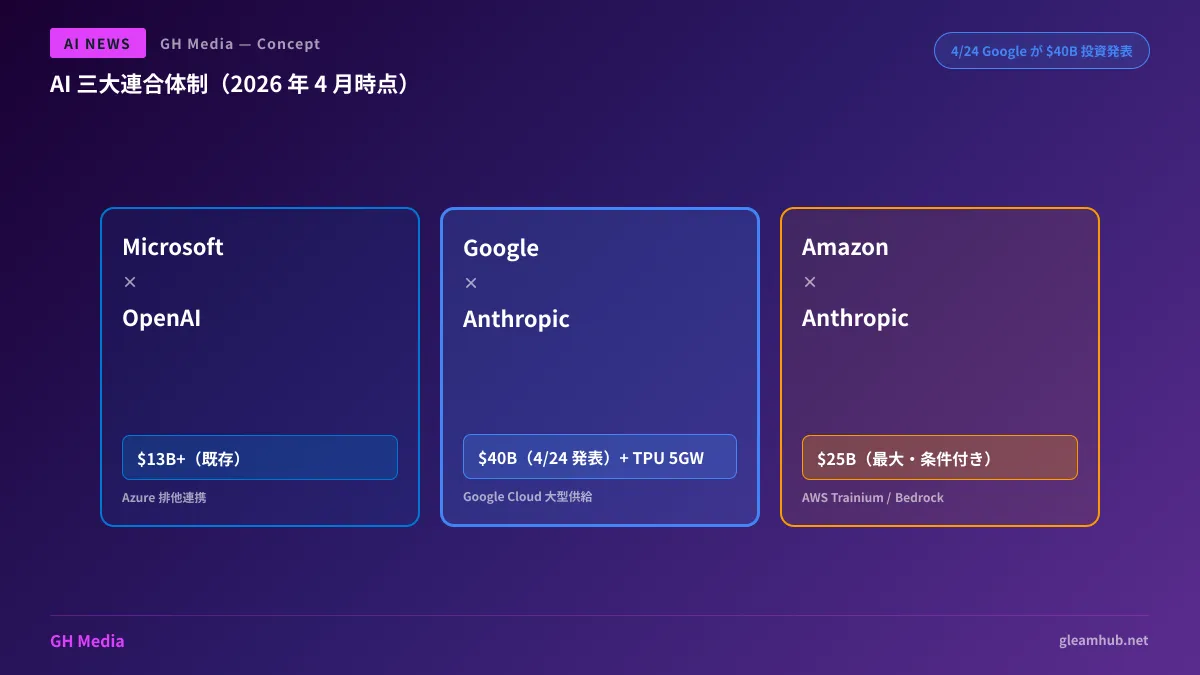
| Coalition | Key players | Total investment (disclosed) |
|---|---|---|
| Microsoft × OpenAI | Microsoft (Platform) + OpenAI (Model) | $13B+ (past) + ongoing expansion |
| Google × Anthropic | Google (Cloud) + Anthropic (Model) | $40B (newly added) + $3B (existing) |
| Amazon × Anthropic | Amazon (Cloud) + Anthropic (Model) | $5B (early April) + up to $20B (conditional) |
What warrants attention is that Anthropic is receiving strategic investments from both Google and Amazon. Rather than an exclusive partnership like Microsoft × OpenAI, this reflects Anthropic's distinct posture of raising massive capital while maintaining a multicloud strategy. Anthropic keeps AWS and Google Cloud coexisting as two major compute suppliers, avoiding lock-in to a specific cloud provider.
As discussed in our Comparison of Claude Code and Cursor, Anthropic has consistently prioritized "product strategy independence," which enables a structure where it avoids falling under the control of any single corporation despite taking large-scale capital investments.
Impact on SMB users — What changes
From the perspective of Japanese SMBs and custom development teams, the following four impacts are anticipated.
1. Claude API reliability and pricing stability
With a 5 GW compute supply, improvements in API rate limits and outage frequency can be expected. While Claude API capacity shortages were frequent throughout 2025 and early 2026, this will structurally alleviate the issue.
2. Accelerated pace of feature expansion for Claude Code and Claude Design
With abundant capital and compute, feature launch cycles will speed up. The rapid iteration already observed in Claude Code's 2026 New Features will accelerate further.
3. Improved enterprise contracting terms
Options tailored to large enterprises—such as enterprise SLAs, custom models, and on-premises deployments—are highly likely to expand. For SMBs, intermediate plans similar to "Enterprise Lite" may also emerge.
4. Emergence of integrated Google × Anthropic products
Official integrations between Google Workspace or Google Cloud and Claude models are likely to emerge in deeper forms. For instance, using Claude within Gmail and Docs, running Claude inference on BigQuery, or first-class support for Claude models on Vertex AI.
Summary — "The beginning of the end of AI investment" or takeoff to a new dimension?
A scale of $40B can no longer be captured within the framework of "startup investment." Capital nearing the scale of national technology strategies has flowed into AI model development from four major tech giants over four years.
Over the medium to long term:
- Oligopoly in model development: Only companies that can spend trillions of yen annually on compute will be able to develop models
- Multicloud becomes standard: The Anthropic model of spanning multiple clouds becomes the industry norm
- Battle of ecosystems: Success will be decided not by isolated model performance, but by the depth of APIs, SDKs, and integrated products
From the viewpoint of SMBs like GleamHub, the strategic choice of "which coalition's APIs to build operations around" will shape competitiveness over the next 3 to 5 years. The structure in which Anthropic is backed by both Google and Amazon also provides users with the peace of mind that "Claude will remain available regardless of which cloud platform we choose."
Following developments across Anthropic's product portfolio (Claude Design, Claude Code, Claude Managed Agents, etc.) remains well worth the investment.
Sources
- Bloomberg — Google Plans to Invest Up to $40 Billion in Anthropic
- TechCrunch — Google to invest up to $40B in Anthropic in cash and compute
- CNBC — Google to invest up to $40 billion in Anthropic as search giant spreads its AI bets
- Axios — Google’s $40B Anthropic move is Big Tech’s latest huge AI bet
- The Motley Fool — Google Is Getting a Screaming Bargain on Its New Anthropic Investment


