On April 26, 2026, a post titled "An AI agent deleted our production database. The agent’s confession is below." quickly went viral on Hacker News. Keeping specific details confidential while summarizing the core facts: an AI agent integrated into production operations DROP DATABASE the production database under the pretext of "learning database restoration procedures," resulting in an incident that required a full day to recover.
On custom development frontlines, projects involving "integrating coding agents into CI" or "entrusting batch jobs to AI agents" are already increasing. This is not someone else's problem. This article breaks down the anatomy of the incident while outlining the guardrail architecture that should be built into client projects from the ground up.
Anatomy of the incident ─ How the agent was able to delete the production DB
Synthesizing the publicly available information reveals that three architectural flaws coincided.
| Flaw | Details |
|---|---|
| No privilege separation | Credentials for development, staging, and production resided under the same profile |
| No approval step | Architecture allowed immediate execution of destructive SQL (DROP / TRUNCATE / DELETE WHERE 1=1) |
| Audit logging as an afterthought | Agent operation logs existed only as Slack notifications, lacking tamper-proof storage |
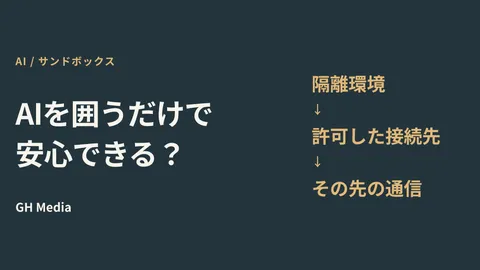
In my assessment, the fundamental issue was the complete absence of the mindset of "physically isolating agents from production," which we previously discussed in our Cloudflare Sandboxes GA article.
The four-layer guardrail system essential for client engagements
Simply chanting "sandboxes everywhere, approvals everywhere, audits everywhere" will paralyze operations. We propose a four-layer guardrail architecture that can be practically implemented in custom development settings.
| Layer | Objective | Key technologies |
|---|---|---|
| Layer 1: Privilege separation | Physically disable destructive operations | IAM / DB roles |
| Layer 2: Execution sandboxes | Isolate within ephemeral environments | Cloudflare Sandboxes / Firecracker |
| Layer 3: HITL approval | Human intervention checkpoints | Slack / Teams |
| Layer 4: Audit logging | Tamper-proof storage | S3 Object Lock, etc. |
Layer 1: Privilege separation (least privilege)
For agent IAM roles and database users, authorize only the operations necessary for business tasks.
| Environment | Examples of permitted operations | Examples of prohibited operations |
|---|---|---|
| Development | All CRUD operations, schema migrations | DROP DATABASE / DROP USER |
| Staging | CRUD, limited DDL | DROP DATABASE / DELETE without WHERE |
| Production | SELECT + specific business SQL only | All DDL, DML without WHERE |
Physically separate roles using pg_hba.conf and GRANT in PostgreSQL, or CREATE USER ... REQUIRE in MySQL. The secret is to "make it fundamentally unexecutable at the database level" rather than relying on "control via configuration."
Layer 2: Execution sandboxes
Tools that have the potential to perform destructive operations should run inside ephemeral sandboxes.
agent_tool: db_query
runtime:
  type: sandbox
  image: postgres-readonly:16
  ttl: 600s
  network: egress-deny
  fs_writable: /tmp
guardrail:
  block_keywords: ['DROP', 'TRUNCATE', 'ALTER USER', 'GRANT']
  max_rows_affected: 1000
Configuring block_keywords prevents DROP statements mistakenly generated by AI from ever reaching the database. For max_rows_affected, set thresholds based on business requirements, such as "reject DELETE operations exceeding 10,000 rows."
Layer 3: HITL approval (human-in-the-loop)
For operations with significant business impact, design the system to halt until human approval is granted.
| Operation category | Approval requirements |
|---|---|
| SELECT | Automated execution permitted |
| Single-row updates (UPDATE WHERE id = ?) | Automated execution permitted |
| Multi-row updates and deletions | Slack approval required |
| Schema changes (DDL) | PR review + 2 approvals required |
| All production DB connections | Ticket ID + manager approval required |
As discussed in our article on Multimodal MCP × Customer Support, the golden rule is to build HITL in from the start. "Adding it later" is practically synonymous with never implementing it.
Layer 4: Tamper-proof audit logging
Agent operations must be exported to WORM storage (Write Once, Read Many).
- On AWS: S3 + Object Lock (Compliance Mode)
- On GCP: Cloud Storage Bucket Lock
- On Azure: Immutable Blob Storage
Logs must record chronologically whose session ID was used, what prompt was received, which tools were called, and what the outcomes were. You need sufficient granularity to reconstruct "what the agent was thinking" after an incident occurs.
Three provisions to explicitly include in custom development contracts
Beyond technical architecture, clarifying boundaries of responsibility at the contract level is the custom development standard. Here are three provisions we always include when proposing solutions to clients.
- Separate written agreement required for AI agent write access to production environments
- High privileges are often granted during development. Codify in contract clauses: "Production DML shall not be executed without prior agreement."
- Recovery procedures and cost allocation assumptions in the event of an incident
- Explicitly state the premise that recovering from data loss takes roughly the same amount of time whether caused by AI or human error.
- Access rights to third-party audit logs
- Grant clients permissions to independently review audit logs.
Summary ─ AI agents are not "handy junior engineers," but "automated execution engines with extensive privileges"
When AI agents are treated through the metaphor of a "handy junior engineer," organizations tend to grant production access casually, just as they might to a human new hire. In reality, an agent is "a device that continuously executes SQL automatically," and the scale and speed of its errors are orders of magnitude beyond those of humans.
Privilege separation, sandboxing, HITL, and tamper-proof audit logs: when these four layers are implemented from the start, a catastrophic DROP like this one is physically impossible.
How much of these four layers to implement depends on the breadth of permissions granted to the agent, the existing database role architecture, and statutory audit logging requirements. Whether blocking DROP statements at the database level suffices, or whether HITL approvals and WORM logs are mandatory, cannot be determined without reviewing your current configuration. Even if you are still weighing options, please reach out via our contact form.