
"If you plan to scale agents across departments, build a shared platform first." When seeking advice on AI adoption, proposals often land here. Because building individually leads to duplication, common features like authentication, logging, and tool integrations should be shared. The logic is sound, and several companies have proceeded along this path.
Yet, speaking with them a year later, many say the exact same thing: "The platform is running, but the people maintaining it cannot work on anything else."
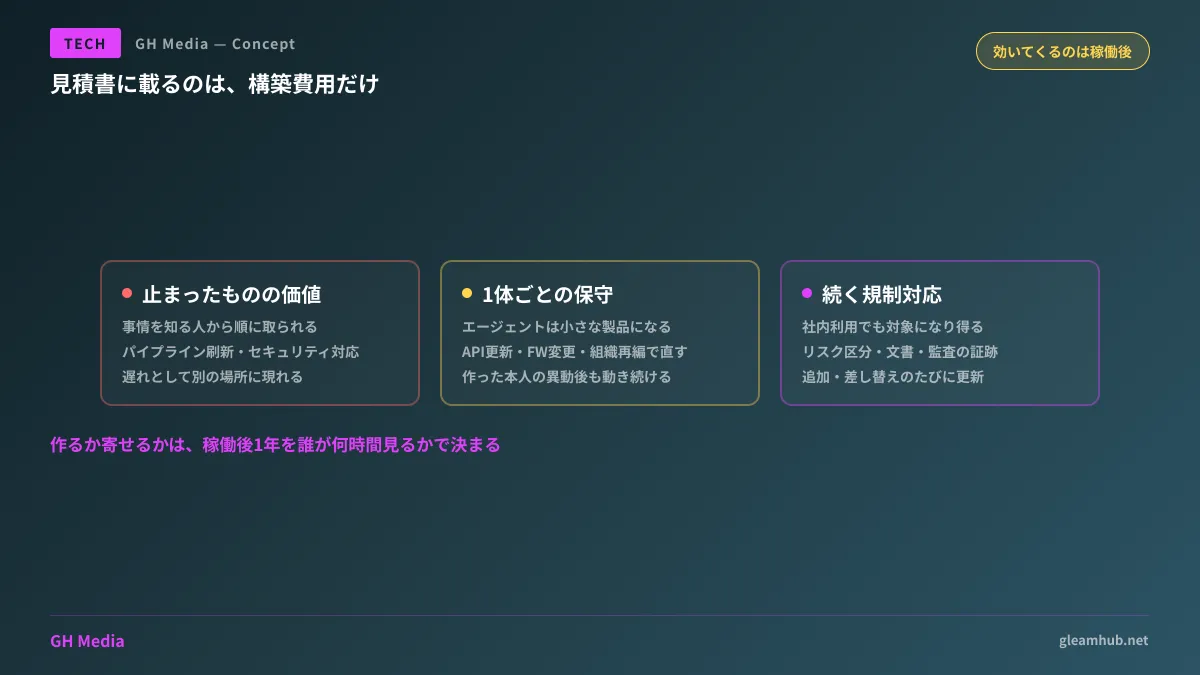
Initial construction expenses appear on the quote. Three costs do not.
First: Stalled Development Projects Prove Far More Costly
What gets overlooked most is the value of initiatives neglected because personnel were diverted.
The moment a company decides to build an internal AI agent platform, the engineers assigned to the task are naturally those who understand the internal architecture best. Inevitably so. And those very same engineers are already juggling updating legacy data pipelines, addressing flagged security issues, and handling urgent business requests.
Three months spent building a platform means those critical initiatives stall for three months. Those stalled projects never appear on any estimate, surfacing instead elsewhere as compounding project delays.
The metric to guide this decision is sequence, not price. If you ask, "Between what is currently stalled and this platform, which should we tackle first?", the conclusion often changes. If you only discuss the platform in isolation, the platform will always take priority.
Second: Each Agent Becomes Its Own Miniature Product
Another factor that compounds post-launch is ongoing maintenance.
Agents integrated into business processes each behave as miniature standalone products. APIs for connected tools change. Underlying frameworks are updated. Departmental ownership shifts following corporate reorganizations. Each time, engineers must investigate which agents are affected, apply fixes, and re-verify operations.
Build ten agents, and that maintenance multiplies by ten. Moreover, they keep running long after their original creator has transferred departments.
What works here is the counterintuitive mindset of making it harder to add agents in the initial architecture. If anyone can create one freely, within six months nobody will understand the complete picture. Deciding whether to place approval gates at creation when exploring architecture for internal agent platforms causes far less organizational friction than attempting to restrict them later.
Designing execution environment isolation and auditing belongs in the exact same phase. As explored in sandboxes and audit logging when running agents in the cloud, retrofitting these components often necessitates rebuilding all existing agents from scratch.
Third: Regulatory Compliance Continues as Long as Systems Remain Operational
The third cost is one often dismissed under the assumption that internal systems never exposed outside the company are exempt.
Under the EU AI Act, internal AI systems are also subject to regulation. Organizations must classify risk categories, prepare mandatory documentation, and maintain audit-ready evidence for as long as that system remains active. Even Japanese corporations providing products or services into the EU may face extraterritorial application, meaning they cannot safely consider themselves exempt.
The key takeaway is that regulatory compliance is not a one-and-done build task. Even if documents are assembled at launch, updates are required every time an agent is added or an underlying model is swapped. In short, it shares the exact nature of maintenance costs: it persists for the entire lifespan of the platform.
Whether your firm falls under jurisdiction depends on your business scope, making this an area requiring legal counsel. However, proceeding blindly under the assumption that "it's merely an internal system" creates risks that will return to bite you later.
Comparing the Option Not to Build with the Same Rigor
Taking all three into account, the comparison ceases to be "build cost versus buy cost."
| Evaluation axis | When building in-house | When leveraging existing services |
|---|---|---|
| Initial estimate | Appears on quote | Appears on quote |
| Engineering commitment | Persists during both construction and operation | Limited to the configuration and connection period |
| Audit trails for regulatory compliance | Maintain and continuously update in-house | Confirm provider coverage and fill only the gaps |
For most companies, what is realistic is not building everything or buying everything, but rather a model where you retain in-house only the parts that touch company-specific data and rely on existing mechanisms for the rest. Where you draw that line constitutes the core of your design.
Cost visibility also becomes difficult if you try to grasp everything at once after building the system. A state where you can see the billed amount but cannot explain the reasons behind it happens in agent platforms just the same. Deciding whether you can break down and view usage on a per-agent basis is an item to resolve before going live.
What to do next
If discussions about an AI agent platform are taking place internally, ask the person who submitted the proposal: "Who will oversee this, and for how many hours, during the first year of operation?" If the answer is "once it's in operation, it won't require hands-on work," the second cost above has not been factored in.
At the same time, write down three development projects currently stalled within your company and line them up alongside building the platform. If, after comparing them, the platform still comes first, then that decision is sound. The danger lies in moving forward without lining them up.
For internal rollouts of AI agents, consultations covering everything from drawing the line between what to build and what to rely on existing services for, designing post-launch maintenance structures, to cost visualization are available through GleamHub's Development, AI, and Automation consulting services. Because viable architectures vary depending on your current organizational setup and the data you handle, please reach out individually via our contact form.
Sources
- Invisible costs lurking behind AI agent platforms [Part 1] — gihyo.jp
- Commentary on the European (EU) AI Act: Overview, implementation timeline, and required enterprise response — PwC Japan Group
- Overview of the EU AI Act and required responses for Japanese companies explained — BUSINESS LAWYERS
- Does the European AI Act (EU AI Act) apply to Japanese companies? — Nemko