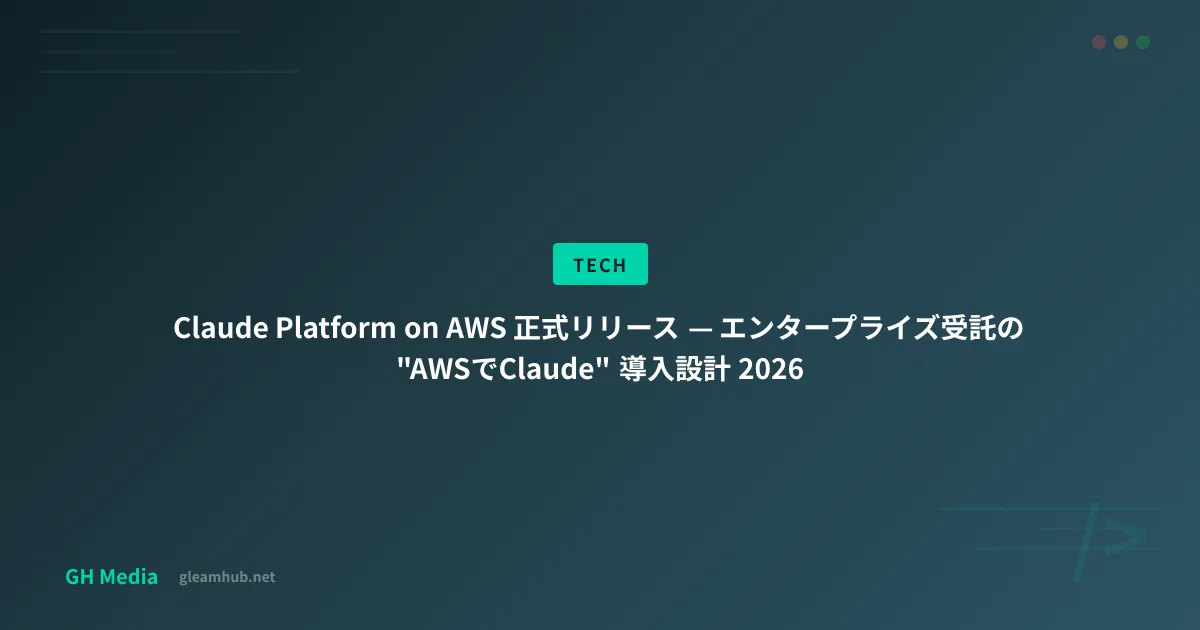
On May 12, 2026, Publickey reported that "Anthropic officially releases 'Claude Platform on AWS' hosted on AWS." The full suite of Claude operated by Anthropic on AWS (Sonnet / Opus / Claude Code / Agent SDK) is now available inside AWS data boundaries, structured as operated directly by Anthropic rather than through Bedrock.
Until now, in our custom development projects as well, internal approvals often stalled on a dilemma: "Bedrock's Claude lags behind on new features" versus "contracting directly with Anthropic crosses AWS data boundaries." Claude Platform on AWS provides an option that balances "feature freshness" with "data governance," marking an update that—alongside OpenAI Models Officially Entering AWS Marketplace—transforms procurement structures in enterprise AI development for clients.
Four differences from using Bedrock
| Dimension | Claude via Bedrock | Claude Platform on AWS |
|---|---|---|
| Operating entity | AWS | Anthropic (operated on AWS) |
| Feature release | 1 to 3 months delayed behind upstream Anthropic | Simultaneous with upstream |
| Data boundary | Inside AWS | Inside AWS |
| Billing | Consolidated into AWS invoice | Supports both direct contract with Anthropic and AWS Marketplace |
| Claude Code / Agent SDK | Not provided | Full features |
| Enterprise SLA | AWS SLA | Anthropic SLA |
In particular, "having Claude Code and Agent SDK run within AWS data boundaries" serves as a powerful differentiator in enterprise custom development projects seeking to balance development productivity with compliance. Previously, as in Claude Code and Client Terms Extraction, running on local PCs was the prevailing assumption, but Platform on AWS makes architectures that run development agents inside a VPC a practical reality.
Three reasons enterprises could not choose Bedrock
Reason 1: Time lag in feature releases
Because Claude on Bedrock is released 1 to 3 months behind the upstream provider, it was frequently ruled out in projects where teams wanted to accelerate development with new Claude Code features.
Reason 2: Absence of Claude Code and Agent SDK
Bedrock is offered on an API basis and does not provide full client-side features like Claude Code or Agent SDK. It could not satisfy the demand to "use Claude directly in IDEs or CLIs."
Reason 3: Differences in model behavior tuning
Because Claude on Bedrock can undergo modifications on the AWS side, there were situations where identical behavior to upstream could not be guaranteed. This caused a division where "PoCs were run on upstream Anthropic, but production ran on Bedrock."
Three deployment patterns handled in custom development
Pattern A: Addition to existing AWS environments (2 weeks minimum)
In cases where AWS is already the primary cloud, it is integrated into the existing security foundation leveraging IAM, VPCs, and KMS. MCP servers covered in our internal Complete MCP Guide can also be placed within the VPC.
Pattern B: Multi-account isolation (4 to 6 weeks)
Development and production accounts are separated and governed via Organizations and Control Tower. Audit logs (CloudTrail) are centralized to maintain Claude usage logs according to compliance standards.
Pattern C: Strict mode for regulated industries (8 to 12 weeks)
For finance, healthcare, and public sectors, we combine private endpoints (PrivateLink) + customer managed keys (KMS CMK) + FIPS-compliant regions. This can be used complementarily with the architectures for regulated industries covered in Coder Agents Self-Hosted AI.
Standard architecture set for custom development
| Layer | Recommended configuration |
|---|---|
| Network | VPC + PrivateLink + Transit Gateway |
| Authentication | IAM Identity Center + SSO |
| Key management | KMS CMK + Secrets Manager |
| Audit Logging | CloudTrail + S3 (Object Lock) |
| Cost management | Cost Explorer + Budgets tags |
| Development environment | Claude Code on EC2 / Workspaces |
In particular, WORM storage of logs in S3 with Object Lock is a critical requirement to satisfy the "tamper-proof audit logs" mandated under the EU AI Act and Japan's AI Guidelines for Business.
Projects suited and unsuited for Claude Platform on AWS
| Suited projects | Unsuitable projects |
|---|---|
| AWS is the master cloud | Dedicated GCP / Azure shops |
| Want to contain data within AWS regions | Multi-region setups for global rollout |
| Want to use Claude Code / Agent SDK in IDEs | API calls alone are sufficient |
| Regulated industries (finance / healthcare / public sector) | Personal projects |
| Unifying governance across development and production | Prioritizing speed and bypassing internal approval |
For GCP-only shops or personal projects, contracting directly with Anthropic remains simpler. In custom development practice, our guiding principle is "align with the client's current primary cloud."
Five clauses to include in custom development contracts
| Clause | Details | What the client should verify |
|---|---|---|
| Data boundary | Explicit specification of AWS regions | Alternatives during regional outages |
| Model version | Minimum supported model version | Risk of sudden release deprecation |
| Audit log retention | CloudTrail / S3 Object Lock | Retention period and costs |
| Cost caps | Automated alerts via Budgets | Demarcation of liability during runaway execution |
| Regulatory compliance | EU AI Act / Japan guidelines | Reporting formats |
Four common pitfalls
Pitfall 1: Confusing costs with existing Bedrock usage
Bedrock and Platform on AWS have separate billing streams. A classic failure is "trying both, resulting in double billing and budget overruns." Unify the channel upfront.
Pitfall 2: Postponing the architecture design for running Claude Code in a VPC
If you begin with "just APIs for now," the engineering hours needed later to integrate Claude Code into IDEs will balloon. We recommend designing with the developer experience in mind from day one.
Pitfall 3: Leaving audit log formats entirely to CloudTrail
CloudTrail's default format records "who invoked Claude and when," but omits "what was asked and how it answered." You must design a separate mechanism for persisting prompts and responses.
Pitfall 4: Overlooking the dual-contract nature of Anthropic SLA and AWS SLA
Many clients mistakenly assume that "since it runs on AWS, the AWS SLA applies," but the operating entity is Anthropic. Confirm SLAs in Anthropic's contract.
Summary: Balancing "feature freshness" and "AWS data boundaries"
Claude Platform on AWS resolves the long-standing dilemma of "Bedrock is too slow" versus "direct contracts leak data." In enterprise custom development where AWS serves as the master cloud, the structural framework to pass Claude through internal approval is now fully in place.
However, whether an engagement settles on Pattern A, B, or C depends almost entirely on how well existing AWS accounts are organized and what granularity of audit logging is mandated. Without visibility into those areas, neither architecture nor timeline can be drawn; progressing the discussion requires bringing together the current state of VPCs, IAM, and CloudTrail. For inquiries at stages such as "deploying Claude into production without leaving AWS data boundaries" or "distributing Claude Code to development teams inside a VPC," please reach out via our contact form.