"Our development velocity has noticeably improved. We have AI writing a substantial portion of our code. But if I am being honest, I lack confidence that we are thoroughly vetting the security of that code." This candid admission came from an engineering lead driving AI adoption. It encapsulates an asymmetry confronting many engineering teams today: AI has drastically increased the speed of writing code, but the speed of finding vulnerabilities in that code has not improved. Output volume multiplies while security inspection falls behind. This reality holds true whether development is handled in-house or outsourced.
To address this asymmetry, Anthropic released its security review plugin (Claude Security) for Claude Code in public beta on July 22, 2026. Having one AI system comprehensively audit code generated by another AI is becoming an operational reality. Here is an analysis from the viewpoint of outsourcing and in-house development regarding what the tool can accomplish and what humans must continue to govern.
Faster Code Generation Widens Inspection Blind Spots
First, let us understand why this presents a serious challenge. While AI can generate vast amounts of code in seconds, the generated output can harbor subtle issues that are difficult to spot at a glance, such as injection flaws, authentication bypasses, and logical errors. Most traditional security scanners rely on mechanical pattern matching against known signatures, frequently missing context-dependent issues that span multiple files.
Consequently, as AI ramps up code volume, blind spots beyond the reach of pattern-matching scanners expand. Attempting to bridge this gap solely through manual reviews turns human reviewers into severe bottlenecks. While integrating security early into coding rather than treating it as an afterthought—the "shift left" approach—is discussed in our article on Security by Design, managing the inspection pipeline itself becomes an even more pressing challenge in an era of AI-generated code.
What the Claude Code Security Audit Plugin Does
This plugin operates directly within a Claude Code session, allowing multiple agents to divide and coordinate the task of auditing a repository for vulnerabilities. Whether checking recent changes prior to a commit or performing a deep scan across the entire codebase, the entire process runs inside the terminal.
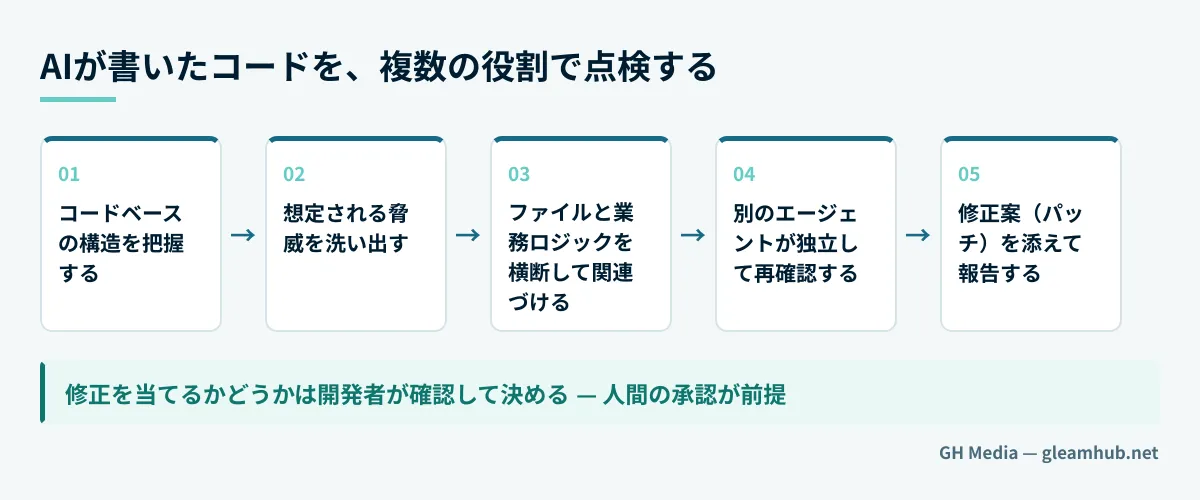
A closer look reveals that it goes well beyond simple pattern matching. It analyzes codebase architecture, models prospective threats, correlates issues across files and business logic, and has separate agents independently verify identified findings before delivering a report accompanied by suggested patches. It focuses specifically on high-impact vulnerabilities such as injection flaws, authentication bypasses, memory corruption, and logic defects (MarkTechPost: Claude Security Plugin, Help Net Security).
The distinction from traditional scanners lies in the depth of inspection.
| Dimension | Traditional pattern-matching scanners | Multi-agent security auditing |
|---|---|---|
| Inspection scope | File-by-file, focused on known signatures | Correlates context across files and business logic |
| False positive handling | Outputs raw alerts without validation | Separate agents independently verify findings |
| Output | Detection list | Actionable report with proposed patches |
Why Human Oversight Remains Indispensable
This is the most critical point: this system does not automatically apply fixes to discovered issues. Proposed fixes are provided as patch files, leaving developers to inspect and decide whether to adopt them. Anthropic itself emphasizes that every fix requires human review and sign-off, recommending that patches be applied via dedicated pull requests.
This caveat matters because assuming code is safe simply because AI audited it creates a dangerous new vulnerability. While AI audits serve as a powerful safeguard against missed flaws, only humans can assess what business assets need protection and what consequences are unacceptable. While foundational accountability frameworks for delegating work to AI are detailed in our AI Agent Practical Guide for Executives and IT Managers, security is a domain that demands both automated scanning and human approval working in tandem. For attack vectors outside the codebase itself, such as compromised packages, consult our article on supply chain attacks and npm execution risks.
From a procurement perspective, the question clients must ask is straightforward: "Who inspects AI-generated code, through what process, and who gives final approval?" If a partner can provide clear answers, their quality assurance pipeline remains sound even when development is accelerated with AI.
First, Designate Who Is Responsible for Inspection
AI-assisted inspection tools do not replace human code reviewers; they serve as a supportive safeguard to reduce missed vulnerabilities. What remains constant before and after tool adoption is defining who holds final sign-off authority. Begin by defining who inspects the security of AI-generated code and who approves it within your organization or vendor team. If that responsibility is unassigned, filling in that single role takes precedence over adopting new tools.
If you need advice on structuring quality assurance and security reviews for AI development, or want third-party auditing of code quality from development partners, GleamHub is here to assist through our Development, AI, and Automation consulting. Architecture needs vary by project, so we provide individualized quotes. Please contact us via Contact Us.
Sources
- Anthropic Releases Claude Security Plugin for Claude Code in Beta — MarkTechPost
- Claude now reviews and fixes vulnerabilities as you write code — Help Net Security
- Anthropic Launches Claude Security Plugin to Scan Codebases for Vulnerabilities Before Commit — GBHackers
- Claude Security | Claude by Anthropic (Official)