"We don't do video streaming, so this doesn't apply to us, right?" When discussing video-related vulnerabilities, this is the usual response. However, upon closer inspection, you often discover the same component being used somewhere: a video upload feature on a recruitment site, an internal conversion tool for meeting recordings, or thumbnail generation for files attached to inquiry forms.
In July 2026, a security research team disclosed a vulnerability in the FFmpeg software dubbed PixelSmash. Identified as CVE-2026-8461, it holds a severity rating of CVSS 8.8. Simply processing a crafted media file can allow arbitrary code execution. What is more, this flaw had been there for 16 years (InfoQ).
PixelSmash Is "Dangerous Even Without Opening": Loose Conditions Are the Problem
What drew attention to this vulnerability was how easily the exploit conditions are triggered. It executes whenever your system processes a crafted file prepared by an attacker. It has been reported to occur not only when played in a video player, but also when streamed by a home media server, and even merely when a Linux file manager generates a thumbnail. In short, "it's safe as long as I don't open it" does not apply. The moment a file is placed there and the system automatically inspects its contents, the conditions are met.
The file format is nothing exotic either. Standard, widely circulated containers like AVI, MKV, and MOV are used. The classic trick of disguising files as popular videos works as is. Technically, it is a memory write boundary error during the decoding process of the MagicYUV codec, and a patched version has been released as FFmpeg 8.1.2.
The fact that it went unnoticed for 16 years also speaks volumes about its nature. It is not that no one looked, but rather that it was so ubiquitous that it was nobody's responsibility. As repeatedly pointed out in the past, the more widely a component is used, the more ambiguous the ownership of responsibility becomes.
FFmpeg Is a "Component Missing from Asset Inventories"
For small and medium-sized businesses, the real challenge is not applying the patch. It is knowing whether your company uses FFmpeg in the first place.
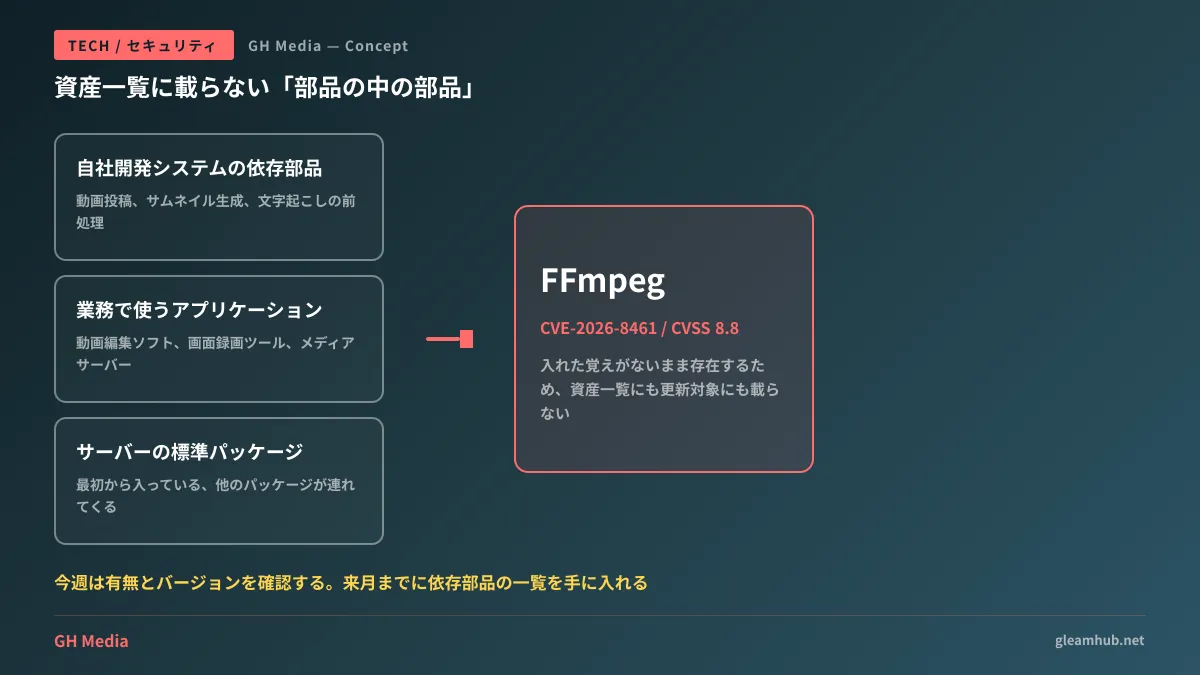
FFmpeg is a foundational component invoked internally by almost all software handling video and audio. Even without any conscious memory of deciding to "install FFmpeg," it enters your environment through pathways such as the following:
| Inflow Pathway | Specific example |
|---|---|
| Dependencies of in-house developed systems | Video posting features, automatic thumbnail generation, audio transcription preprocessing |
| Business applications | Video editing software, screen recording tools, media servers |
| Standard packages on servers | Pre-installed on Linux servers; introduced as dependencies by other packages |
The troublesome ones are the middle and bottom rows. Because they exist without anyone consciously having installed them, they appear neither in asset lists nor in software ledgers. Software you don't know exists naturally cannot be targeted for updates. This "hidden component" dilemma lies at the core of software supply chain attacks.
Checks You Can Do This Week, and Actions to Take by Next Month
First, in the short term: if you have technical staff, have them check for the presence and version of FFmpeg on your servers and client workstations. For servers, a package manager can generate a list. Any version older than 8.1.2 should be scheduled for an update.
If you do not have technical personnel or have outsourced your systems, asking your maintenance provider a single question is the fastest route: "Does our system use FFmpeg? If so, please inform us of the impact of CVE-2026-8461 and your response plan." That is all it takes. If they can investigate and answer, the relationship is healthy; if the question itself is not understood, that in itself reveals valuable information.
Beyond that, what you should tackle by next month is obtaining a list of dependencies. Have you received a list of components that run your system—a Software Bill of Materials (SBOM)—as part of your deliverables? In most cases, you haven't. Without it, when a similar vulnerability emerges next time, you will have to start the exact same investigation all over again.
For new projects, we recommend including the submission of an SBOM in your project requirements. While we previously discussed what to verify during acceptance in our Acceptance Checklist, whether you include documenting "what it is built from" in addition to verifying "that it works" within the scope of delivery will reshape your operations for years to come.
Let us also touch on how to prioritize response efforts. Just because FFmpeg is found does not mean every instance requires the same urgency. The determining factor is "does it process files coming from the outside?" If there is a pathway that automatically processes user-uploaded files or files received via email, an attacker could introduce a crafted file, making the priority high. Conversely, if it is a closed conversion process handling only internally generated media, the entry point is narrow and it can be placed lower on the list. Once your inventory is created, sorting by this single question establishes your response priorities.
Don't Stop at a One-Off Fix
PixelSmash is not the type of issue you handle simply because it is trending today. The discovery of a flaw that lurked for 16 years suggests it is only natural that similar ones remain hidden elsewhere. In fact, the spread of AI-driven vulnerability discovery has brought long-overlooked flaws in legacy code to light one after another. This trend will continue for the foreseeable future. While we explored who checks the security of AI-written code in our Security Inspection of Claude Code Article, AI moves just as swiftly when searching for flaws as it does when writing code.
If so, an operational model that panics over every individual vulnerability is unsustainable. Having both "a state where you always know what components you use" and "a state where it is predetermined who decides and applies patches when critical vulnerabilities emerge" ultimately proves far more cost-effective.
Check FFmpeg this week. Obtain a bill of materials by next month. Proceeding with this two-pronged approach is the practical way forward.
Whether you lack an understanding of what components are used in your systems, or have no one available to assess emerging vulnerabilities, GleamHub can assist starting from clarifying your situation through our development, AI, and automation consultations. Because approaches vary based on requirements, we provide customized estimates. Please contact us via Contact Us.