"Last year, we had an integration built so AI could view our internal inventory data. If the standard changes, will it have to be rebuilt from scratch?" Companies taking early steps in AI adoption frequently face this anxiety. Something that is working smoothly might stop due to specification changes decided without their knowledge—and they don't understand the inner workings.
On July 28, 2026, new specifications were finalized for MCP (Model Context Protocol), the common standard connecting AI with external systems. The core of this change is an architectural shift known as "statelessness," representing a substantial overhaul for the standard. You do not need to follow all the technical nuances, but knowing what to confirm as the client who commissioned the work is well worth your time.
Explaining MCP Statelessness with an Analogy
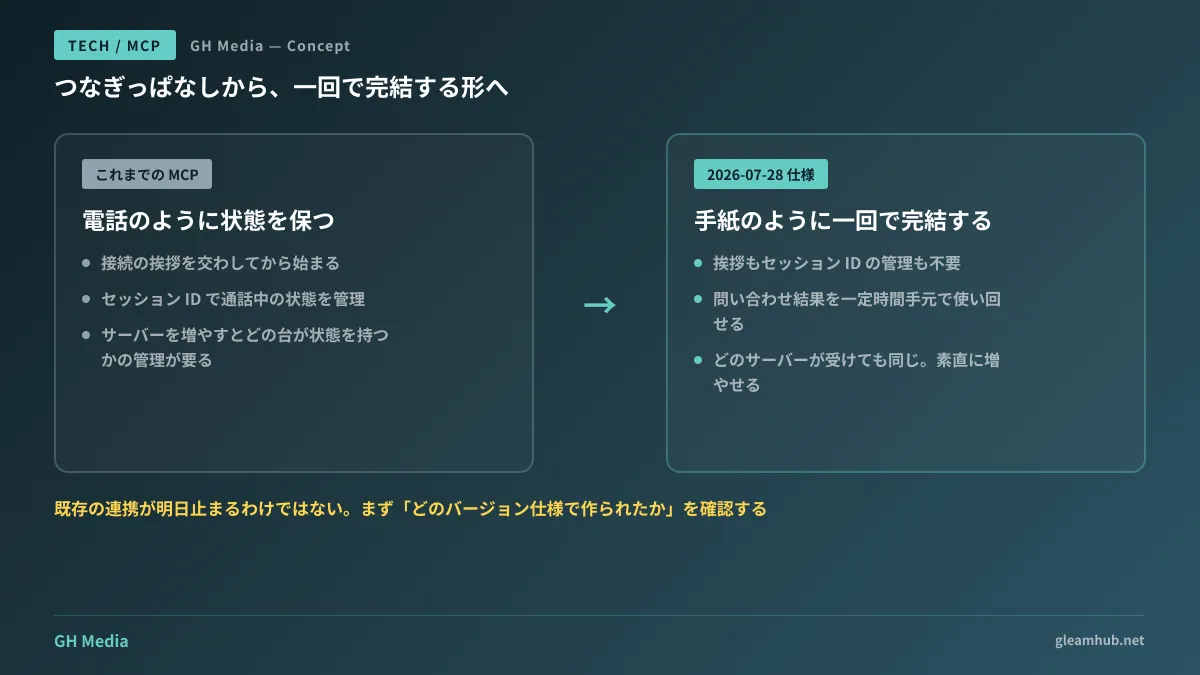
Until now, MCP operated under the premise that both the AI side and the system side remembered an ongoing "connected state." It worked much like a telephone call: first exchanging connection greetings, sharing an identifier (session ID) showing that the call is active, and keeping the line open throughout the interaction.
Under the new specification, this "phone call" approach has been abandoned. It transitions to interactions that complete independently each time, like letters. Neither greetings nor active call session management are required. Along with this, mechanisms to cache query results locally for reuse, enhancements in authorization handling (who can access what), and a formal extension framework have been introduced (Model Context Protocol Blog: The 2026-07-28 Specification).
The primary reason for this change is operational ease. In an approach where a phone call is kept connected, attempting to add multiple servers to balance the load creates overhead in tracking "which server remembers this call." Switching to self-contained interactions means any server can handle any incoming request. In practical terms, it allows systems to scale effortlessly when usage increases.
| Dimension | Previous MCP | 2026-07-28 Specification |
|---|---|---|
| Connection method | Requires connection greetings and session management | Self-contained with each request |
| Server scaling | Requires managing which server maintains state | Identical regardless of which machine receives it |
| Primary use case | Small-scale, single-server architectures | Configurations needing load balancing as usage grows |
Existing MCP Integrations Won't "Break Tomorrow"
To address the core concern directly: just because the specification was finalized does not mean existing integrations will suddenly stop working the next day. MCP specifications are versioned by date, and integrations built on older versions will continue to operate as long as their corresponding implementations run. While some implementations, such as GitHub's MCP server, promptly announced support for the new specification, "supporting it" is entirely different from "deprecating the old one" (Publickey).
That said, "it works for now" is not the same as "it can be left alone." When a standard is updated, surrounding libraries, SDKs, and external services gradually shift toward the new specification. Six months or a year later, the impact typically manifests as "the connected service now only accepts the new specification." There is no need to panic, but putting it on your roadmap is the proper perspective.
If you want to review how MCP itself functions, reading our Complete Guide to MCP will help connect the dots for the discussions ahead.
Three Questions to Pose to Your Maintenance Vendor
Even without technical knowledge, what you need to check can be narrowed down to three questions. Asking them directly in your next regular meeting or via email is the fastest approach.
- Which version of the MCP specification was used to build our current integration? Without knowing this, you cannot evaluate whether you will be affected. If they cannot answer immediately, having them look it up is the first step.
- If we need to support the new specification, what scale of work will it require? Will updating the SDK suffice, or will it require redesigning the architecture? Getting a sense of scope before receiving a quote helps in budget planning.
- If the external service migrates to the new specification, by when must we respond? Deadlines may be dictated not by internal schedules, but by the counterpart service you are connected to. Knowing whether you have a firm grasp of this deadline determines whether you will be caught off guard.
None of these three questions seek a technical silver bullet. They are questions to confirm whether the situation is understood. If the vendor answers immediately, you can rest easy; if they ask for time to investigate, that is an equally sound response. If the answer remains vague and brushes past the issue, you will know where the weakness in your maintenance setup lies.
Changing the Sequence of Verification When Building New Integrations
If you are about to commission development connecting internal systems to AI, you should explicitly determine "which version of the specification to build with" before finalizing requirements. While this sounds obvious, it is frequently omitted in practice.
The architectural pattern of exposing existing internal APIs for AI consumption is detailed in Design Patterns for Turning Existing APIs into MCP Servers. Along with that, you should verify authorization design. The new specification reinforces authorization mechanisms. Allowing AI to reference internal data also means defining "who" can touch "which data." Prioritizing connection while leaving this ambiguous means having to tighten permissions later. Governing AI access to internal systems is covered extensively in Enterprise MCP Authorization Management.
Furthermore, standards of this nature will continue to be updated in the future. This is not the last time. That is why, rather than stressing over individual specification updates, it is far more effective to establish within the maintenance contract who evaluates and acts when standards change. Consulting from scratch every time a specification changes only slows down both decisions and implementation.
Start First with "Which Version?"
There is one thing you can do today: send a one-line email to whoever connected your internal systems to AI, asking, "Which MCP version specification does our current integration use?" That alone will clarify whether you need to worry. In most cases, the answer will be "There are no immediate issues." Taking action to receive that single sentence of reassurance is the most cost-effective preparation you can make.
Whether you want to design integrations between internal systems and AI, or have a third party review whether your existing setup aligns with current specifications, GleamHub is here to help through our development, AI, and automation consultation desk. Because optimal configurations vary based on requirements, we provide customized estimates. Please reach out via Contact Us.
Sources
- The 2026-07-28 Specification — Model Context Protocol Blog
- The 2026-07-28 MCP Specification Release Candidate — Model Context Protocol Blog
- MCP Specification Updates Tomorrow: Stateless Connection Becomes Official Spec from July 28 Edition — Publickey
- MCP 2026-07-28 RC Commentary: AI Agent Implementation Brought by Statelessness — Mamezou Developer Site
- 2026-07-28 MCP Specification Goes Stateless-First — azukiazusa.dev