Inquiries asking whether AI can take over logging and setting calibration for measurement equipment arrive from both manufacturing and research departments. In many cases, discussions stall the moment teams see estimates that stack up custom integration development for every individual device.
The reason for stalling is not technical difficulty. Having five devices means building five separate integrations, none of which can be repurposed if device manufacturers change. The dynamic where connecting devices costs more than what you actually want to achieve has held back these initiatives for years.
Why connection work must be rebuilt every time
Industrial and research instruments each have their own control methods: sending proprietary command syntaxes via serial communication, routing through manufacturer SDKs, or exposing only dedicated PC software. Even for identical tasks like "reading" or "moving," each instrument speaks a different vocabulary.
Placing an AI agent on top requires writing a translation layer every time to bridge the device's vocabulary and the agent's vocabulary. Because this layer is device-specific, it must be discarded on the next project. Requiring specialist hours, taking weeks or months, and lacking reusability—this is why estimates inflate.
What the Model Hardware Standard standardized
On August 27, 2026, Anthropic released the Model Hardware Standard (MHS) as a research preview to an initial cohort of scientific research labs and advanced manufacturers as a shared specification enabling AI agents to operate physical devices safely.
At its core are standardized drivers. Operating as software between computer operating systems and physical devices, they interact with hardware through a set of foundational commands (primitives) including read and write. Targets cover any device with a programmable interface, citing microscopes, liquid handlers, and robotic arms. Agents can operate these in parallel, with outlined applications ranging from drug discovery to laser calibration for quantum computers.
According to Anthropic, integrations that normally take weeks to months of custom development by specialists will now take only hours or minutes. In addition, the specification is model-agnostic and not tied to Claude models. Plans to open-source it in the future have also been announced.
Its structural intent closely resembles how MCP spread as a shared specification linking AI agents to software tools. The difference is that the target of its actions is not behind a screen, but an actual physical machine.
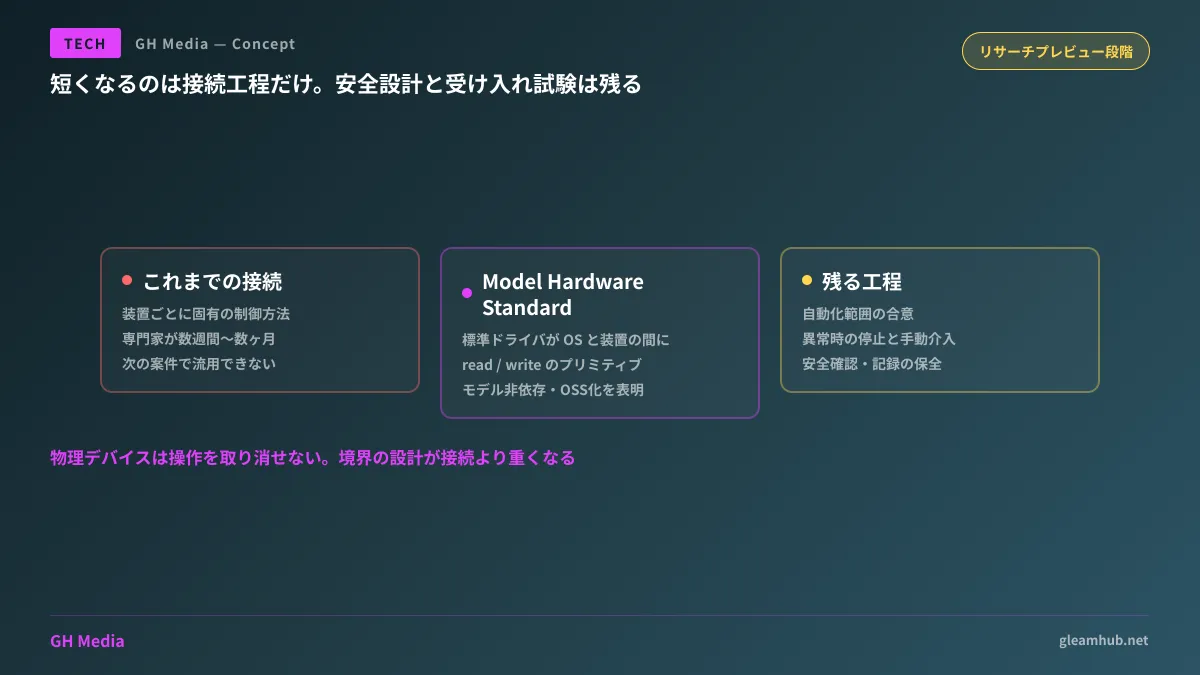
Steps not included in "a few hours"
Misreading this will lead to misaligned internal expectations. What is shortened is building the integration layer, not the entire project.
| Shortened steps | Steps that remain |
|---|---|
| Implementing device-specific connection layers | Agreeing on what and how much to automate |
| Researching and implementing control commands | Designing emergency stop conditions and manual interventions |
| Scaling horizontally when adding devices | Safety validation, acceptance testing, and audit logging |
Because you are operating physical hardware, erroneous commands cannot be rolled back. On-screen tools allow undoing operations, but you cannot undo a liquid handler dispensing reagent or a robotic arm in motion. Determining which actions to entrust to an agent and where to require human confirmation becomes a far heavier design task than the integration itself.
Structuring permissions for agents connects directly to discussions in the software domain. The framework for placing trust boundaries covered in Permission Design for AI Agents applies directly. When dealing with hardware, crossing that boundary simply results in physical consequences.
When your existing devices are unsupported
In field operations, the device you want to run most is often the oldest. It lacks external control interfaces and can only be operated through dedicated applications on dedicated PCs. In such cases, adopting a shared specification will not help even if it gains widespread adoption.
You are not without options, but the approach changes: rather than trying to operate the hardware directly, you automate the outputs it produces. If measurements export as CSVs or logs, you can automate data collection, aggregation, and anomaly detection. Humans handle operations, while machines handle preparing decision-making material.
While seemingly modest, this approach often yields a higher return on investment. Automating operations requires custom work per device, whereas automating outputs lets you reuse the pipeline across different machines. If hardware replacement is years away, solidifying this layer first and selecting models with programmable control interfaces during the next refresh is the pragmatic sequence.
A realistic approach based on current positioning
Because it remains a research preview with limited availability, the decision you can make today is not whether to adopt it, but whether to prepare for it.
Specifically, there are two steps. First, confirm whether your devices have programmable interfaces. Instruments operable only through proprietary desktop applications will remain out of scope even if the standard becomes prevalent. You can investigate this today.
Second, articulate the granularity of the tasks you want to automate. "Operating equipment with AI" is not a specification. "Running 20 measurements under varying conditions and consolidating logs into a single table" is. If you prepare connections without refining this granularity, what you build will end up unused. The typical trap of stalling by over-expanding scope is covered in Requirements Design to Avoid Overbuilding.
What to do next
First, select a single candidate task for automation and write down its steps on paper. Note who operates which device in what order, and where judgments occur. Those judgment points define the boundary between what to hand to agents and what humans must retain.
Next, check manufacturer documentation for that instrument's external control options. The presence of a programmable interface largely dictates your remaining options. If absent, the standard's adoption will not change your path, making alternative approaches faster to pursue.
At GleamHub, we assist with evaluating architectures for connecting devices and systems to AI agents, defining automation boundaries, and organizing requirements through our development, AI, and automation consulting services. Because execution depends on hardware setups and objectives, feel free to consult with us individually via Contact Us.