An MCP server was built upon a request to make an internal inventory system manageable from AI. It has 12 tools, authentication passes, and specifications are in order. Acceptance inspection also concluded without issues.
Three months later, it is not being used.
When you ask the frontline team, the answers are mostly the same: "When we ask the AI, we get an answer different from what we expected," or "In the end, it's faster to look it up ourselves on the usual screen."
Even with tools lined up, procedures haven't been handed over
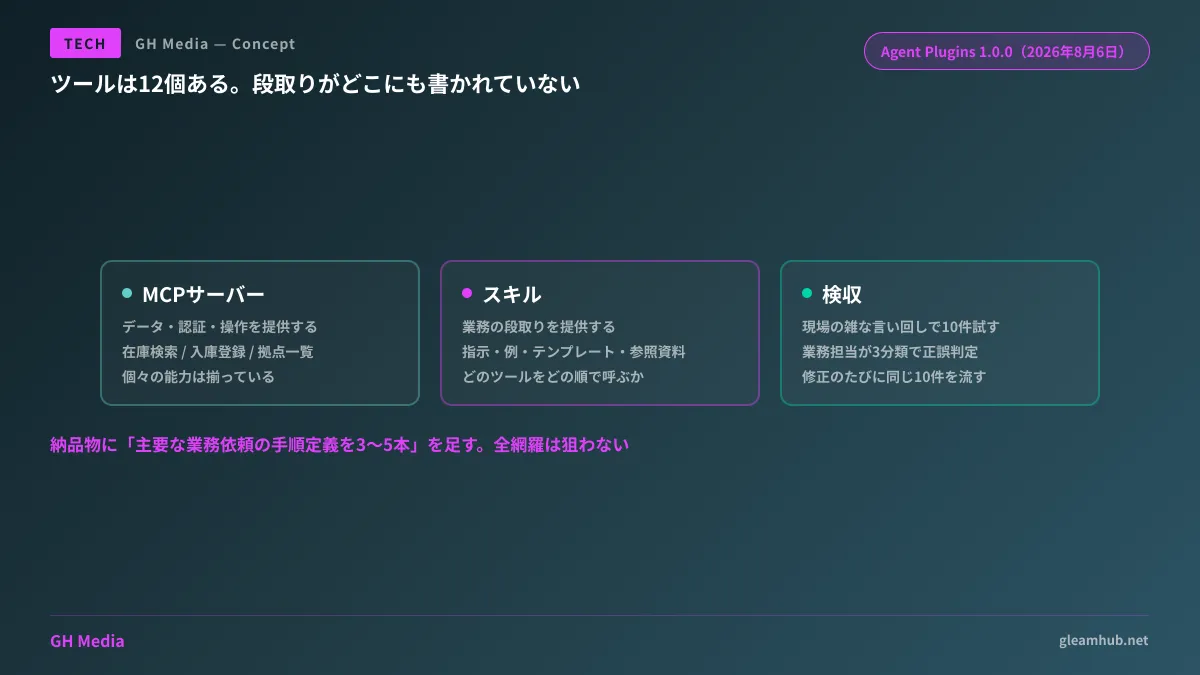
The cause lies in the contents of the deliverables. What the MCP server provides is data, authentication, and operations. Individual capabilities such as "search inventory," "register incoming shipment," and "retrieve list of bases" are laid out.
On the other hand, what the frontline wants the AI to do are requests like this:
"Provide this month's out-of-stock risk for Company A broken down by base."
Handling this request requires a procedure: fetch the list of bases, look up the inventory for each base, cross-check against Company A's order schedule, and extract items falling below the threshold. That procedure is written nowhere. The tool descriptions merely say things like "searches inventory." The AI has simply been handed 12 tools without knowing the workflow arrangement.
While MCP design and operations themselves were covered in Stateless MCP Specifications and Internal Integration Maintenance and Write Operation Boundaries and Execution Logging, the bottleneck this time is one step prior: the question of "what we define as a deliverable."
Two movements that emerged in August 2026
Movements to bridge this gap emerged one after another in August.
The first is Agent Plugins 1.0.0. Published on August 6, 2026, as a joint specification by five companies—Amazon, Anysphere (developer of Cursor), Microsoft, OpenAI, and Vercel—it is intended to bundle agent skills and MCP servers into a single distributable folder. Because pairings are described in the manifest, the client side can automatically recognize that "this server comes with this usage." This means the correspondence previously written in prose inside a README is now machine-readable.
The second is support for Skills Over MCP. On August 26, 2026, Max Stoiber of OpenAI posted that they added early support for this approach in public plugins. According to reporting by gihyo.jp, skills are imported from the MCP server side upon plugin submission. This creates a flow where the server distributes its own usage instructions.
"Skills" here do not mean adding features. They are bundles of instructions, examples, templates, and reference materials detailing how to execute recurring tasks. MCP servers provide the tools, while skills provide the procedures. Their roles are clearly divided.
Add one line to the deliverables section when ordering
For projects enabling internal systems to be used from AI, previous deliverables looked like this:
- MCP server proper (source code and execution environment)
- Tool definitions and specifications
- Authentication and permission design documents
Add one line to this: "3 to 5 procedure definitions (skills) for key operational requests."
Narrowing the number is intentional. Trying to cover every business process causes workload to spike, and furthermore, none of them end up being used. Select 3 to 5 requests the frontline actually makes at least once a week, and standardize only those. Confirming whether the first one is used before adding more ensures far better adoption.
The conceptual approach to writing them has been discussed previously as file design for passing procedures to AI. The structure outlined in Differentiating AGENTS.md, SKILL.md, and DESIGN.md serves directly as the foundation.
How to verify "usability" during acceptance inspection
When skills are included in deliverables, the acceptance inspection method changes as well. Automated testing can confirm whether tools work, but only people who know the operations can judge whether procedures are sound.
Practical acceptance inspection steps consist of the following three:
- Have frontline staff submit 10 requests using their everyday phrasing. Rather than polished prompt sentences prepared by the commissioning side, test with the casual phrasing actually used
- Have operational staff judge the correctness of returned answers. Three categories are sufficient: "correct," "incorrect," and "requests that should not be answered"
- Run the same 10 requests with every revision. Because attempting to fix one item can break another request, preserve a state that allows comparison
This concept of "continuously running the same set" is common across acceptance inspections of AI features in general. I summarized this in detail in Told That "the AI Occasionally Hallucinates," Nobody Can Verify if It Has Been Fixed.
Please keep in mind that the standards have only just emerged. Agent Plugins is at the stage where 1.0.0 was published, and compatible clients are set to increase going forward. Rather than building on the assumption that today's implementation will be used unchanged for two years, maintaining a structure separating skill content (business procedure descriptions) from distribution format (manifests) minimizes the impact when formats change.
What to do next
First, if you have an internal system that has been made accessible to AI, check its usage logs for the past month. If invocation counts are close to zero, what is missing is not functionality, but procedures.
From there, write down three requests generated by frontline staff in that operation at least once a week. Writing them down in their actual phrasing, like "Provide out-of-stock risk for Company A by base," is crucial. These three are what should be standardized first. There is no need to rebuild existing MCP servers. There are many cases that begin working simply by adding procedures.
At GleamHub, we accept consultations on AI integration design for internal systems, designing MCP servers and business procedures, and accompanying clients until systems achieve active usage after introduction through our development, AI, and automation consultations. Because available approaches vary depending on existing system architectures, please consult us via Contact Us.
Sources
- OpenAI Early Supports Skills Over MCP in Public Plugins: Skills Imported from MCP Server on Submission — gihyo.jp
- Skills — OpenAI Developers(Plugins)
- Agent Plugins: The Open Standard for Skills and MCP Servers
- MCP Server vs Connector vs Plugin vs Skill: What Each Word Means in 2026 — Drag
- MCP New Roadmap Released: Focusing on AI Agent Support, Unification to HTTP Communication, Identity, and More — Publickey