When asked why a specification was decided six months ago, no one in the company can answer. Searching meeting minutes yields no relevant record, and scrolling back through Slack turns up only a single line: "Let's go with that then." The decision was made, but only the rationale has vanished.
This is a frequent occurrence in custom development. Regular meeting minutes capture only conclusions, while the deliberation leading up to them took place in chat. On August 20, Slack launched "Slack Code." It allows AI coding agents to join as channel members, grasping preceding discussions before handling implementation. It is available on all plans.
This means chat transitions from a "place for discussion" into an "input for implementation." Decisions left ambiguous in conversation will now manifest directly as generated code.
What happens with Slack Code
Mentioning an agent launches a dedicated Code Channel, organizing execution plans, code diffs, and previews cleanly across tabs. Supported agents include Anthropic's Claude Code, Cognition's Devin, GitHub Copilot, and Vercel's agent, with support for ChatGPT also planned.
From the client's perspective, the change is not simply having more tools. Channel history, previously read and interpreted by human team members, has become machine-readable input.
When the reader changes, the significance of what is left behind changes as well. Customer lists pasted with the thought "I will delete it later," competitor quotes shared "for reference," and personal data mingled into casual banter. What humans filtered out through context is treated as equal input by machines.
1. Which channels to grant access to
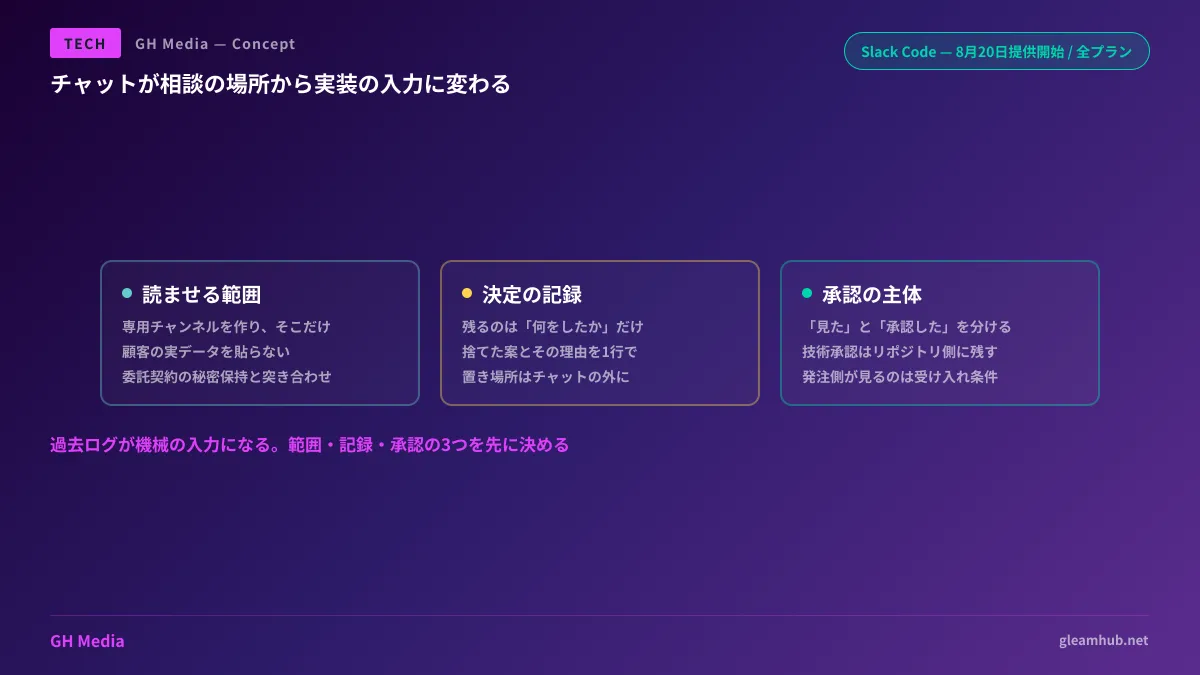
The first thing to define is scope. While it appears to be a technical configuration matter, in reality, it is a contractual matter of how much of your company to expose to a contractor's agent.
Practically speaking, drawing boundaries in the following order should prove manageable:
- Create dedicated channels for agents and never invite them elsewhere. Adding them directly to existing discussion channels assumes your entire history will be read. Creating fresh channels makes perimeter explanation straightforward.
- Operate channels as spaces where real customer data is never pasted. In teams accustomed to pasting production data during incident triage, this becomes the largest vulnerability. If pasting data is necessary, establish workflows to conduct that investigation outside of chat.
- Reconcile with provisions in vendor agreements. What contractors supply to which AI services directly impacts non-disclosure obligations. How to draft terms for AI tool usage in creative and custom development contracts is summarized in Agreements on Contractor AI Usage and Deliverables.
2. Record decisions outside of chat
Plans and diffs remain recorded in Code Channels. While convenient, what remains is "what was done," not "why it was done."
Furthermore, once agents can read discussions and implement solutions, humans have even less incentive to document decisions. The logic of "it is in chat, so it will be understood" takes hold. Six months down the line, it is precisely what was omitted here that comes back to bite you.
As a mechanism, the countermeasure is simple: record architectural decisions line by line in a separate location.
- The chosen option, along with discarded options and why they were rejected (reasons for rejection are more impactful later on)
- Assumptions under which the decision holds valid (user count, target browsers, expected data volumes, etc.)
- The date decided and the person who decided it
Whether in repository documentation or a wiki, there is one non-negotiable requirement: it must exist outside your chat tool. Channels get archived, workspaces migrate, and contracts with vendors end. Any state where decision records exist solely in chat will inevitably be lost.
3. Eliminate ambiguity around approval ownership
Because diffs are visible within Code Channels, reviews take place directly inside the conversational flow. While an advantage for speed, it brings the side effect that the line between "seen" and "approved" easily blurs.
Check whether a casual reply like "looks good" from a client representative in the channel is being treated as formal approval. Client leads are rarely in a position to evaluate code soundness, which is entirely natural. The problem is that such comments take on the outward appearance of approval.
The following two points must be established in advance:
- Who is responsible for technical approval? Is it a designated reviewer within the contractor, or your own technical lead? Ensure it is recorded as an approval record on the repository, independent of chat conversations.
- What does the client evaluate? Specifications and acceptance criteria. Confirming behavior is the client's role, but evaluating implementation validity is not. How to define acceptance for AI-generated code is detailed in Acceptance Policies for AI-Generated Code.
Adopting these tools without drawing this line frequently results in "the client saw it in the channel too" when incidents occur. A tool introduced to accelerate delivery ends up muddying accountability.
What to do next
First, open the channels used with your contractor and read through the past month from top to bottom. If actual customer data or competitor quotes are pasted there, that requires immediate remediation, regardless of whether you introduce agents.
Next, decide just one location in your next regular meeting for "where to record architectural decisions." Once the location is set, documentation habits follow. Without it, no matter how fast your tools become, you will still be unable to explain the reasoning six months later.
GleamHub offers assistance with structuring custom development workflows, designing development frameworks that incorporate AI agents, and formulating operational rules for generative AI through our Development, AI, and Automation Consultations. Because approaches vary based on organizational structure and data sensitivity, please reach out for personalized guidance. Get started via Contact Us.
Sources
- "Slack Code" arrives: AI agents parse developer conversations on Slack to code and build documentation — Publickey
- Slack announces "Slack Code" to collaborate with AI in teams — ITmedia NEWS
- Slack announces new Slack Code feature for collaborative development between teams and AI agents — Business + IT