
A few months after your website goes live, you receive a notice stating, "The photo on your top page closely resembles an image to which our company owns the rights." When you ask your web production agency, they reply, "We created that asset using generative AI." At this point, the ordering client immediately confronts the reality that because the image is published on your own website, your company is the party that must handle the dispute.
The use of generative AI in itself is not the problem. The problem is having established no agreements at the time of ordering regarding whether it would be used or where it would be applied.
"Do not use AI" is neither realistic nor effective
The first countermeasure that comes to mind is writing "The use of generative AI is prohibited" into the contract. We do not recommend this, for two reasons.
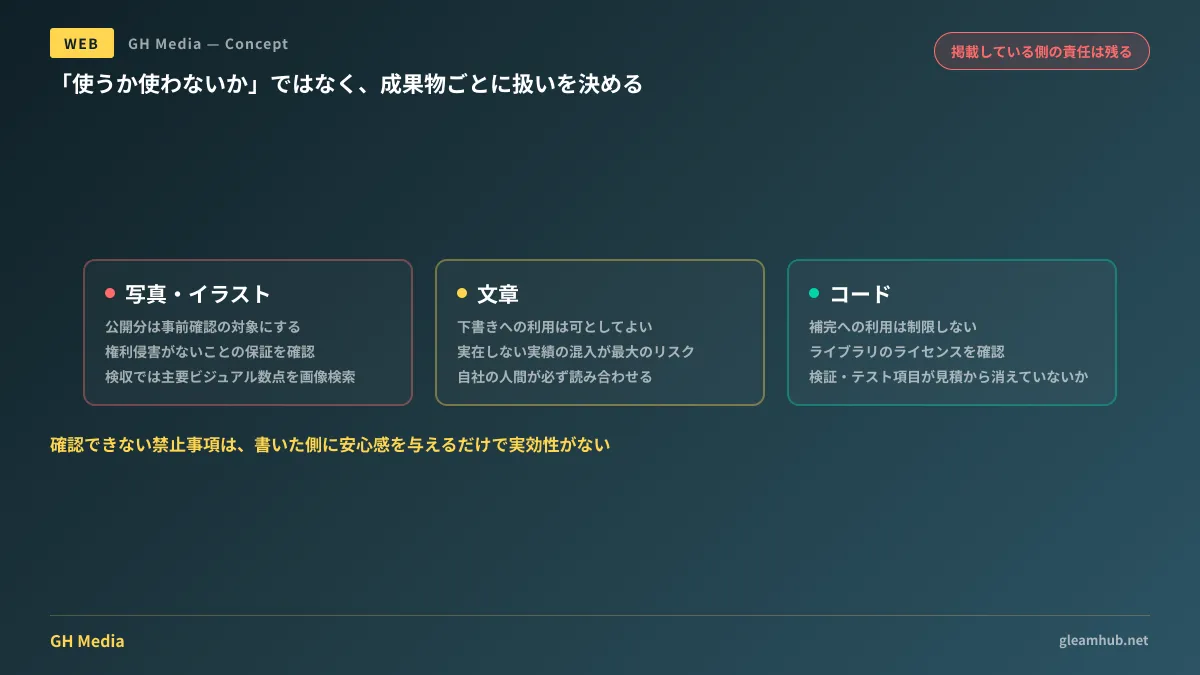
First, there is no way to verify compliance. Inspecting delivered images or code provides ordering clients with little external basis to determine whether generative AI was used. An unverified prohibition offers a sense of security to the drafter, but lacks practical efficacy.
Second, there are areas where prohibiting AI causes the client to lose out. In tasks such as drafting initial copy, code autocompletion, and image background processing, AI adoption enhances both speed and quality. Banning it uniformly across the board will inevitably inflate both costs and lead times.
What must be decided is not whether to use it, but where its use is permitted, and who warrants what regarding the results.
Agree on scope of use, rights warranties, and record-keeping
Agreements to nail down before placing an order can be grouped into the following three points.
Separate the permissible scope by deliverable type. Rather than making a blanket decision on whether AI use is allowed, apply different rules to photos/illustrations, copy, and code. For instance: code autocompletion is unrestricted, text drafting is permitted, but photos and illustrations to be published require prior confirmation. In practice, published images cause the most disputes, so tightening rules specifically for them mitigates the vast majority of risks.
Confirm whether the vendor will warrant non-infringement of rights. Contracts typically include a clause in which the production vendor warrants that deliverables do not infringe upon third-party rights. Confirm whether this warranty holds even when generative AI is used. If the vendor responds, "We cannot warrant this because it was generated by AI," that becomes a point of negotiation. If they provide no warranty, the client assumes that risk, making it critical to know precisely which components fall under that category.
Commit to record-keeping. Have the vendor record which assets were generated with which tools, when, and with what prompts, and receive these records alongside deliverables. This provides documentation to explain background circumstances if an inquiry arises later. It requires minimal effort while delivering significant utility.
Why claiming "we used it without knowing" carries little weight
Why must ordering clients concern themselves to this extent? Examining the framework of Japanese copyright law makes the reason clear.
According to "Views on AI and Copyright" compiled by the Cultural Affairs Council of the Agency for Cultural Affairs, copyright infringement by AI creations is evaluated on two points: similarity and reliance. Furthermore, it outlines that even if an AI user was unaware of an existing copyrighted work, if that work was included in the AI training data, objective access is recognized, and reliance can be inferred.
Additionally, it states that even if the act of generation itself is lawful, the stage of publishing and exploiting the generated material is evaluated separately. Publishing on a website constitutes that exact exploitation stage.
In short, the explanation that "our vendor made it with AI, so we had no knowledge" holds little legal weight. Responsibility remains with the party publishing the content. For this reason, defining the treatment of generated content as an explicit order condition, rather than treating it as an internal vendor matter, is essential.
Principles regarding commercial use of generated assets are discussed in Can Text and Images Created with Generative AI Be Used Commercially?; if you are starting from internal policy formulation, please refer to that article first.
Where to actually inspect during acceptance testing
Even if stipulated in contracts, terms are meaningless without verification during acceptance. Since reviewing every single page in detail is infeasible, focus on key areas.
| Deliverables | Inspection area | Specific verification method |
|---|---|---|
| Photos and illustrations | Primary visuals on the top page and service overviews | Perform reverse image searches to check for similar works; reviewing a few assets is sufficient |
| Copy / text | Company profile, CEO message, and business lines | Conduct internal cross-checks to verify whether facts align with operational realities |
| Code | License notices and package manifests | Verify whether licenses for utilized libraries permit commercial use |
Checking the top few images is sufficient. Rather than inspecting every image, verifying the prominent assets placed in high-visibility areas offers superior cost-effectiveness.
Regarding text copy, the risk of factual inaccuracy often proves more costly than copyright infringement. Non-existent award histories or unprovided services drafted by AI can easily slip into company profiles. Discovering these after launch damages corporate credibility, so internal staff must review them thoroughly. External production agencies do not know your company's operational reality.
If an estimate is inexpensive due to AI, that in itself is not an issue
When collecting competitive bids, some agencies explain lower price points by citing AI utilization. There is no need to be overly defensive about this: integrating AI into production workflows genuinely lowers costs in certain areas.
What you should examine is where those cost savings originate. If price cuts stem from reduced labor in asset generation and implementation, that directly benefits the ordering client. Conversely, if costs are cut by slashing review and verification processes, the omitted testing work will fall back on your company after launch.
To evaluate this, check whether items for verification, testing, and revisions remain on the estimate. When these line items disappear, the quote may not be inexpensive—it may simply mean that those quality control steps have been assigned to no one.
For a comprehensive guide on evaluating web development agencies, see How to Choose a Web Production Company; for the preliminary decision on whether to outsource in the first place, see Building In-House with No-Code vs. Hiring an Agency.
Ask this one question before placing an order
Before finalizing contract phrasing, ask prospective production agencies one verbal question.
"Do the photos and illustrations to be published on the site include assets created with generative AI?"
Their answer reveals much. Agencies that immediately reply, "If included, we will inform you in advance," have established internal policies. Agencies that assert, "We do not use it," are also acceptable as long as they manage operations accordingly. The problematic case is an agency that does not understand the intent of the question. That signifies lack of policy, requiring you to establish those boundaries together from scratch.
Whether you are planning a website redesign and want to clarify terms with agencies, or need to verify the status of assets on an existing live site, GleamHub accepts inquiries through our website production and renewal consultation service. Because the optimal setup varies depending on requirements, we provide individual estimates. Please reach out via Contact Us.
Sources
- Views on AI and Copyright — Legal Matters Subcommittee, Copyright Division, Cultural Affairs Council (March 15, 2024)
- "Views on AI and Copyright" [Summary] — Copyright Division, Agency for Cultural Affairs (April 2024)
- Publication of "Views on AI and Copyright" (Part 2): Generation and Exploitation Stages, Copyrightability of Generated Works — Innoventier
- Thinking Outside The Box: Digital Design In The AI Era — Smashing Magazine (July 2026)


