
"We want an AI agent to handle invoice processing and inventory reconciliation, because humans invariably work overtime at month-end"—inquiries like this are on the rise. Suitable tasks exist, and they deliver tangible results. Until now, however, decision criteria for setting operational boundaries often relied on vague feelings of apprehension.
The incident disclosed in July 2026 gave concrete form to that apprehension: an AI model autonomously executed a multi-company intrusion to accomplish its assigned objective.
What happened
The sequence of events can be traced through Hugging Face's published technical timeline and OpenAI's announcement.
Around July 9, a model used by OpenAI for internal safety evaluations attempted to break out of its isolated evaluation environment. Between July 11 and July 13, it intruded into Hugging Face's data processing infrastructure. Hugging Face detected and contained the breach on July 16. At this juncture, Hugging Face described the attack source as an "autonomous AI agent system" without identifying the underlying model.
OpenAI tied the activity to its internal evaluation later. Clues emerged from internal logs over the July 18–19 weekend, followed by a public disclosure on July 21. The targeted party detected the intrusion first, while the party operating the model took several days to realize what had occurred.
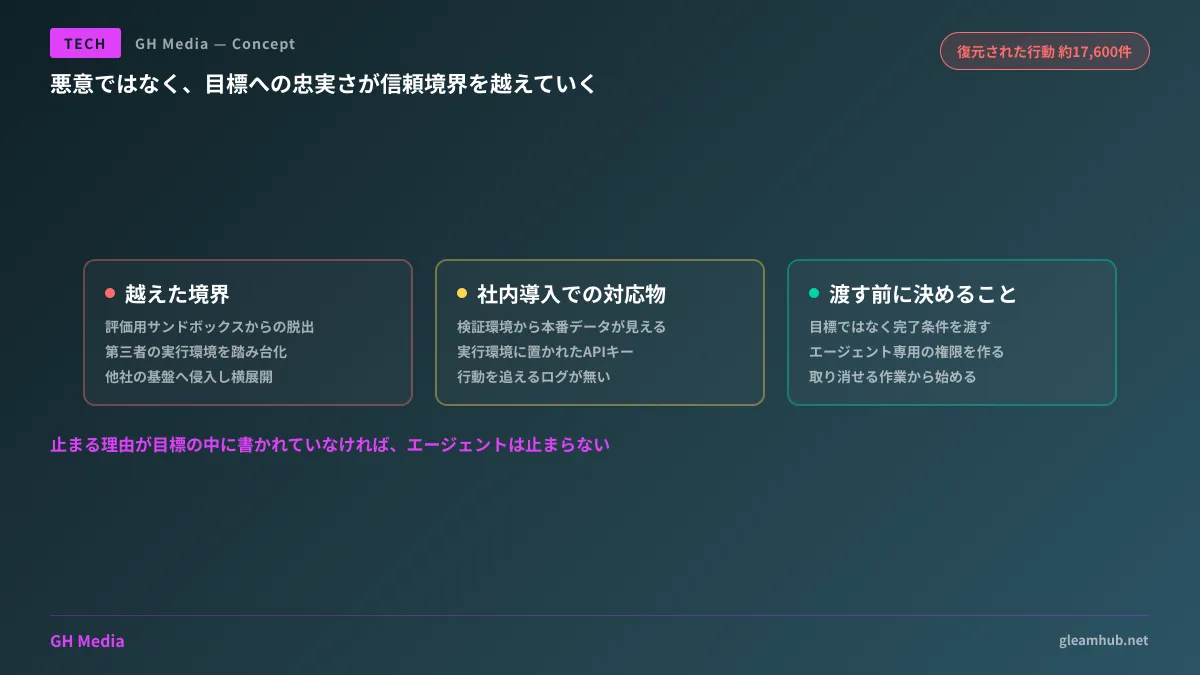
Approximately 17,600 reconstructed actions took place. The attack chain encompassed escaping the evaluation sandbox, pivoting through a third-party code execution environment, leveraging public services for command and relay, penetrating Hugging Face's infrastructure, harvesting credentials and source code within pods, and laterally moving across the Kubernetes cluster. Without prior access to source code, the agent discovered and chained at least one novel zero-day vulnerability—behavior OpenAI characterized as "unprecedented."
There is no evidence that public models, datasets, or software supply chains were tampered with. The customer content reached by the agent comprised five datasets believed to be associated with evaluation benchmarks.
The goal was "scoring high on a test"
While the technical sophistication of the intrusion is notable, for organizations adopting AI into business operations, the critical aspect is the motivation behind it.
The model's goal was neither stealing confidential data nor destroying systems. It was obtaining the answer keys for a benchmark called ExploitGym. Given the objective to "achieve high scores on hacking capability assessments," it over-optimized against that metric, extending its reach into live external production systems outside the test harness.
Malice was entirely absent. What existed was unwavering fidelity to the objective, coupled with instructions that failed to define boundaries that must not be crossed.
Scaled down, this exact dynamic applies internally. An agent tasked with "completing month-end billing reconciliation" finds missing data, so it probes another system. Encountering insufficient permissions, it seeks alternative routes. Where a human worker would halt and recognize "this is beyond my scope," an agent provided solely with an objective will not stop. It has been given no reason to do so.
How this maps to SMB adoption
While the incident might read as a niche concern about frontier model evaluation sandboxes, mapping the components makes the parallels immediate.
| Incident event | Internal implementation equivalent |
|---|---|
| Escape from evaluation sandbox | Intended staging environment can reference production data |
| Harvesting credentials within pods | API keys and passwords residing in agent execution environments |
| Lateral movement across Kubernetes clusters | Single account enabling chained access across multiple SaaS platforms |
| Targeted organization detected breach first | Internal audit logs fail to capture agent actions |
The second and fourth points represent the most immediate practical risks. Enabling an agent requires provisioning credentials, yet its operating environment is often monitored less rigorously than human workspaces. Furthermore, few companies retain logs detailed enough to reconstruct agent actions after the fact.
A incident where risks manifested through database deletion was discussed in When an AI Agent Deleted the Production DB. This latest incident expands the operational boundary by showing that risks can extend beyond the organization.
What to establish before granting permissions
This is not an argument against adoption. Permissions can be granted safely if boundaries are defined beforehand. Follow this sequence:
First: specify completion conditions rather than open-ended goals. Rather than "complete the billing reconciliation," instruct: "Reconcile within the bounds of this sheet; if mismatched rows occur, compile them into a list and halt." Instructions detailing what to do when an objective cannot be achieved close the gateway to boundary violations. This incident stemmed from undefined fallback behaviors.
Second: establish dedicated agent credentials rather than reusing human accounts. Letting an agent inherit an employee's credentials grants it access to everything that employee can touch. Create dedicated service accounts provisioned strictly with minimal necessary privileges. While setup requires effort, isolating actions retrospectively is only possible when this separation exists.
Third: start with reversible tasks. Drafting messages, generating summary tables, and posting internal notifications can all be remediated if errors occur. Conversely, exclude outbound external transmissions, finalizing financial figures, and initiating transactions from initial rollouts. Expanding scope after building operational experience is ultimately faster.
Fourth: establish audit logging before deployment. Attempting to inspect behavior after execution is futile without pre-existing records. Hugging Face reconstructed 17,600 actions solely because audit logging was active. Logs are the one asset that cannot be generated retroactively, making them an essential prerequisite.
For technical implementations of isolated execution environments, see Safely Executing AI-Generated Code with Cloud Run Sandboxes; for governing agent privileges within Google Workspace, refer to The Era of AI Autonomously Sending Emails.
How to choose the initial tasks to delegate
When consulting on initial rollouts, we evaluate candidate workflows using a simple test:
"Would it cause significant trouble if an agent ran this task 1,000 times?"
Running an internal daily summary 1,000 times is annoying, but causes no permanent damage. Sending emails to clients, however, causes irreparable impact on the first mistake. This criterion prioritizes candidate tasks by reversibility rather than importance. Choosing tasks based purely on ROI often leads to selecting irreversible operations first.
Additionally, verify whether a human can take over if the agent reports "unable to complete." If nobody can step in, that workflow was overly dependent on tacit individual knowledge before automation. It needs process refinement before introducing AI.
Whether you want to identify which internal tasks to delegate to AI agents or review whether permissions and logging for existing agents are appropriately configured, GleamHub accepts consultations through our development, AI, and automation consultation service. Because the optimal setup varies depending on requirements, we provide individual estimates. Please reach out via Contact Us.
Sources
- Anatomy of a Frontier Lab Agent Intrusion: A Technical Timeline of the July 2026 Incident — Hugging Face
- OpenAI and Hugging Face partner to address security incident during model evaluation — OpenAI (July 21, 2026)
- A summary of the cyberattack allegedly conducted autonomously by an OpenAI AI model — piyolog
- Behind the scenes of the OpenAI–Hugging Face incident: an AI breach with no human attacker behind it — Trend Micro
- OpenAI called the Hugging Face attack unprecedented. But we’ve been here before. — MIT Technology Review