Maintenance estimates for the upcoming fiscal year arrive, and the figures have gone up. The reason column simply states: "Due to memory price increases." Our business system does not use AI at all, so why is AI showing up on our invoice? Is there room for negotiation, or must we simply accept it? Here is the context needed to make that determination.
In short, this is not vendor price gouging, but a direct reflection of what is happening in procurement markets. However, that does not mean you must unconditionally accept the full increase as presented.
What is happening
Major European hosting provider OVHcloud announced price increases on dedicated servers starting in September. The price hike varies by server generation.
| Target | Price increase |
|---|---|
| 2026 generation gaming range | Up to 87% |
| Current generation servers | Roughly 40–59% |
| 2024 generation servers | Average of 28% |
According to founder Octave Klaba, memory procurement prices as of June had increased sixfold compared to a year earlier, with projections pointing to 9x by September and 12x by early 2027.
The cause is memory manufacturers shifting production capacity toward high-bandwidth memory for AI. Meanwhile, demand for conventional DRAM and NAND has not decreased. When identical demand remains in a market with constrained supply, prices climb. This dynamic explains why business systems at companies not using AI face cost increases as a side effect of AI investment.
In contrast, AWS has barely shifted its pricing. Because they procure years in advance, recent market fluctuations do not immediately show up on invoices (with the exception of a price adjustment on one reserved GPU product). Providers procuring on a monthly basis feel it fastest, while those purchasing in advance in bulk see it delayed.
Where and when it appears on your invoices
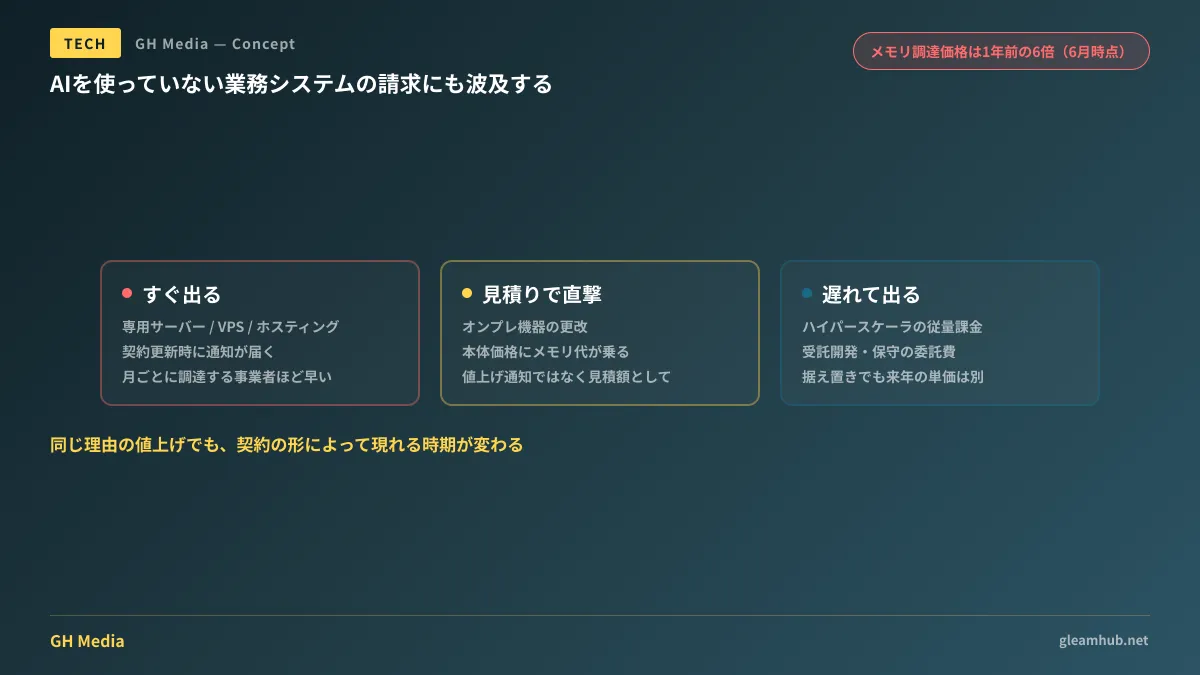
Even for price increases stemming from the same cause, how they manifest depends on contract structure. Misinterpreting this leads to prioritizing the wrong countermeasures.
- Dedicated servers, VPS, and domestic hosting: Hits fastest and most distinctly. Notices arrive at contract renewal.
- Hyperscaler pay-as-you-go billing: Slower to appear immediately, but hits with a lag. Even if current invoices remain unchanged, there is no guarantee next year's unit rates will be the same.
- On-premises hardware refreshes: Hits directly at the estimate stage. Because memory costs are built right into the server hardware price itself, this appears as estimated totals rather than price increase notices.
- Contractor fees for custom development and maintenance: Passed through with a lag when contractors bear any of the above costs. This is where reviewing the breakdown of reasons is worthwhile. How to interpret maintenance fee breakdowns is covered in Deconstructing Maintenance Fees for Business Systems.
Decisions worth taking action on now
When price hikes reach several tens of percent, the economics change for tasks previously dismissed as "not worth the trouble." Specifically, consider the following three actions:
- Audit unused environments. Servers spun up for validation and left running, legacy environments supposed to be decommissioned, and monitoring instances nobody views. As unit prices rise, the cost of neglect increases proportionally. Simply building an inventory usually reveals immediate savings.
- Reviewing configurations based on installed memory capacity. Capacities decided with "plenty of extra headroom" are now the most expensive component. Check actual peak usage to see if there is room to bring it closer to what is strictly necessary. Measures to lower memory usage on the application side are summarized in Reducing backend memory usage.
- Reviewing the renewal timing itself. If hardware renewal was scheduled for next year, it is worth examining whether there is a rationale for moving it up now. However, as discussed below, this is an item that should be judged cautiously.
Continuous reviews of cloud expenses are effective regardless of price increases. Please refer to Auditing cloud costs for how to proceed with visualization and reduction.
Decisions you should not rush
On the other hand, there are also pitfalls that are easy to step into during sudden price changes.
The first is rushing into a migration just to avoid price hikes. Migrations incur person-hours for design, verification, and cutover, and it is not uncommon for those costs to exceed the price increase. Because the destination is procuring from the same memory market, even if it looks cheap now, the same notification could arrive six months later.
The second is jumping into long-term contracts before prices rise completely. A three-year contract can lock in unit prices, but what you are locking in might be "today's high level." No one knows where the market peak will be. If you make a decision, base it on whether "it is certain you will continue using that configuration for three years" rather than on price outlooks.
The third is skipping the verification of breakdowns before passing price increases directly to users. Price hike notifications from contractors sometimes mix increases caused by market conditions with unrelated increases. Asking what went up and by how much is a legitimate check.
What to do next
First, make a list of currently running servers and their contract renewal months. The order of approaching renewal months will be the order in which price increase notifications arrive. Without this list, you will end up reacting individually every time a notification comes in.
On top of that, mark any among them that "no one would mind if you stopped." Now that unit prices have risen, deciding to decommission that single server is more effective than ever before.
GleamHub accepts inquiries regarding reviewing system configurations, auditing cloud expenses, and organizing decision-making criteria for server renewals through our development, AI, and automation consultations. Available measures vary depending on your current configuration and contract type, so please consult us individually via Contact.
Sources
- OVHcloud Raises Prices as AI Memory Demand Reprices Non-AI Infrastructure — InfoQ
- OVHcloud to raise dedicated server prices by up to 87 percent from September — Data Center Dynamics
- OVHcloud increases prices by up to 87 percent due to more expensive RAM and storage — ITdaily
- Pricing evolution of Public Cloud, Bare Metal and VPS at OVHcloud — OVHcloud Blog