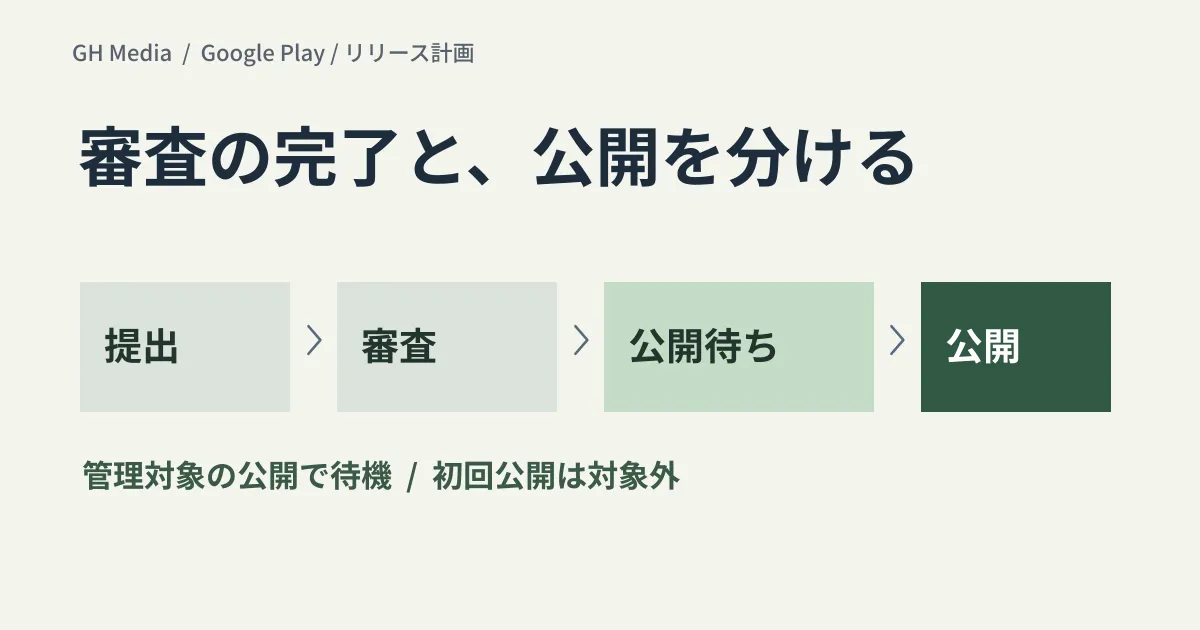
The day an app build is completed is not the day it can be published on Google Play. If coordinating with a marketing campaign, plan development, review, and release execution as separate phases.
Official Play Console help notes that review processing can take anywhere from several hours to 7 days, and exceptionally longer, recommending a buffer of at least one week from submission to launch. This does not guarantee completion within 7 days, nor does exceeding 5 business days necessarily mean an issue exists.
For app updates, review and release timing can be decoupled
When Managed Publishing is turned on, approved changes can be held until you are ready to release them. This mechanism allows teams to inspect approved updates and trigger publishing manually.
However, it cannot be used when publishing an app for the first time. Additionally, certain modifications, such as price changes, are exempt from being held. Consult the official help documentation beforehand to confirm whether your planned changes qualify.
| Stage | Items for coordinators to check |
|---|---|
| Pre-submission | Prepare app binaries, store listing details, required declarations, and review credentials |
| In review | Evaluate the necessity of additional modifications and their impact on planned launch dates |
| Post-approval | Confirm which changes are held in staging and which apply immediately |
| At release | Designate deploy operators, emergency contacts, and post-release validation checks |
Submitting additional changes while a review is underway may reset your queue priority. Before layering changes to chase a scheduled date, check current submission contents and queue status.
Checking testing requirements beforehand for initial releases
Under requirements for new personal developer accounts, accounts created after November 13, 2023, must run a closed test with at least 12 testers continuously opted in for 14 days before applying for production access.
This does not imply that identical testing rules apply to all account tiers. Conversely, organization accounts are not exempt from identity verification or reviews. Confirm necessary stages according to your account type and Play Console dashboard.
Sample schedule for immovable launch dates
Below is a proposed template of schedule items for projects, rather than measured calendar timelines from our own operations.
- Latest submission date: Deciding how much margin to factor in for rejection handling and resubmissions on top of official guidelines.
- Decision cutoff date: The date to alter public marketing announcements if the app is unapproved. Never promise release dates before approval.
- Release lead: Designated operator to publish upon approval, along with an alternate if unavailable.
- Post-release verification: Validating store listings, user login, primary features, and support contact channels.
- Incident response policy: Procedures to halt rollout and support plans for users who have already installed the build.
Halting a staged rollout is fundamentally different from rolling back user devices to an older version. Furthermore, remotely enabling features unreviewed by app reviewers should never be employed as an evasion tactic.
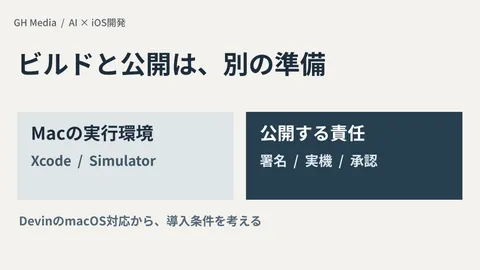
Development environments, code signing, and publishing permissions for iOS are outlined in Considerations Before Entrusting iOS Development to AI.
This is an exploratory article based on official help documentation reviewed on September 20, 2026. Live app submissions and empirical measurements of review timelines were not performed.
For app release planning that incorporates store reviews, please contact GleamHub.