For developers who want to handle internal document search or RAG (retrieval-augmented generation) prototypes with SQLite embedded in their app instead of running a separate vector database, the arrival of the vector search extension "vec1" in the main SQLite repository is a topic of interest.
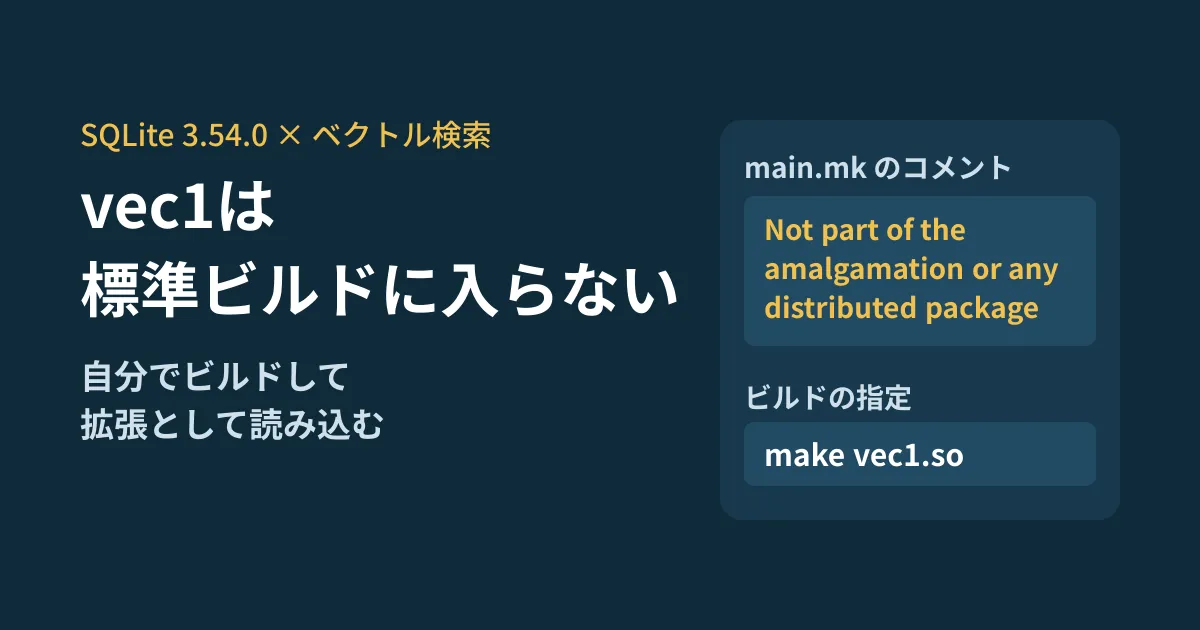
The version-3.54.0 tag dated October 9, 2026 includes the vec1 source and tests in ext/vec1/. However, a comment in the build configuration says it is "not included in the amalgamation (the single-file distribution source) or in any distribution package." Upgrading SQLite to 3.54.0 does not by itself make it available. In this article, we report its status as confirmed in the source and official documentation, and the results of building and running it in the editorial team's test environment.
vec1 is not bundled with SQLite; you build the extension yourself
The 3.54.0 build configuration (main.mk) contains the following comment about vec1.
vec1 loadable extension. Not part of the amalgamation or any distributed package; built only by explicitly running “make vec1.so”.
At the top of vec1.c, there is an example of building it as a loadable extension with gcc on x86_64 (gcc -O3 -DNDEBUG -mavx2 -mfma vec1.c -shared -fPIC -o vec1.so) and a pointer to the documentation page (sqlite.org/vec1). The version in the source is 0.8. It explains that building via main.mk can also make it detect at runtime whether the CPU supports AVX2.
In other words, you cannot use vec1 as-is with the sqlite3 command or the SQLite bundled with each language. You need to build the extension and load it on a connection that allows extension loading. vec1 is also not mentioned in the SQLite 3.54.0 release notes dated October 9, 2026.
The vec1 documentation page (sqlite.org/vec1) describes vec1 as an extension that performs approximate nearest neighbor search using SQLite's virtual table mechanism and supports Euclidean distance (L2) and cosine distance. The "current release" on the page is 0.7, a different version from the source in the 3.54.0 tag (0.8). The future plans section says "testing is insufficient," and it is at a pre-1.0 stage.
We built and ran it in the editorial team's test environment
On October 14, 2026, we tested it in the following environment.
| Item | Details |
|---|---|
| OS・CPU | Linux x86_64, Intel Xeon 2.10GHz (4 cores) |
| vec1 | Built ext/vec1/vec1.c from the version-3.54.0 tag with gcc -O3 -DNDEBUG -mavx2 -mfma |
| SQLite | 3.54.0 (bundled with the Python library apsw 3.54.0.0) |
We loaded it from apsw, which includes SQLite 3.54.0, rather than Python's SQLite (3.45.1 in this environment). We did not test whether it works with older SQLite. After loading, SELECT vec1_info() returned version 0.8 (AVX2, multi-threaded).
The SQL we used follows the style of the test file (ext/vec1/test/).
-- ベクトル列と、任意の付随データ列(ここでは文書名)を持つ仮想表
CREATE VIRTUAL TABLE docs USING vec1(vector, title);

INSERT INTO docs(rowid, vector, title)
  VALUES (1, vec1_from_json('[1,0,0,0]'), '請求書の発行手順');

-- 全件を比べる索引(flat)で作り直す
INSERT INTO docs(cmd, vector) VALUES ('rebuild', '{index:"flat"}');

-- 問い合わせのベクトルに近い3件
SELECT rowid, title, distance
  FROM docs(vec1_from_json('[1,0.05,0,0]'), '{K:3}');
We inserted five 4-dimensional vectors as a test and confirmed the following.
CREATE VIRTUAL TABLEcreated six auxiliary objects (tables and indexes onsqlite_master):docs_base,docs_config,docs_idx,docs_idx_idx,docs_metaanddocs_model- Search returned results even before
rebuild, and they were the same as afterrebuild(flat) distancewas the squared Euclidean distance (the function reference also describesvec1_l2_distanceas "the square of the Euclidean distance"). For vectors differing by 0.05 it returned0.0025, andvec1_l2_distancecomparing orthogonal unit vectors returned2.0.vec1_cos_distancewas1.0PRAGMA integrity_checkwasok
If you use the distance directly as a threshold, you need to set it on the assumption that it is a squared value.
Approximate search trained with only codesize 16 had a low match rate
To speed things up as the number of rows grows, vec1 also offers an approximate nearest neighbor (ANN) index trained on the data. You create the training result with vec1_train and then rebuild using that result.
-- 学習(codesize は圧縮後の大きさの指定)
SELECT vec1_train(vector, '{codesize:16}') FROM big;
-- 得られた学習結果で索引を作り直す(? に上の結果を渡す)
INSERT INTO big(cmd, vector) VALUES ('rebuild', ?);
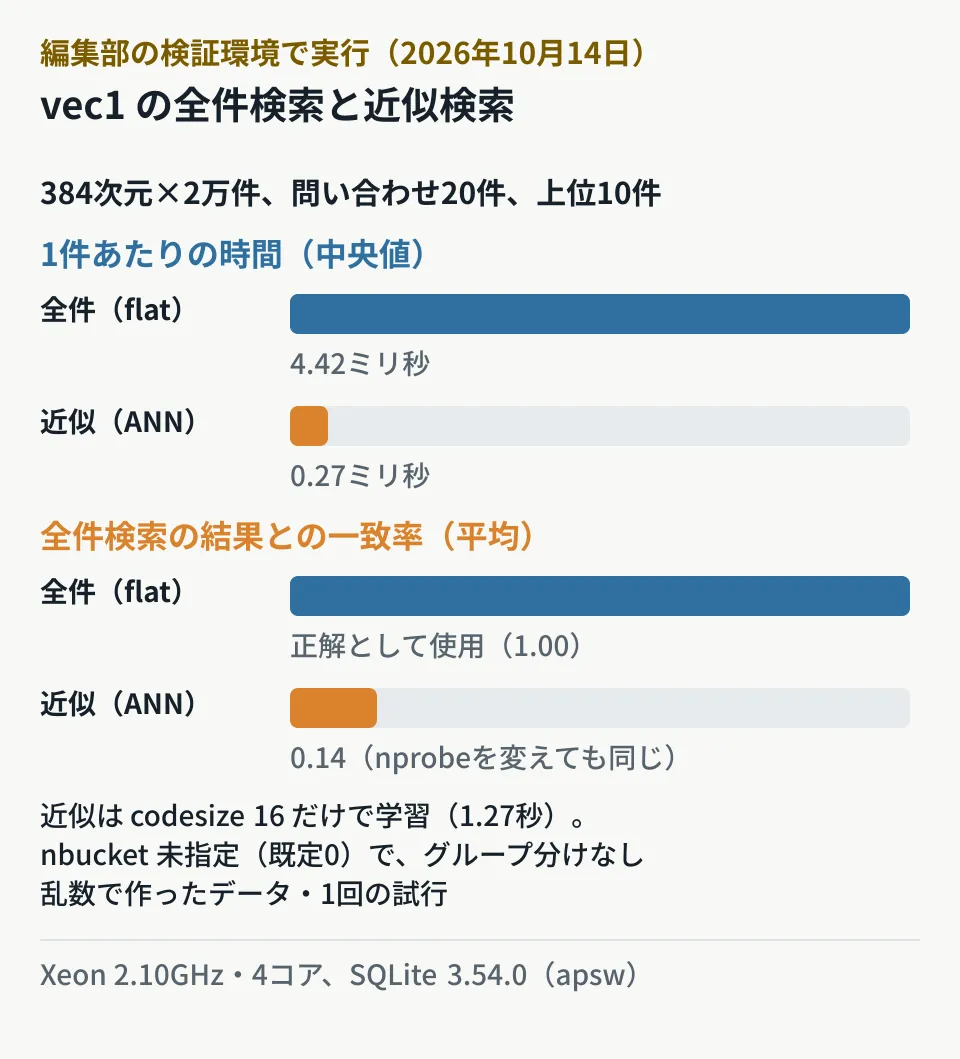
We generated 20,000 random 384-dimensional vectors scattered around 200 centers and compared the top 10 results for 20 queries. Treating the exhaustive search (flat) results as ground truth, we measured how many of the same items the approximate search returned (match rate).
| Search method | Per query (median) | Top-10 match rate (average) |
|---|---|---|
| Exhaustive search (flat) | 4.42 ms | Used as ground truth |
| Approximate search (codesize 16 only, nprobe default 0.05) | 0.27 ms | 0.14 |
| Same (nprobe 0.2 specified) | 0.16 ms | 0.14 |
| Same (nprobe 1.0 specified) | 0.15 ms | 0.14 |
Training took 1.27 seconds and rebuilding the index took 0.40 seconds. Approximate search was more than an order of magnitude faster than exhaustive search, but on average only 1.4 of the top 10 results matched the ground truth. Raising nprobe, which widens the search scope, did not change the match rate.
When we later compared this with the official documentation (checked on October 16, 2026), our settings had deviated from the recommendations.
- We were not using bucket partitioning. The reference says that
nbucketofvec1_train(how many groups to split the data into for searching) defaults to 0, and when it is 0, no partitioning is done and all compressed vectors are scanned. Since we did not specifynbucket, we were not using the mechanism through whichnprobe(the fraction of groups to search) takes effect at all. This is likely why the match rate did not change withnprobe - The compression may have been too aggressive. According to the documentation, the guideline for
codesizein thepqcompression method is 1/8 or 1/16 of the number of dimensions (48 or 24 for 384 dimensions). Our value of 16 was smaller than that. The documentation also recommends theopqmethod for recent embeddings
We did not re-measure with different settings, so we have not confirmed how much the match rate improves with the recommended settings. This is a single result on randomly generated data, and the same may not hold for embeddings of real documents.
What to check first if you are considering adoption
From here on are the editorial team's suggestions.
- Whether you can distribute the extension. Check whether you can build and deploy the extension in your production runtime and allow it to be loaded. It cannot be used with managed databases or in environments that do not allow loading extensions
- Whether your data size is small enough for exhaustive search. Under our conditions, exhaustive search on 20,000 vectors with 384 dimensions took 4 to 5 ms per query. For internal document search, first measure whether flat meets your requirements, and consider approximate search only when it becomes necessary
- Measure the match rate of approximate search on your own data. Specify
nbucketexplicitly, startcodesizefrom the guideline on the documentation page, and compare by varyingcodesize,nbucketandnprobewith exhaustive search results as ground truth. Do not choose settings based on speed alone - Store the original text and embeddings separately. vec1 is at a pre-1.0 stage, and the auxiliary table format also has a version number. Make sure you can recover if an extension update requires rebuilding
If you can use PostgreSQL, Running pgvector in production is also an option. For overall search design, see RAG optimization patterns, and for setting assumptions when using SQLite in business systems, see The SQLite bug that went unnoticed for 16 years.
Scope of verification
On October 14, 2026, we retrieved the
version-3.54.0tag (the "Version 3.54.0" commit from October 9, 2026) from the SQLite mirror on GitHub (sqlite/sqlite) and read parts ofmain.mk,ext/vec1/vec1.c,ext/vec1/Makefileandext/vec1/test/. We then builtvec1.cin the environment above, loaded it from apsw 3.54.0.0 (SQLite 3.54.0) and ran it (hands-on testing). On October 16, we reviewed the SQLite 3.54.0 release notes and the vec1 documentation, usage guide, function reference and test results pages (sqlite.org/vec1) (document research). The data was randomly generated, and we did not test embeddings of real documents, behavior on Windows, macOS, ARM or older SQLite, approximate search withnbucketspecified, or comparisons varyingcodesize.
If you are considering how to integrate internal document search or RAG into existing systems, contact us through Consultation on development, AI, and automation.