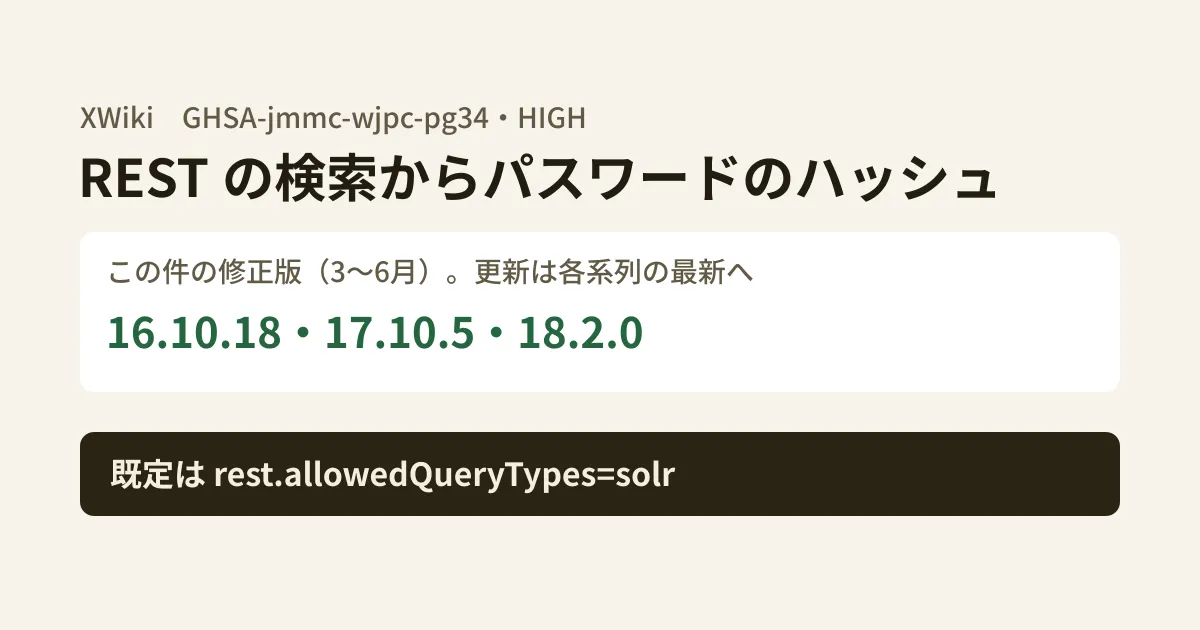
Some companies run XWiki, an open-source wiki, on their own servers as a place to keep internal procedures and meeting minutes. Because viewing permissions can be set per page, some may also keep HR and accounting documents in the same wiki and limit who can see them. A vulnerability has been disclosed that lets content outside those permissions be extracted bit by bit through the search feature.
On November 2, 2026, the XWiki developers disclosed a REST API search vulnerability (GHSA-jmmc-wjpc-pg34, CVE-2026-61689, HIGH, 8.8 on CVSS 4.0) in their GitHub repository. It was added to GitHub's advisory database on November 19. The fixed versions for this issue are 16.10.18, 17.10.5 and 18.2.0, all released between March and June. However, three more advisories were disclosed on November 16, including one that lets guests execute code (CRITICAL), so upgrading only to 17.10.5 or 18.2.0 is not enough. Based on the advisory and the fix commits, this article sorts out what can be extracted, what the fix changed, and what to check on a running wiki.
What can be extracted through the search API
XWiki's REST API has a search (/rest/wikis/{wikiName}/query) that filters pages and returns a list, and as the query type you could specify not only solr (full-text search) but also hql and xwql (database query languages).
According to the advisory, this search does check the user's viewing permissions, but by combining query conditions, an attacker could join another table in the FROM clause and bypass the column restrictions allowed by the HQL validation. The technique checks values one bit at a time, using the fact that the results change depending on whether a condition is true or false. The advisory says the following can be extracted as a result.
- Data from pages the user has no permission to view
- Users' password hashes (XWiki uses salted SHA1, and weak passwords can be cracked offline)
- Passwords stored in configuration properties
The advisory says that a typical password hash takes about 800 REST API requests, and adds that with a more elaborate technique, the attack should be considered feasible even for an attacker who cannot read any page. Its title is 'Unauthenticated database extraction'. It also notes that heavy queries slow down the server's responses.
Affected versions and what the fix changed
The advisory covers (org.xwiki.platform:xwiki-platform-rest-server) the following three ranges.
- From 4.3-milestone-1 up to (but not including) 16.10.18
- From 17.0.0-rc-1 up to (but not including) 17.10.5
- From 18.0.0-rc-1 up to (but not including) 18.2.0
Judging by the tags in xwiki/xwiki-platform, 18.2.0 was created on March 30, 17.10.5 on April 1, and 16.10.18 on June 29. As of November 24, the latest releases in each series are 18.9.0 (October 26), 18.4.8 (November 3), 17.10.15 (November 10) and 16.10.19 (October 2). A release candidate for 18.10.0 (rc-1) was also published on November 23.
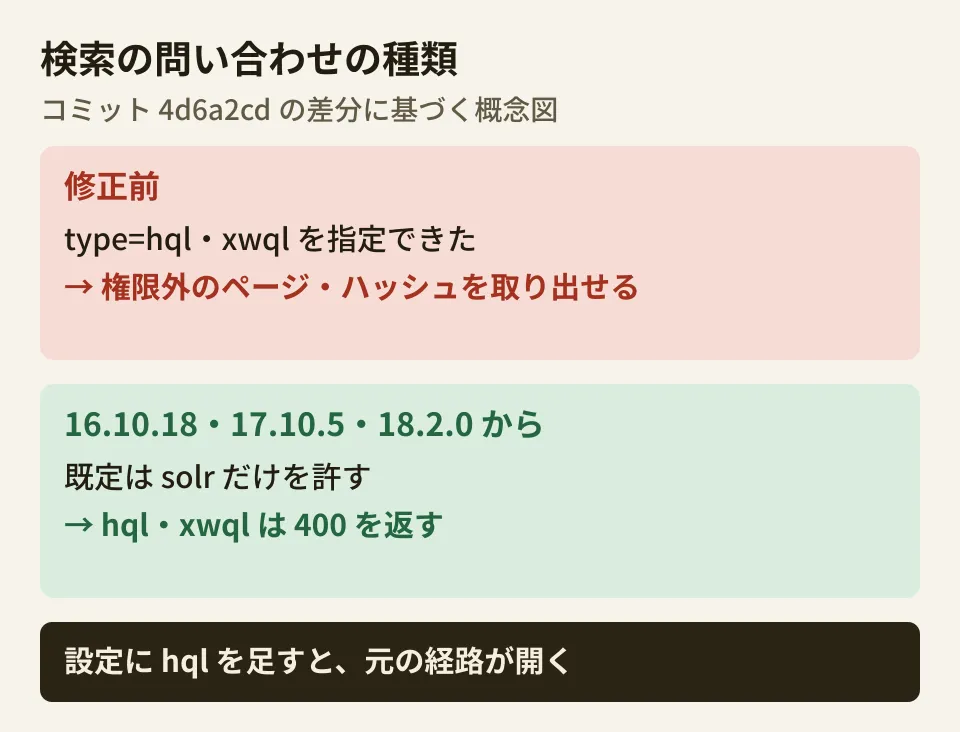
The fix blocks HQL and XWQL queries in the REST API by default. The commit (XWIKI-24061 'Allow configuring the allowed query types'; 18.2.0 includes 4d6a2cd, 17.10.5 includes b63d383, and 16.10.18 includes 62b034d) added the following entry to the configuration file xwiki.properties.
# rest.allowedQueryTypes=solrThe default is solr only, and search requests that specify hql or xwql return a 400 error ('Query type [hql] is not allowed'). The setting's description says that allowing hql or xwql 'may reveal confidential information even to guest users'.
Three more issues disclosed on November 16
On November 16, the XWiki developers disclosed three advisories in the same repository that guests (users who are not logged in) can exploit. As of November 24, none of the three had been added to GitHub's advisory database.
| Advisory | Severity | Details (summary of the advisory) | Fixed versions |
|---|---|---|---|
| GHSA-x462-9fp3-ghjp(CVE-2026-53967) | CRITICAL | A crafted page name lets wiki content be executed with the rights of the author of the XWiki.UserDirectoryMacros page (titled 'Guest RCE') | 16.10.18・17.10.10・18.4.1・18.5.0-rc-1 |
| GHSA-2gv8-69wg-hv5r(CVE-2026-49479) | HIGH | Through temporary file paths (such as /tmp/), files on the server that the XWiki process can read can be read | 16.10.18・17.10.10・18.4.1・18.5.0-rc-1 |
| GHSA-8vj7-5597-c484(CVE-2026-49480) | HIGH | Solr search can leak the contents of objects on view-restricted pages to guests. Requires a setup with permissions set on spaces | 16.10.18・17.10.9・18.4.4・18.5.0-rc-1 |
In the 16.10 series, all four issues are fixed in 16.10.18. The 17.10 series needs 17.10.10 or later, the 18.4 series needs 18.4.4 or later, and newer series need 18.5.0 or later; staying on the fixed versions for the HQL issue (17.10.5 and 18.2.0) leaves these three issues in place.
What to check on a running wiki (editorial suggestion)
- Check the version. Check the version you are running and upgrade to the latest release in your series (16.10.19, 17.10.15, 18.4.8 or 18.9.0 as of November 24). Even if you are outside the range of the HQL issue, the three issues above may apply.
- Block the search path until you can upgrade. The advisory's workaround is to block requests to
/rest/wikis/{wikiName}/queryat the web server or reverse proxy. If you use the REST API for other integrations, block only this path. However, this is a workaround for the HQL issue only. Of the three November 16 issues, the temporary file and Solr issues are described as having 'no workaround other than upgrading', and for the code execution issue, the advisory describes applying a fix to theXWiki.UserDirectoryMacrospage. - Review the settings after upgrading. Check that
hqlorxwqlhas not been added torest.allowedQueryTypesinxwiki.properties. If you used HQL searches for integrations, they will stop working after the upgrade. Reverting the setting to fix that also reopens this attack path. Decide first whether to switch the integration to Solr search or to restrict the REST API to the internal network or behind an authenticated proxy. Because Solr search is also affected by GHSA-8vj7-5597-c484 above, switch to Solr only after upgrading to a version that includes that fix. - If the wiki was reachable from the internet, review passwords. Search the access logs for large numbers of requests to
/querywithtype=hqlortype=xwql. If you find traces, or if no logs remain, consider changing users' passwords and regenerating the passwords stored in configuration properties (such as credentials for external services or outgoing mail).
We also covered self-hosted internal tools that stop being updated while remaining reachable from the internet in our article on the Etherpad vulnerability and our article on headless CMSs. Internal wikis hold a lot of information, so include them in the systems whose versions and exposure you check regularly.
Scope of verification
On November 22 and 24, 2026, we checked the JSON for GHSA-jmmc-wjpc-pg34 in github/advisory-database (listed on November 19, 2026), the repository advisories in xwiki/xwiki-platform (GHSA-jmmc-wjpc-pg34 published on November 2, the other three on November 16), the diffs of commits 4d6a2cd (March 24, 2026), b63d383 (March 24) and 62b034d (June 10), and the tag dates for 16.10.18, 17.10.5, 18.2.0 and the latest release in each series (desk research). The official XWiki website could not be opened from our working environment, and XWIKI-24061 in the issue tracker (jira.xwiki.org) required a login and could not be read. We did not reproduce the issue locally or perform any upgrade.
GleamHub's development, AI and automation consulting covers setting up update processes for internal information-sharing tools and reviewing system maintenance. Please reach out via our contact form.
References
- GHSA-jmmc-wjpc-pg34: XWiki Platform: HQL injection in search allows unauthenticated database extraction including password hashes(github/advisory-database)
- xwiki/xwiki-platform — GHSA-jmmc-wjpc-pg34 (repository advisory)
- xwiki/xwiki-platform — GHSA-x462-9fp3-ghjp: Guest RCE via UserDirectoryMacros
- xwiki/xwiki-platform — GHSA-2gv8-69wg-hv5r: Guest Path Traversal in temp-resource handler
- xwiki/xwiki-platform — GHSA-8vj7-5597-c484: Solr leaks XObject content of view-restricted pages to guests
- xwiki/xwiki-platform — commit 4d6a2cd(XWIKI-24061: Allow configuring the allowed query types)
- xwiki/xwiki-platform — commit b63d383(XWIKI-24061、17.10.5)
- xwiki/xwiki-platform — commit 62b034d(XWIKI-24061、16.10.18)
- xwiki/xwiki-platform — tags