Some companies run Etherpad on their own servers or in cloud containers so several people can write meeting minutes or event notes at the same time. It is open source and easy to set up, but keeping it updated after setup is left to whoever runs it. A serious weakness has been disclosed that affects environments where those updates have stopped.
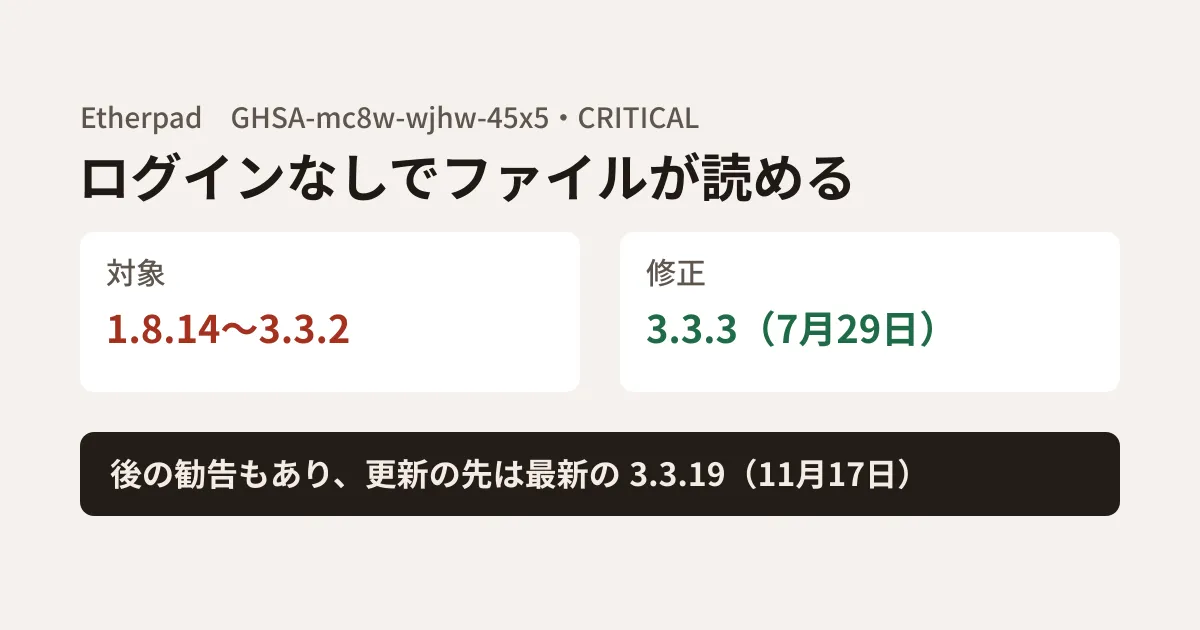
The Etherpad project published an advisory (GHSA-mc8w-wjhw-45x5, CVE-2026-114516, CRITICAL, CVSS 9.8) in its GitHub repository on October 27, 2026, covering a flaw that lets anyone read arbitrary files on the server without logging in. On November 20, it was also added to GitHub's global database. The fixed version, 3.3.3, was released on July 29, about three months before the disclosure. This article uses the fix commit and the changelog to lay out the cause and the steps to check.
Consequence
Etherpad serves plugin images and scripts on paths under /static/. According to the advisory, this path is registered before the authentication handling, so it can be called without logging in or changing any settings.
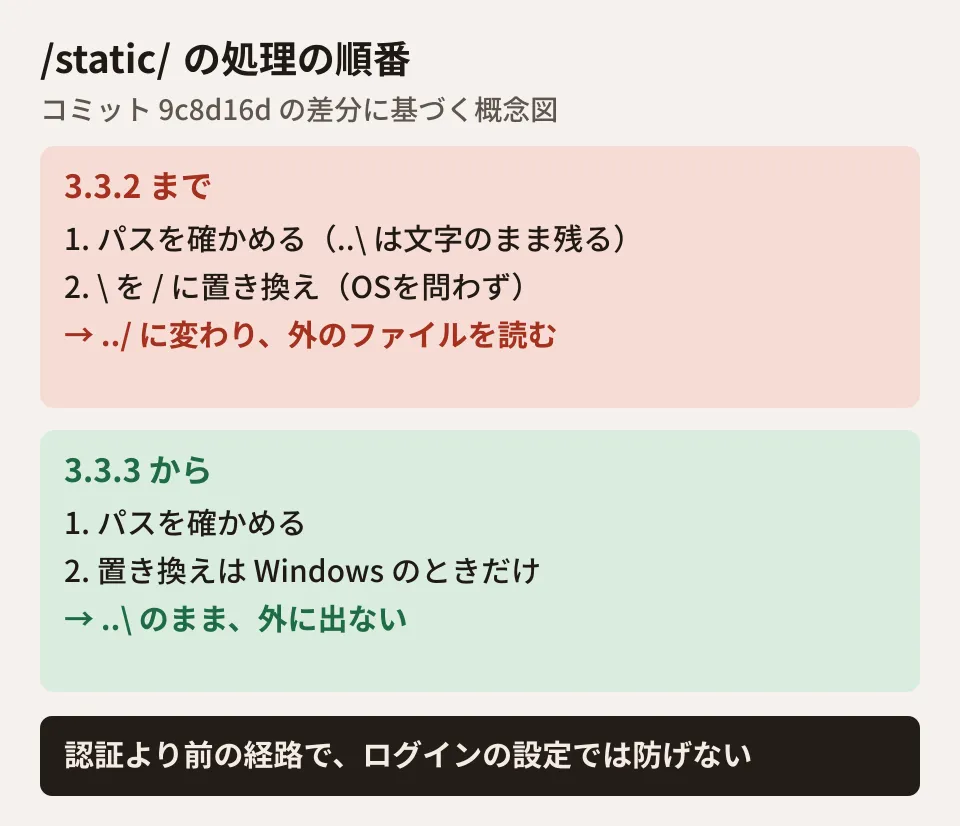
The cause is the order of the processing that checks whether a path is safe and the conversion that follows it.
- First,
sanitizePathname()removes references that leave the directory via... On Linux and similar systems, backslashes are not treated as separators the way they are on Windows, so..\..\remains as ordinary characters (which is harmless by itself) - After that,
Minify.tsreplaced backslashes with slashes regardless of the OS - As a result, after the check has passed,
..\..\turns into../../and points to a file outside the directory
The advisory shows an example in which a request that stacks ..%5C (a URL-encoded backslash) after /static/plugins/ep_etherpad-lite/static/ returns /etc/passwd. The fix (commit 9c8d16d) limits this replacement to Windows only. Before the fix, the code carried a comment that said the opposite of what actually happened: "this conversion does not create a vulnerability because sanitizePathname has already removed it."
How a file read can escalate
Being able to read files is serious in itself, but the advisory also describes where it can lead. According to the advisory, in a typical configuration, settings.json, credentials.json, and /proc/self/environ (the process's environment variables) contain the administrator password. Reading it lets an attacker log in as an administrator and run code on the server through the plugin installation feature in the admin panel.
In other words, if you were running an old version somewhere reachable from the internet, you need to check on the assumption not only that "files may have been read" but also that "administrator privileges or the server may have been taken over."
Affected versions and issues fixed in the same release
The advisory covers versions 1.8.14 and later but earlier than 3.3.3. According to the tags in ether/etherpad, 3.3.2 is dated June 21 and 3.3.3 July 29, and as of November 20 the latest is 3.3.19 from November 17.
The 3.3.3 changelog describes this version as a "security release" and says that, in addition to this issue, it bundles the following four fixes.
- The built-in OpenID Connect provider used a fixed cookie signing key, and its CORS configuration allowed any
Origin(GHSA-pp5v-mvwg-76mp) - Session IDs were not regenerated on authentication (session fixation, GHSA-73h9-c5xp-gfg4)
- Switching pads on the same connection allowed writing to a different pad (GHSA-6mcx-x5h6-rpw2)
- Putting the separator character
:in the destination ID ofcopyPadormovePadcould corrupt another pad's history (GHSA-wg58-mhwv-35pq)
That said, stopping at 3.3.3 is not enough. Even after 3.3.3, the Etherpad repository published a series of advisories from September through November that were fixed in 3.3.4 through 3.3.17. For example, GHSA-c36r-65p6-q3m9 (HIGH, November 7) concerns the fix for GHSA-6mcx-x5h6-rpw2 above being incomplete, and was fixed in 3.3.16. There are also stored XSS issues (3.3.4 and 3.3.7) and OpenID Connect authentication issues (3.3.6 and 3.3.8). Update to the latest release in the 3.3 series.
What to check if you self-host (editorial suggestions)
- Check which version is running. If it is 3.3.2 or earlier, upgrade to the latest release in the 3.3 series. Even on 3.3.3 or later, upgrade if you are not on the latest, because of the later advisories described above. If you use containers, also check that the image tag has not been left as
latestand that any pinned tag is not outdated. - Check how widely it is exposed. Check whether it is reachable from the internet or only from the internal network, and whether there is an authenticating proxy in front of it. Because this path can be called before authentication, Etherpad's login settings cannot prevent it.
- Review the access logs. If you were running 3.3.2 or earlier somewhere reachable from the internet, search your web server and proxy logs for requests that contain
/static/plugins/along with repeated%5Cor... - Regenerate secrets. If you find suspicious requests, or if no logs remain, regenerate the administrator password, the database connection details in
settings.jsonandcredentials.json, and any keys stored in environment variables. Also check whether any plugins installed through the admin panel are unfamiliar.
We covered admin entry points left open to the internet in our article on headless CMSs, and how to proceed when a security fix is released in our article on the emergency PHP fixes. For self-hosted collaborative editing tools too, it is essential to decide who is responsible for updates and how often they happen.
Scope of verification
On November 20, 2026, we checked the JSON for GHSA-mc8w-wjhw-45x5 in github/advisory-database (added November 20, 2026), the list of advisories in the ether/etherpad repository (retrieved with the GitHub API), the diff of commit 9c8d16d (July 29, 2026) and the 3.3.3 changelog added in it, and the dates of the v3.3.2 through v3.3.19 tags (document research). We did not check the official Etherpad website. We did not reproduce the issue locally or perform any updates.
GleamHub's development, AI, and automation consulting can help with setting up update processes for self-hosted web tools and reviewing system maintenance. Please reach out via our contact form.
References
- GHSA-mc8w-wjhw-45x5: Etherpad: Pre-auth arbitrary file read(github/advisory-database)
- ether/etherpad — commit 9c8d16d(fix: pre-auth path traversal in /static/* handler)
- ether/etherpad — CHANGELOG.md
- ether/etherpad — Security Advisory GHSA-mc8w-wjhw-45x5(2026-10-27)
- ether/etherpad — Security Advisory GHSA-c36r-65p6-q3m9 (2026-11-07, incomplete fix for GHSA-6mcx-x5h6-rpw2)