
Slow website loading speeds, struggling to keep up with security measures, complex and time-consuming development processes... If you are facing such challenges in web development, you cannot afford to ignore the new web architecture known as Jamstack.
Jamstack breaks away from traditional server-side dynamic processing by serving pre-generated static files, achieving ultra-fast site speeds, enhanced security, and a dramatic improvement in development efficiency. For developers pursuing cutting-edge web technologies and companies seeking to accelerate business growth, it is truly becoming the "next standard." In this article, we thoroughly and clearly explain Jamstack—from the fundamentals shaping the future of the web to specific technologies and practical applications for your business.
What is Jamstack? Understanding the basics
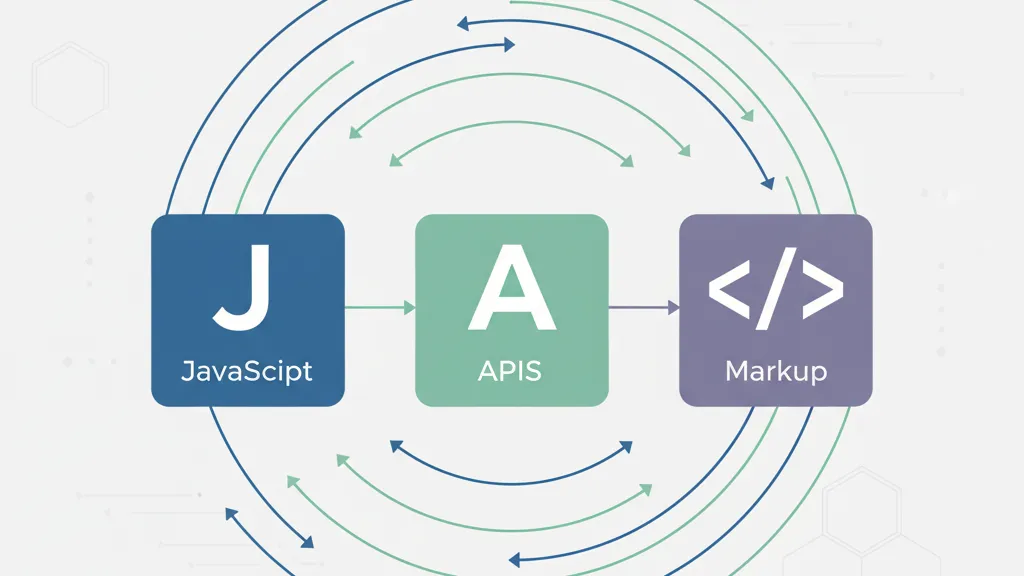
Jamstack is a modern architecture for building websites, named after the initials of "JavaScript," "APIs," and "Markup." Rather than referring to a specific technology, consider it a design philosophy for modern web development. While traditional websites rely on a "dynamic" architecture that handles dynamic processing on the server side before returning pages to the browser, Jamstack is grounded in a "static" architecture.
With conventional websites—such as those running WordPress—every time a user requests a page, the server fetches data from a database and runs programs to generate HTML. When this workload grows heavy, page rendering inevitably slows down, and the risk of server crashes under heavy traffic spikes increases.
In contrast, Jamstack pre-generates (builds) all pages as HTML files prior to publishing the site. When a user sends a request, these static HTML files are served directly from globally distributed servers known as a CDN (Content Delivery Network). Consequently, processing delays are virtually eliminated, enabling pages to load at astonishing speeds.
Jamstack consists of the following three pillars:
1. JavaScript (J)
All dynamic interactions triggered by user actions are handled entirely by client-side JavaScript in the browser. This significantly reduces server load.
2. APIs (A)
Whenever dynamic data is required—such as database reads and writes, authentication, or comment systems—it leverages external services via APIs (Application Programming Interfaces). This eliminates the need to maintain your own servers. Examples of such external services include headless CMSs and authentication services.
3. Markup (M)
The HTML forming the fundamental structure of a website is pre-generated (built) using tools known as static site generators (SSGs). These "static HTML files" are the key to lightning-fast rendering.
Jamstack adheres to the simple philosophy of "eliminating server-side dynamic processing as much as possible and serving pre-rendered static files via a CDN,"
which dramatically elevates website performance, security, and scalability.
Jamstack combines JavaScript, APIs, and Markup to deliver high-speed, secure websites.
Pros and cons of Jamstack
Jamstack is becoming the next-generation web standard because it offers numerous advantages that were difficult to achieve with conventional architectures. Here, we outline its key benefits alongside the drawbacks you should understand before adoption.
Pros: Ultra-fast speeds and robust security
The greatest appeal of Jamstack is, without question, its "speed." Rather than generating pages on the server for each request, pre-built static files are delivered via a CDN (Content Delivery Network), dramatically improving load times. This directly elevates user experience and boosts SEO (search engine optimization) rankings. Because Google treats site speed as an essential metric, this provides a massive business advantage.
Next is "high security." On traditional dynamic websites, databases and server-side programs are frequent targets for attacks. Jamstack, however, simply serves static HTML files, removing these primary attack vectors. Because dynamic processing is delegated to specialized external services (APIs), the risk of vulnerabilities in self-hosted servers being exploited drops substantially.
Furthermore, "development efficiency and scalability" are also major benefits.
- Development efficiency: With fewer concerns regarding server management and complex backend processing, teams can focus on frontend development, accelerating development speed.
- Scalability: CDNs distribute loads even during heavy traffic surges, making the architecture exceptionally resilient to sudden traffic spikes.
Cons: Dynamic feature limitations and build times
On the other hand, there are caveats you should know regarding Jamstack.
The most notable drawback is that "building fully dynamic sites is challenging." Features requiring advanced real-time dynamic processing—such as e-commerce shopping carts that dynamically personalize content per user, or members-only portals—rely heavily on API integrations and client-side (browser) processing, which can increase implementation complexity.
There is also the issue of "build times." Because the entire site is generated as static files, rebuilding the entire site upon each content update can take considerable time if the site has a very large page count or high update frequency. Minimizing this build time represents a key challenge in Jamstack development. However, modern static site generators increasingly support incremental builds that rebuild only updated sections, technically overcoming this hurdle.
| Pros | Cons |
|---|---|
| Ultra-fast page loads (improved UX and SEO) | Implementing advanced dynamic features can become complex |
| Robust security (reduced attack surface) | Build times can increase with page count and update frequency |
| High scalability (resilient to heavy traffic) | |
| High development efficiency (focus on frontend) |
Key technologies comprising Jamstack
To implement Jamstack architecture, several essential tools and services are combined. Together, they form a modern technology stack distinct from traditional web development.
1. Static site generators (SSGs)
An SSG is the central technology of Jamstack. It is a tool that takes content data (such as Markdown files or data from a headless CMS) and design templates to pre-generate the entire website as a collection of static HTML files.
Prominent SSGs include the following:
- Next.js / Nuxt: Built upon modern JavaScript frameworks like React and Vue.js, they offer flexible capabilities including both static generation and server-side rendering (SSR).
- Gatsby: React-based, characterized particularly by its use of GraphQL for data fetching.
- Hugo / Jekyll: Written in Go and Ruby respectively, appealing for their simple configuration and exceptionally fast build speeds. Commonly used for blogs and documentation sites.
By using an SSG, dynamic elements are converted into static files through the "build" process, enabling high-speed content delivery.
2. Headless CMS
While dynamic websites historically relied on monolithic CMSs like WordPress—which handle both content management and presentation in a unified system—Jamstack primarily adopts headless CMSs. A headless CMS has no "head" (display layer) and provides content data solely via APIs.
Developers retrieve content through these APIs and integrate it into HTML using an SSG. Because content management is completely separated from presentation technologies, security increases, and delivering the same content to various "heads"—such as smartphone apps or digital signage—becomes effortless in the future. Strapi, Contentful, and microCMS are well-known examples.
3. Hosting and CDNs (Content Delivery Networks)
To deliver generated static files worldwide at high speed, hosting services with built-in CDNs are indispensable. Notable platforms include Netlify and Vercel, which integrate with Git (such as GitHub) to provide CI/CD pipelines that automatically build and deploy (publish) every time code is updated.
These services are exceptionally fast and drastically eliminate tedious tasks like server configuration and maintenance, providing an environment where developers can focus purely on writing code.
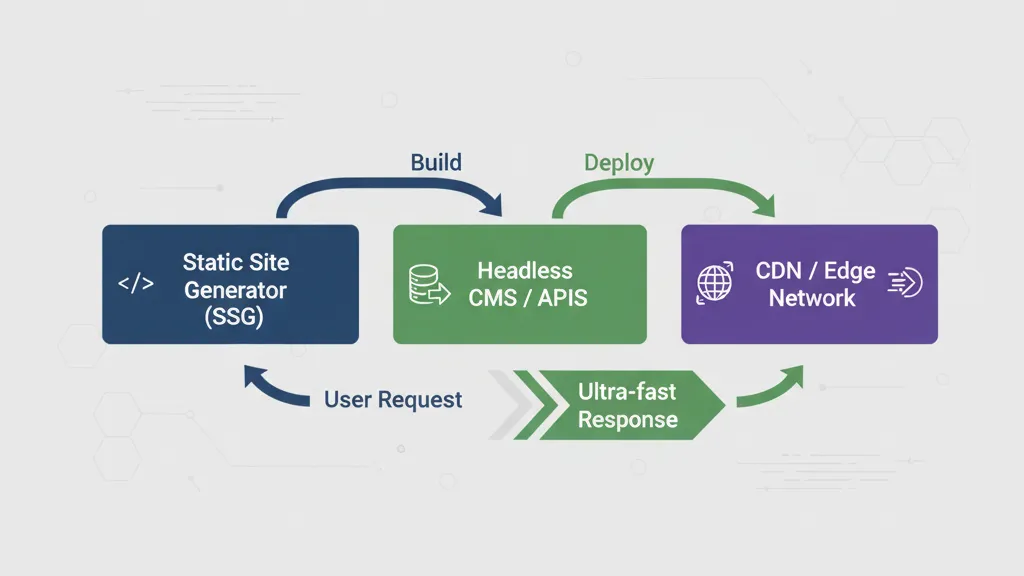
By combining these core technologies, Jamstack balances development efficiency with site performance.
What types of sites are suited for Jamstack?
While Jamstack is suitable for many types of websites, its benefits are maximized especially for sites where "content is not updated constantly" and "stable performance and security are required." Specifically, Jamstack proves highly effective in projects such as:
1. Corporate and brand websites
Corporate websites, serving as a company's public face, demand top-tier performance and security at all times. Content updates are often limited to sections like blogs or news announcements, while primary pages such as the homepage and company overview change infrequently. Building with Jamstack delivers ultra-fast page loads, offering visitors peace of mind and elevating credibility. Furthermore, because the risk of server downtime is extraordinarily low, it is ideal as a platform for disseminating critical information.
2. Blogs and news media
Blog and article content essentially becomes static content once published. Because Jamstack builds vast numbers of articles as static files and delivers them rapidly via a CDN, it remains unshakeable even during traffic spikes. Site speed is also critical from an SEO perspective, and Jamstack meets these demands at a high level. Pairing it with a headless CMS lets authors focus on writing while maintaining a fast website.
3. Documentation sites and landing pages (LPs)
Websites for product manuals and technical documentation are also extremely well-suited to Jamstack. Consisting primarily of extensive text with clear structures, they are easy to manage with static site generators. Fast rendering reduces user friction when searching for information and enhances usability. Moreover, for marketing landing pages (LPs), Jamstack holds a commanding edge in page speed, which directly impacts conversion rates.
4. E-commerce frontends (partial adoption)
While we noted that building fully dynamic sites is challenging, Jamstack is also utilized in e-commerce (EC). In an approach known as "composable commerce," catalog sections that change infrequently—such as product detail pages—are built with Jamstack, while dynamic features like shopping carts and checkout are offloaded to specialized external services via APIs. This allows teams to supercharge just the frontend (presentation layer) of an e-commerce site with Jamstack, dramatically upgrading the user experience.
Jamstack is an exceptionally powerful option for any reading- or information-oriented website seeking performance and security.
Whether for blogs, corporate sites, or documentation, Jamstack demonstrates its power in projects where stability and speed are paramount.
Leave Jamstack website development to the pros
We hope this overview helped you understand how Jamstack, a leading modern web trend, delivers high-performing and secure website construction. However, building an optimized site combining multiple technologies—such as Next.js, headless CMSs, and Vercel/Netlify—requires advanced technical expertise and architectural design principles.
At GleamHub, building websites with cutting-edge Jamstack architecture is our greatest strength. Beyond simply adopting technology, we deliver "essential value" to solve client business challenges and maximize results.
Our strengths in Jamstack development
1. Relentless dedication to performance tuning
To maximize Jamstack's greatest advantage—speed—we perform rigorous performance tuning with Core Web Vitals in mind. In addition to optimizing static generation, we pursue millisecond-level improvements through lazy loading of images and optimal asset placement, achieving speeds that overwhelm competitor sites.
2. Deep expertise and adaptability with cutting-edge technologies
We possess in-depth knowledge of the latest updates in static site generators (SSGs) like Next.js and Nuxt, as well as the unique characteristics of diverse headless CMS platforms. We select the optimal technology stack tailored to your content operation workflows and required dynamic features, proposing the most efficient, future-proof architecture.
3. CI/CD streamlining everything from development to operations
By establishing an automated deployment (publishing) environment integrated with Git, we dramatically streamline the process from content updates to publishing. This establishes a modern operational framework where marketing teams and content creators can work stress-free while maintaining security.
To build a "fast, secure, and highly efficient" website with Jamstack, look no further than gleamhub.net. We deliver next-generation web experiences that accelerate your business.
Leveraging the latest Jamstack technologies, we propose websites that drive business results.


