Severe vulnerabilities disclosed in Movable Type on April 8, 2026
On April 8, 2026, Six Apart Ltd. announced critical vulnerabilities in Movable Type and urged immediate upgrades to the latest version. The IPA also issued an advisory on the same day as JVN#66473735, indicating wide-reaching impact.
The vulnerabilities patched this time fall broadly into two categories:
- CVE-2026-25776 (MTC-31204) — Remote code execution (RCE) allowing arbitrary Perl code execution via filtering logic in the listing framework
- CVE-2026-33088 (MTC-31212) — SQL injection within request processing in the listing framework
While both assume authenticated users, anyone reaching the admin console can inflict severe damage, prompting urgent reporting by gihyo.jp and Web Tan. A defining characteristic this time is that unsupported, end-of-life versions are also affected, meaning unmaintained sites face the greatest risk.
This article is written for web managers, IT administrators, and leadership who want to determine whether to use this opportunity to commit to a full CMS replacement, rather than simply applying a patch and waiting.
Immediate remediation — Actions to complete within 48 hours
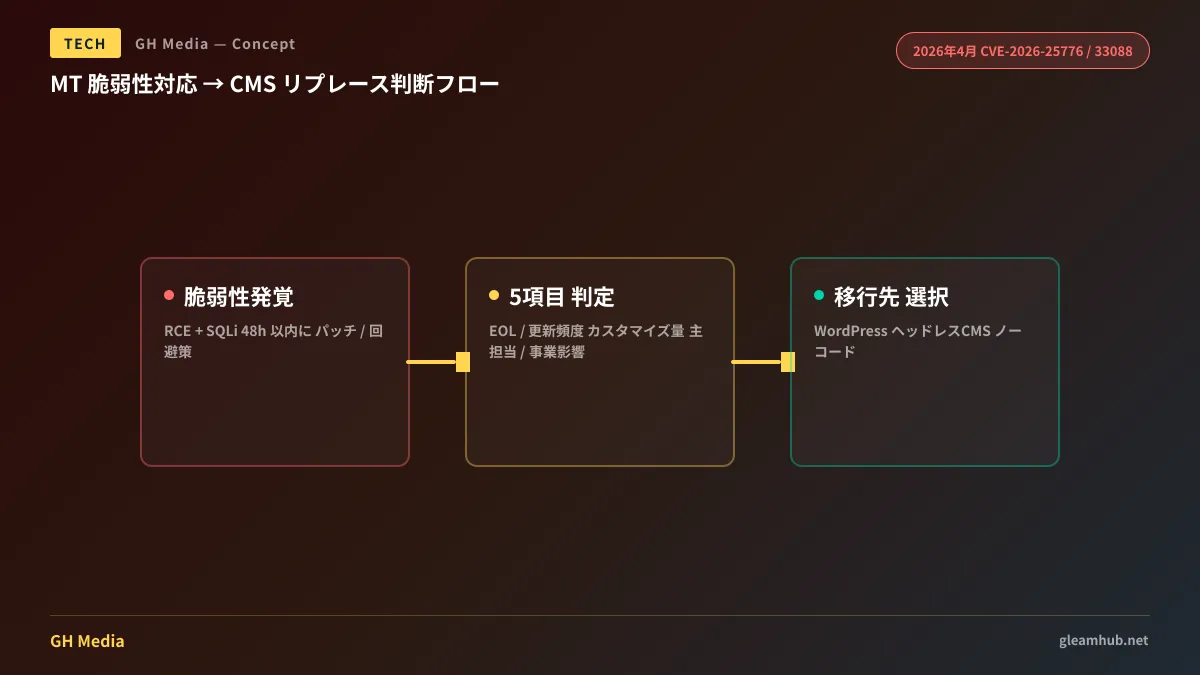
Before debating a full replacement, prioritize addressing the immediate vulnerabilities. Following Six Apart's official advisory, the standard playbook is to execute in this order:
- Audit affected sites: Compile an inventory of versions across all active Movable Type sites. Check whether any end-of-life (EOL) versions are in use.
- Update to the latest release: For the cloud edition, Six Apart announced that all instances were patched as of April 8, 2026. Software installations require manual updates for each instance.
- Workarounds if immediate patching is not possible: Enforce access restrictions on the Data API. Specifically, restrict access to the admin console and Data API to trusted IP addresses via
mt-config.cgiand web server configurations. - Verify whether breaches occurred: Conduct an initial audit of access logs, admin login records, and publishing histories for suspicious activity.
This covers your immediate priorities for today and tomorrow. Foundational web security practices are also summarized in our Introduction to Website Security Measures, which can help ensure your defense posture is solid.
"Patch to extend life" or "replace"? — A five-criteria evaluation framework
Once immediate actions are wrapped up, focus turns to medium- to long-term decision-making. Should you stop at "we patched it, so we are good for now," or should you take this occasion to reassess your CMS entirely? Evaluate using these five criteria:
| # | Evaluation criterion | Signal favoring replacement |
|---|---|---|
| 1 | MT version status | End-of-life, or one or more major versions behind |
| 2 | Site update frequency | Less than one post per month, or abandoned for several years |
| 3 | Volume of tooling customizations | Heavy plugin reliance, custom Perl modules, custom patches on legacy versions |
| 4 | Primary owner of security response | Departed the company, external vendor unreachable, or internal architecture understood by no one |
| 5 | Business impact | Site supports mission-critical funnels like inquiries, hiring, or investor relations where downtime is unacceptable |
If three or more criteria match, it is time to seriously consider replacement. Scrambling through late-night emergency patching every time vulnerabilities make headlines is unsustainable for both the organization and individual engineers. If you are uncertain about overall redesign timing, consult the benchmarks in our Optimal Timing for Website Redesigns.
Comparing 3 migration pathways away from MT
When migrating away from MT, destinations generally fall into three patterns. Considering Movable Type's strengths in static rebuilding and structured content management, realistic options in 2026 include:
| Option | Best suited for | Pros | Important precautions |
|---|---|---|---|
| Migration to WordPress | High publishing frequency, emphasis on plugin extensibility | Abundant resources and broad talent pool; straightforward to find maintenance partners | Requires ongoing maintenance and security management on the WordPress side |
| Headless CMS + Astro/Next.js | Corporate brand sites, recruitment/IR portals, owned media | Static delivery dramatically eases security burdens and accelerates page load speeds | Higher initial migration costs; editorial staff requires time to adapt |
| No-code CMS (Studio / STUDIO CMS class) | Small sites, landing pages | Extremely low operating overhead and learning curves | Limitations in extensibility and complex article structures |
Regarding alignment with core MT use cases (corporate sites, professional services, municipalities, educational institutions, publishers), we believe that headless CMS + static site generation is often the most natural fit. The reason is straightforward: because public servers do not run dynamic PHP environments like WordPress, the attack surface exposed by CMS vulnerabilities is eliminated entirely.
Detailed migration steps are explained in our WordPress to Headless CMS Migration Guide. While written with WordPress in mind, the core sequence—information architecture → content extraction → CMS configuration → frontend implementation → URL reconciliation—is identical for MT migrations.
Estimated timelines and costs — Hiring professionals
The question of "how much will it cost?" is inevitable. Based on GleamHub's historical delivery of corporate and media platforms, here are general market benchmarks (note these are estimates and vary significantly with requirements):
- Headless migration + Astro static delivery (10–30 pages): Approx. ¥1,200,000 to ¥3,000,000; timeline 8–16 weeks
- WordPress migration (similar scale): Approx. ¥800,000 to ¥2,000,000; timeline 6–12 weeks
- No-code CMS migration (small scale): Approx. ¥300,000 to ¥800,000; timeline 3–6 weeks
Our general philosophy on cost estimation is detailed in our Complete Website Development Cost Guide 2026 and Corporate Website Renewal Guide. Leveraging government subsidies can also reduce out-of-pocket costs by up to half in certain cases, so reviewing our Subsidies Guide for Website Development is well worthwhile.
Three checkpoints to confirm before contracting
Finally, here are three essential points to verify when outsourcing a migration. Leaving these ambiguous before signing is the single largest failure pattern in replacement projects.
- URL reconciliation and redirect planning: Agree in advance on a 301 redirect map from old URLs to new URLs to protect existing SEO equity. Pay close attention to MT-specific formats like
mt-entry-X.html. - Content portability: Ensure that content in the proposed new CMS can be exported as Markdown or JSON should you migrate again in the future. This is the baseline defense against vendor lock-in.
- Clarify the primary owner of security operations: Explicitly define who monitors vulnerability advisories, using what tools, and who decides when to apply patches in the post-launch SLA.
For broader vendor selection guidance, consult our How to Choose a Web Development Agency guide.
Conclusion
- On April 8, 2026, critical RCE and SQL injection vulnerabilities were disclosed in Movable Type. Within 48 hours, take emergency action via updating to the latest release or restricting the Data API.
- For the medium to long term, objectively evaluate whether to extend life with patches or transition to a full replacement using our five-criteria evaluation framework.
- For core MT corporate, professional, municipal, educational, and publishing use cases, headless CMS with static site delivery is often an ideal match.
- When contracting work, establish explicit contractual commitments around URL reconciliation, data portability, and the primary owner of ongoing security operations.
GleamHub provides one-stop support for Movable Type replacement consultations, emergency patching, and headless CMS migration architecture. If you want to use this vulnerability as a turning point to rethink your CMS infrastructure, please share your details via our inquiry form.