The barrier: "Wanting to use ChatGPT, but unable to send company data outside"
Many organizations looking to introduce AI internally encounter hurdles around data sovereignty and information leakage risks. Customer data, price quotes, contracts, meeting minutes—while teams want to feed these into ChatGPT or Gemini, the dilemma of not being able to send them to external SaaS platforms cuts across every industry.
On April 3, 2026, the National Institute of Informatics (NII) released an open-source licensed Japanese-specialized LLM trained on approximately 12 trillion tokens, "LLM-jp-4," featuring 8B and 32B-A3B (MoE) models. This development means that maintaining a Japanese private AI foundation operating entirely on in-house servers has become a realistic path even for small and medium-sized enterprises.
This article summarizes the characteristics of LLM-jp-4 and practical design considerations for deploying it as an internal LLM.
Features of LLM-jp-4
Japanese specialization and large-scale training
LLM-jp-4 represents the fourth-generation model developed under the NII-led LLM-jp project. Training tokens and parameter sizes have expanded substantially over the prior generation, delivering benchmark scores on Japanese language evaluations that rival commercial models.
| Item | LLM-jp-4 8B | LLM-jp-4 32B-A3B |
|---|---|---|
| Architecture | Dense Transformer | Mixture of Experts(MoE) |
| Training tokens | Approx. 12 trillion | Approx. 12 trillion |
| Inference active parameters | 8B | Approx. 3B |
| License | Open source (commercial use permitted) | Same as above |
| Intended use case | Edge / low-cost inference | High accuracy / specialized for business operations |
Why a "domestically developed" model matters
While English-centric open-source models (such as Llama 4, Qwen, and Gemma 4) can process Japanese, domestic models hold distinct advantages for the following reasons.
- Tokenizer efficiency: Japanese text processes with fewer tokens compared to English-based models → lowers inference costs
- Precision with legal, public, and business terminology: Trained on Japanese data, yielding consistent output across commercial customs, statutory language, and boilerplate administrative text
- Data governance: Operations can run completely within Japan, simplifying compliance with the Act on the Protection of Personal Information and industry-specific regulations
For on-device LLM trends, see the Complete Guide to Gemma 4; for competitive evaluations of domestic LLMs, see the Gemma 4 vs Qwen vs Granite Comparison.
Architecture for internal LLM deployment
Minimal setup (single on-premise machine)
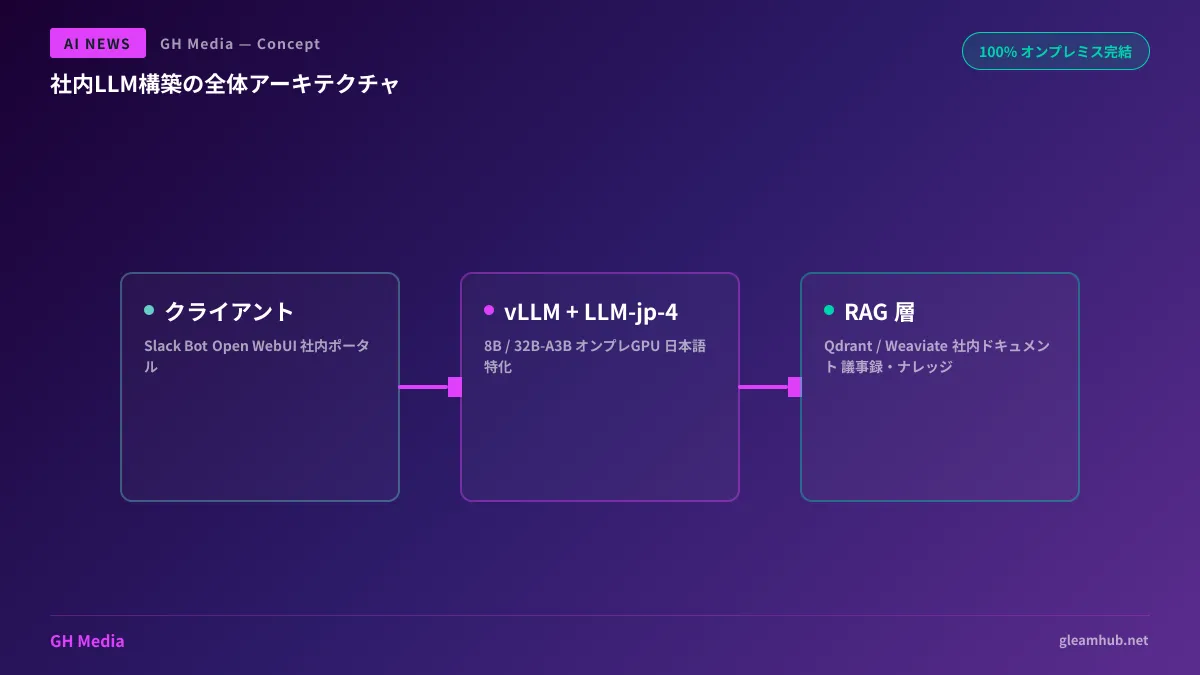
For small and medium-sized enterprises conducting their first trial, a simple stack like the following is practical.
| Layer | Technology selection example |
|---|---|
| Hardware | 1 GPU server (RTX 6000 Ada or 1x H100) |
| Inference engine | vLLM / Ollama / TGI |
| Model | LLM-jp-4 8B (or 32B-A3B) |
| Frontend | Open WebUI / internal Slack bot |
| RAG | LlamaIndex + vector DB (Qdrant / Weaviate) |
With this architecture, an initial investment of several million yen and monthly electricity costs of a few tens of thousands of yen can support internal usage for organizations of 20 to 50 people.
RAG integration is the core objective
An LLM by itself does not function as an "AI well-versed in internal company knowledge." Connecting internal documentation, meeting minutes, and knowledge repositories via RAG (Retrieval-Augmented Generation) turns it into a true internal AI assistant.
Architectural patterns for RAG are detailed in 2026 RAG Optimization Patterns, and external integrations using MCP are covered in the Complete Guide to MCP.
Phased rollout strategy
Phase 1: Validation PoC (1 to 2 months)
Begin by narrowing the PoC scope to a specific business workflow or department.
- Deploy a single GPU server on-premise and launch LLM-jp-4 8B using vLLM
- Vectorize 20 to 30 internal wiki pages and meeting records for RAG connectivity
- Have one department (5 to 10 users) use it for day-to-day operations
- Collect usage logs, satisfaction ratings, and erroneous response samples
Phase 2: Domain-specific tuning (2 to 3 months)
Using feedback gathered during the PoC, conduct task-specific adapter training (LoRA / QLoRA).
- Convert internal document hierarchies and terminology glossaries into training datasets
- Apply prompt engineering for disallowed outputs and required response formats
- Compile failure patterns into an evaluation suite for regression testing
Phase 3: Company-wide rollout (3 to 6 months)
Expand user access while establishing SSO integrations, access permissions, and audit logs. From this stage onward, security and operational monitoring become primary themes. For overall security design, please also consult Web Security Fundamentals.
Common pitfalls
- The misconception that "OSS means free" — While the model weights are free, costs for GPUs, electricity, and operational labor remain
- Overestimating RAG accuracy — When internal documents are scattered or redundant, RAG creates confusion. Organizing knowledge comes first
- Insufficient hallucination countermeasures — Plausible falsehoods happen even in internal settings. Make displaying citations for answers mandatory
- Lacking operational owners — Organizations need internal staff or external partners to continuously manage model updates, evaluations, and prompt improvements
Conclusion
The arrival of NII's LLM-jp-4 has the potential to become a watershed moment where Japanese companies operate their own in-house LLMs.
- Significance: Private AI infrastructure independent of external SaaS becomes viable
- Minimal setup: 1 GPU + vLLM + RAG + Open WebUI supports 20 to 50 users
- Success factors: Knowledge curation, RAG architecture, evaluation cycles, and operational ownership
- Return on investment: Initial costs of several million yen and monthly costs of tens of thousands of yen can build an in-house experience comparable to ChatGPT Enterprise
For organizations that felt compelled to abandon ChatGPT because they could not export data externally, LLM-jp-4 can be a true game changer.
At GleamHub, we provide hands-on partnership to support small and medium-sized enterprises in building private LLMs, designing RAG architectures, and conducting domain-specific fine-tuning. If you are considering internal AI adoption, please feel free to reach out to us.
References