"Works in PoC but dies in production" — the biggest hurdle remaining in 2026 AI development
In April 2026, an article published on the LayerX Engineering Blog titled "Moving Beyond 'Vague Improvements': Building an AI Development Platform with Langfuse That Continuously Improves Accuracy" created substantial buzz on Zenn Trending. Written by a software engineer in the Bakuraku business division, its essence boils down to a single insight:
Building something with questionable accuracy that exhibits plausible behavior is easy, but building features that customers will use continuously while maintaining stable, ongoing accuracy improvements is far more difficult than imagined.
Anyone developing AI features inside operating enterprises in 2026 nods painfully in agreement with this statement. Because LLMs operate probabilistically, conventional software mindsets like "fix bugs when they happen" and "protect with tests" do not suffice on their own. An infrastructure to quantitatively measure accuracy and an experimental environment where improvements can be made reproducibly have become indispensable for production operations.
Centered around Langfuse, which is seeing accelerating adoption among Japanese enterprises such as LayerX and ZOZO, this article compiles how to build an LLMOps infrastructure to move beyond "stuck in PoC."
What is Langfuse? — built on four core pillars
Langfuse is an open-source LLM observability and LLMOps platform. Available in both cloud and self-hosted editions, LayerX disclosed that unlimited user seats and SSO support were the deciding factors for adopting the self-hosted edition.
Its capabilities can be broadly organized into four pillars.
| Pillar | Problem addressed | Core Capabilities |
|---|---|---|
| Observability | Not knowing what is happening under the hood | Trace, span, and metadata collection; automated instrumentation via decorators |
| Prompt Management | Requiring full redeployments for every prompt update | Git-like version control for prompts, A/B delivery |
| Datasets / Experiments | Lacking a quantitative baseline to compare accuracy | Evaluation datasets, Experiment Runner SDK |
| LLM-as-a-Judge | High burden of manual qualitative evaluations | Automated evaluation using a secondary LLM as a judge |
The strength of Langfuse lies in having these capabilities integrated into a single UI. Across all phases—PoC, production, and continuous improvement—teams can communicate while looking at the exact same dashboard, allowing PdMs, engineers, QA, and business stakeholders to debate using identical numbers.
To instrument tracking in Python, you truly just need to add the @observe decorator.
from langfuse.decorators import observe
from langfuse.openai import openai  # OpenAI SDK の薄いラッパ

@observe()
def summarize_invoice(text: str) -> str:
    """請求書 OCR の後処理要約。トレースは自動記録される。"""
    response = openai.chat.completions.create(
        model="gpt-4o-mini",
        messages=[
            {"role": "system", "content": "以下の請求書データを構造化して返してください。"},
            {"role": "user", "content": text},
        ],
    )
    return response.choices[0].message.content
With just this snippet of code, Langfuse's UI automatically records inputs, outputs, token counts, latency, and cost. From initial setup to your "first single trace" takes under 30 minutes.
Three-tier evaluation design learned from the LayerX case study
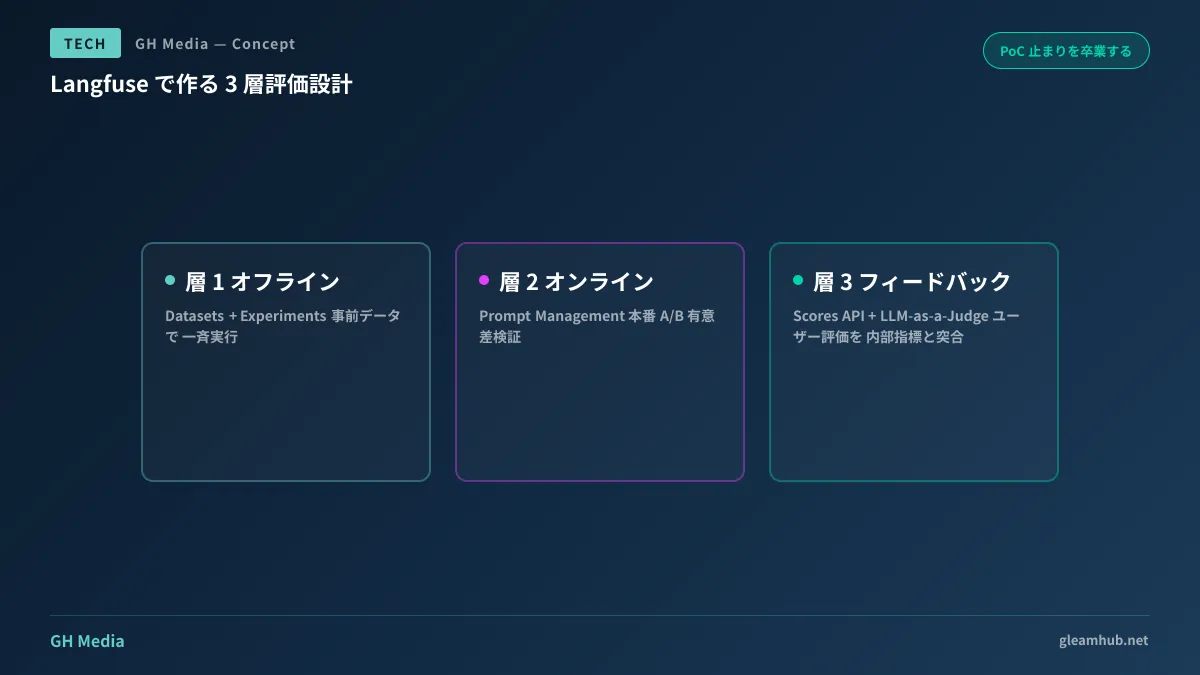
Simply installing Langfuse will not magically jumpstart accuracy improvements on its own. The improvement cycle only begins once you design how to measure. Synthesizing the "three-tier evaluation design" learned from LayerX's series of articles gives the following structure:
Tier 1: Offline evaluation (Datasets + Experiments)
- Prepare evaluation datasets paired with expected outputs directly on Langfuse
- Execute prompts or model variations simultaneously across the identical dataset
- The concrete implementation of experiment management is also detailed in LayerX's Experiment Runner SDK article
The key here is "judging against pre-defined metrics." You can enforce a culture that avoids claiming "it got better" based on mere vibes right at the infrastructure level.
Tier 2: Online A/B testing (Prompt Management)
- Split production traffic across prompt versions A and B
- Trace user behaviors (save rates, re-run rates, complaint rates) into Langfuse alongside prompt data
- Switch entirely to the winner once statistical significance is established
Tier 3: User feedback (Scores API)
- Send user "thumbs up / thumbs down" or "ratings 1–5" to Langfuse's Score API
- Verify the gap between actual user experience evaluations and internal metrics inside Observability
- Combining this with LLM-as-a-Judge significantly alleviates the manual review bottleneck
By running all three tiers simultaneously, prior expectations, statistical impact, and actual user experience appear side-by-side on the same dashboard. This is the root remedy for the "great in PoC but dies in production" problem. To get the complete picture, read this alongside RAG Optimization Pattern Catalog 2026, where we cover combining this with RAG-specific accuracy optimization techniques.
Langfuse vs. other LLMOps tools — market positioning as of April 2026
Does this mean Langfuse is the only viable choice? Not at all. You need to select the tool that fits your company's situation. Here is an overview of four major tools.
| Tool | Deployment Model | Strengths | Ideal use cases |
|---|---|---|---|
| Langfuse | OSS / SaaS / Self-host | OSS, self-hosted with SSO support, four integrated pillars | Japanese enterprises with data exfiltration constraints, teams wanting integration into internal infrastructure |
| LangSmith | SaaS (Official LangChain) | Tight integration with LangChain and LangGraph | LangChain-centric agent development |
| Helicone | SaaS / Self-host | Proxy-based approach requiring virtually no application modifications | Teams looking to add observability to existing applications in the shortest time |
| Arize Phoenix | OSS | Flexible evaluation tailored for enterprise environments | Organizations where an MLOps culture is already established |
LayerX's rationale—"self-hosted with unlimited users and SSO support"—is the exact point resonating with mid-to-large Japanese enterprises. Predictable licensing costs and the ability to deploy in a self-hosted architecture that IT departments can easily audit often prove to be decisive factors in on-the-ground tool selection.
Additionally, if you are considering Japanese-specialized LLMs as your model option, be sure to check How to Run a Dedicated In-House AI with NII's "LLM-jp-4". The architecture combining on-premise infrastructure + Japanese LLMs + Langfuse is becoming a practical solution even in industries with strict data transfer restrictions.
Checklist for clients to quantify "AI accuracy improvement"
When outsourcing the development of LLM features, whether the contractor can quantify accuracy improvements is an essential perspective to verify before signing. You may paste the following checklist directly into your RFP:
- Observability tool: Which tool will be used (Langfuse, LangSmith, Helicone, etc.) and who will monitor it?
- Evaluation datasets: Who will prepare them, by when, and how many items will be included?
- Definition of success metrics: Can the passing threshold for offline evaluation be committed to in numerical terms?
- A/B test design: What percentage of traffic will be allocated to which users before and after production rollout?
- Improvement cycle lead time: How long does it take from updating a prompt to deploying it to production?
- User feedback aggregation path: How will thumbs up/down or NPS data be fed back into AI development?
Simply locking these down with your contractor in advance dramatically reduces reports stating "we made some vague improvements." We also cover overall requirements definition in the AI agent era in Spec, Context, and Harness Three-Layer Architecture, so please consult that as well.
Conclusion
- The biggest challenge in 2026 AI feature development is that features work in PoC, but accuracy fluctuates in production. Solving this requires quantitative evaluation, experiment management, and user feedback to coexist on the exact same platform.
- Langfuse is an LLMOps platform integrating Observability, Prompt Management, Datasets, and LLM-as-a-Judge into a unified UI. Its open-source, SSO-supported self-hosted model makes it an easy fit for Japanese enterprises.
- You can directly adopt the three-tier evaluation design from the LayerX case study (offline evaluation + online A/B + user feedback) within your own organization.
- When selecting an outsourcing partner, always lock down six items: observability tool, evaluation datasets, success metrics, A/B testing, improvement lead time, and feedback pathways.
At GleamHub, we provide end-to-end support for designing, implementing, and coaching teams on LLM observability platforms centered on Langfuse. If you are a PdM or EM struggling with "our PoC works, but quality destabilizes in production," please share your situation with us.