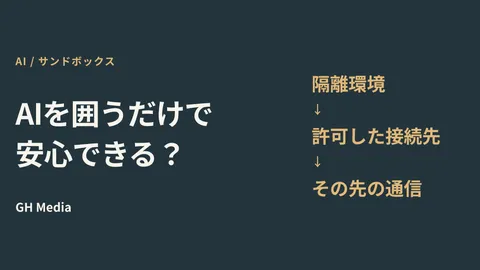
On May 23, 2026, The True Attack Surface of AI Coding Agents Was Configuration Files was published on Zenn, sparking a major reaction across the developer community. Security incidents in AI coding agents that surfaced in 2026, such as TrustFall and Kiro RCE, were not caused by "malicious LLM outputs"; rather, configuration files such as .cursor/, .kiro/, .continue/, and .claude/ served as the entry points for RCE and credential theft. The author also introduced initiatives to inspect these using the open-source tool Sigil.
From our position supporting AI coding agent adoption at mid-sized enterprises through custom development, this clarifies the concrete attack surface that must be closed first in addressing the typical issue of "worrying only about LLM guardrails while leaving local dotfiles completely exposed." This threat model represents an entirely different vector from the cloud-side agent attack surface addressed in our AWS Security Agent Pentest Custom Development, the production runtime protection in our Kubernetes Autonomous AI Agent Security Custom Development, the OSS supply chain in our Mini Shai-Hulud npm Worm IR Custom Development, and the developer endpoint governance in our GitHub Internal Repo Compromise + VSCode Extension Custom Development. This article examines the "dotfile and configuration file attack surface" and how to secure it before an organizational rollout.
Why "Configuration Files Are the True Attack Surface"
| Dimension | Via LLM Output (Anticipated) | Via Configuration Files (Blind Spot) |
|---|---|---|
| Entry Point | Prompt injection | Arbitrary configuration of .cursor/ and .kiro/ |
| Threat | Data leakage / incorrect answers | RCE / credential theft |
| Trigger Condition | Human submits a malicious query | Triggered merely by cloning a repository |
| Effectiveness of Existing Countermeasures | Guardrails / monitoring | Virtually ineffective |
| Detection Difficulty | Traceable via prompt history | Dotfile changes are easily overlooked |
| Affected scope | Limited to that session only | Entire developer workstation |
| Psychology Exploited | Utilized from an attacker's perspective | Trusted simply because it is "configuration" |
In essence, the dotfiles of AI coding agents represent "configuration files containing executable code," becoming the new primary battlefield for open-source supply chain attacks.
Three structural changes beneficial to custom development projects
Structure 1: From "Sole Focus on LLM Guardrails" to "Dotfile Auditing"
Historically, security discussions around adopting AI coding agents centered on "guardrails for LLM prompts and outputs." Auditing dotfiles and configuration files with tools like Sigil structurally closes off the "upstream layer before the LLM runs." This is a step toward expanding the developer endpoint governance covered in GitHub Internal Repo Compromise + VSCode Extension Development for Clients down to the dotfile layer.
Structure 2: From "Individual-Based Agent Adoption" to "Organization-Standard Configuration Governance"
The current status quo, where individual engineers freely install Cursor, Claude Code, Continue, or Gemini CLI and author their own dotfiles, leads to an uncontrolled expansion of the organization's attack surface. Establishing organization-standard configuration templates, auditing, and distribution enables control where "only authorized configurations are executed."
Structure 3: From "Trusting the Repository Alone" to "Trusting the Repository Inclusive of Dotfiles"
For modern editors and agents where .vscode/, .cursor/, and .kiro/ within a repository are loaded the moment git clone is executed, the dotfiles inside open-source repositories have become the trust boundary. This is a "git clone arbitrary execution" problem identical in nature to the "npm install arbitrary execution" covered in Mini Shai-Hulud npm Worm IR Development for Clients.
5 Phases of "AI Coding Agent Configuration File Hardening" Provided via Custom Development
Phase 1: Current state assessment (2 weeks)
- Inventory of AI coding agents used across the organization
- Inventory of dotfile / configuration file types and storage locations
- Identification of configuration discrepancies across individuals and projects
- Gap analysis against existing security policies
- Initial scan using open-source tools like Sigil
Phase 2: Hardening Design (2 Weeks)
- Formulation of organization-standard dotfile templates
- Allowlists / denylists (command execution / file access / network)
- Developer workstation distribution method (dotfile managers / IDE configuration sync)
- Automated scanning CI upon repository ingestion
- Anomaly detection rules (integrating Sigil + EDR)
Phase 3: PoC construction (2–3 weeks)
- Distribution to a pilot team of 10–20 engineers
- Scanning dotfiles in existing repositories
- Operational validation of anomaly detection and alert workflows
- Developer interviews (evaluating usability trade-offs)
- Incorporating feedback and improvements
Phase 4: Production rollout (3–4 weeks)
- Company-wide developer distribution + enforced application
- Mandating dotfile scanning in CI
- Audit log integration (EDR / SIEM)
- Emergency exception request workflow
- Developer security training
Phase 5: Monthly operational reviews (ongoing)
- Tracking new agents and new dotfile formats
- Reviewing scan results and anomaly detection counts
- Review and updates of allowlists
- Incorporating ongoing developer feedback
- Tracking emerging threat trends
Standard technology stack set for custom development
| Layer | Recommended technology | Alternative |
|---|---|---|
| Dotfile Scanning | Sigil(OSS) | Custom ESLint rules |
| CI integration | GitHub Actions / GitLab CI | CircleCI / Jenkins |
| Dotfile Distribution | chezmoi / yadm | dotbot |
| IDE Configuration Integration | Settings Sync / Profile | In-house dotfile management |
| EDR / Monitoring | CrowdStrike / SentinelOne | Microsoft Defender |
| SIEM | Splunk / Datadog / Sentinel | Elastic |
| Secret detection | TruffleHog / Gitleaks | Trivy |
| Container Dev Environments | Devcontainers / Codespaces | Coder |
Which projects need this and which do not
| Projects requiring this | Projects not requiring this |
|---|---|
| Company-wide rollout of AI coding agents underway | Individual evaluation phase |
| 30 or more developers | 5 or fewer developers |
| Heavy use of open-source repositories | Exclusively in-house code |
| Preparing for ISMS / SOC2 audits | Not subject to regulations |
| Prior experience with supply chain incidents | No prior incidents (but seeking preparedness) |
Six clauses to include in client contracts
| Clause | Details | What the client should verify |
|---|---|---|
| Target Agents | Cursor / Claude Code / Gemini CLI, etc. | Comprehensive mapping of usage status |
| Target Dotfiles | .cursor/, .kiro/, .claude/, etc. | Boundaries of personal settings |
| Enforcement Scope | Company-wide / departmental / project-level | Operational impact |
| Exception Request Process | Application → Review → Time-bound approval | Business continuity |
| Detection-to-Notification SLA | Time from detection to notification | Incident response structure |
| Handover Upon Project Completion | Templates + scanning rules + runbooks | Internal operational continuity |
Client-Side ROI Estimate (Assuming 100 Developers / 300 Repositories / Combined Cursor + Claude Code Use)
| Item | Existing (Left to Individuals) | After Hardening Implementation | Difference |
|---|---|---|---|
| Estimated Losses from Configuration-Based RCE | 18 million yen / year | 2 million JPY / year | -16 million yen |
| Estimated Losses from Credential Theft | 12 million yen / year | 1.5 million yen / year | -10.5 million yen |
| Incident Investigation Person-Hours (Annual) | 480h | 80h | -400h |
| Audit support workload (annual) | 320h | 80h | -240h |
| Developer Training Person-Hours (Annual) | 240h | 80h | -160h |
| Annual benefit | — | — | Equivalent to ~33 million yen + governance visibility |
Even calculated at an hourly rate of 8,000 yen, net annual savings exceeding 27 million yen are anticipated. A realistic approach to investing in hardening begins by estimating these potential losses and labor reductions against your organization's developer headcount and repository count.
Five common pitfalls
Pitfall 1: Leaving a "Hands-Off Culture Around Dotfiles" Intact
If you maintain an engineering culture of "never touching personal dotfiles," governance will never be established. Explicitly define at the contract and policy level that dotfiles for agents used in business operations are subject to organizational management.
Pitfall 2: Denylist-Centric Operations
Relying on "banning dangerous commands" cannot keep pace with novel attack techniques. Adopt allowlists (permitting only explicitly approved configurations) as your operational policy.
Pitfall 3: Stopping at Warnings in CI Scans
If CI only outputs warnings and allows builds to pass, no one will address them. Design a workflow where scan violations trigger hard blocks requiring an exception request.
Pitfall 4: Neglecting Auto-Execution When Cloning Open-Source Repositories
If you ignore setups where git clone → code . results in automatic dotfile loading and arbitrary command execution, even developers who only consume open-source dependencies are at risk. Mandate "Workspace Trust" in developer workstation IDE settings.
Pitfall 5: Failing to Track New Agent Releases
New AI coding agents emerge almost monthly. Build monthly reviews and template updates directly into your service agreements.
90-day action plan
| Week | Action |
|---|---|
| Week 1〜2 | Agent / dotfile inventory + initial Sigil scan |
| Week 3〜4 | Hardening design + organization-standard template definition |
| Week 5〜7 | Pilot team rollout + feedback incorporation |
| Week 8〜10 | Company-wide phased rollout + CI integration |
| Week 11 | EDR / SIEM integration + audit dashboard setup |
| Week 12〜13 | Developer training + launching monthly operational reviews |
Conclusion — "Securing Dotfiles Before LLM Guardrails" is the New Standard
The true attack surface of AI coding agents lies not in LLM outputs, but in configuration files. From the standpoint of supporting AI development governance at mid-sized enterprises through custom development, "AI Coding Agent Configuration File Hardening Platforms"—integrating organization-standard dotfiles, Sigil scanning, CI enforcement, and monthly updates—will become a major new service.
Where to begin—from auditing dotfiles and designing organizational templates to integrating scans into CI—varies greatly depending on the agents used, developer headcount, and existing governance maturity. If you are facing scenarios like "planning a company-wide rollout of Cursor / Claude Code," "pausing adoption due to fears of configuration-based incidents," or "being asked about AI development governance in ISMS / SOC2 audits," we will provide an individualized quote after reviewing your current environment. Please feel free to reach out via our contact form.
Sources
- The True Attack Surface of AI Coding Agents Was Configuration Files (Zenn)
- AWS Security Agent Pentest Development for Clients (GH Media)
- Kubernetes Autonomous AI Agent Security Development for Clients (GH Media)
- Mini Shai-Hulud npm Worm Incident Response Development for Clients (GH Media)
- GitHub Internal Repo Compromise + VSCode Extension Development for Clients (GH Media)