
Looking at ranking reports, nothing looks worse. Your site maintains positions around 5th place for key terms. Yet traffic to the site is down year-over-year. Checking impressions in Search Console reveals impressions have dropped while rankings remain unchanged.
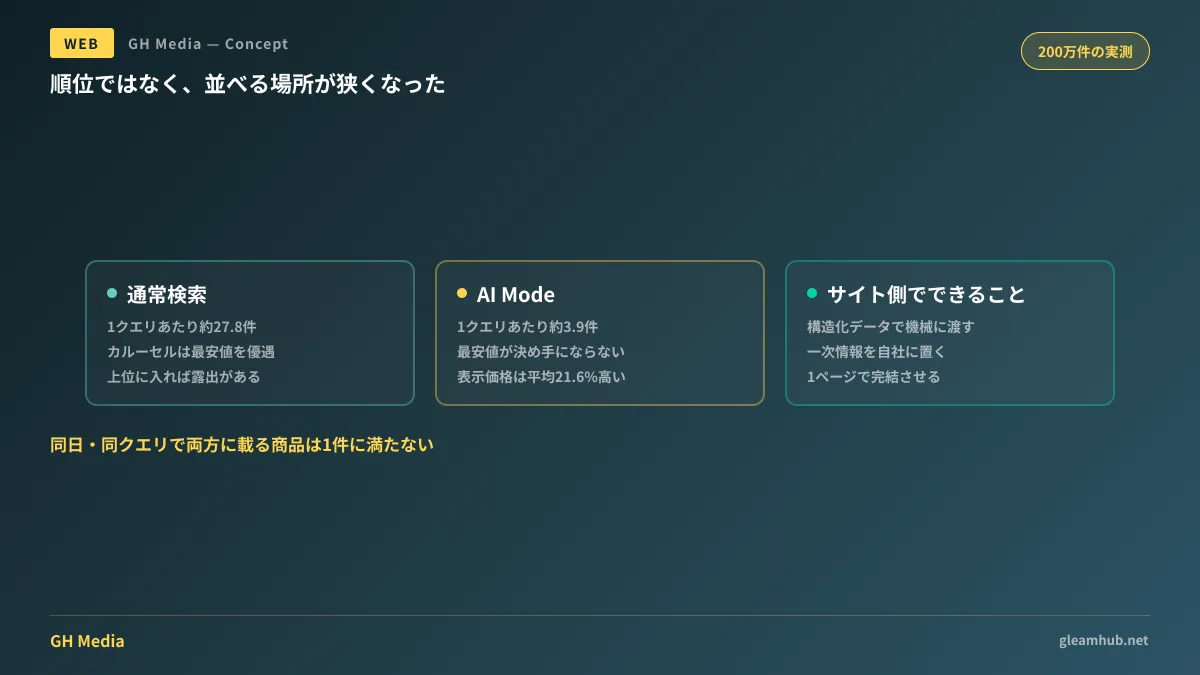
A concrete number has emerged to explain this phenomenon. In a study tracking over 2 million product listings between August 9 and 31, 2026, Productrise found that on the same day for the same query, traditional search results displayed an average of 27.8 products, whereas AI Mode displayed only 3.9. Fewer than one product (0.94) appeared in both.
Rankings did not drop; the display surface simply shrank.
What "21.6% higher" really meant
What generated buzz in that same study was pricing. When identical products appeared on both surfaces on the same day, the price shown in AI Mode was on average 21.6% higher.
This is easily misunderstood, but Google is not marking up prices. According to researchers, this stems from the fact that while traditional product carousels favor the lowest price, being the cheapest is not a ranking factor in AI Mode. Even for the same item, AI Mode does not necessarily pull from the cheapest retailer.
Across the entire surface, median product price was $149 in AI Mode compared to $100 in traditional search. This is not a direct comparison of identical items, but a reflection of the types of products each surface features.
Translating this to a website owner's perspective yields two takeaways.
| Previous Assumption | What Is Happening in AI Search |
|---|---|
| Offering the lowest price makes pickup likely | Being the cheapest is not the deciding factor |
| Ranking in the top 20–30 yields exposure | Only a few slots exist, making inclusion an all-or-nothing contest |
Surfaces where competing on price loses efficacy
This shift hits sites that rely on price as their primary competitive weapon hardest.
The model of ranking high on price comparison sites by pricing a few cents lower to capture traffic collapses when available slots shrink to 3 or 4. Whether a site offers reasons beyond price to be selected among hundreds of retailers selling the exact same product translates directly into exposure differences.
For B2B sites that do not publish pricing, the situation differs slightly. While product listing findings do not map one-to-one, the structural shift of "fewer slots and evolving selection criteria" is identical. Whether selecting a web agency or sourcing custom software development, if AI summarizes and names only a few firms, an interface that once featured ten companies shrinks to three.
What site owners can and cannot do
Let's clarify what cannot be done first. Site owners cannot directly force inclusion in AI Mode via site settings. If pitched configuration packages labeled "AI search optimization," check specifically what those settings actually change.
What you can do boils down to presenting information in machine-readable formats:
- Provide prices, stock, model numbers, and terms as structured data, not just body text
- Publish primary sources on your own site; content rehashed from third-party articles will not be selected as citations
- Ensure company names, service names, and descriptions of what they are can be fully understood within a single page
The third point is understated but effective. Summarizers can pull from single-page complete explanations far more easily than stitching context across multiple pages. The perspective of checking whether content is readable by AI aligns directly with this structural preparation.
Changes to search surfaces themselves are covered in What AI Mode Means for Search and Site Traffic. This study provides the first large-scale empirical data measuring that shift.
Structured data shouldn't stop at "implemented"
Many sites assume they have implemented structured data when it is not actually machine-readable. The following three pitfalls are common:
Prices embedded in images. Pricing tables formatted as images can be read by humans, but not by machines. Build them as tables, or at minimum provide matching plain text.
Stock and availability statements limited to body text. Writing "currently accepting orders" in body copy does not help machines determine freshness unless reflected in structured data.
Deploying without ongoing validation. Site updates frequently break structured data output. Regularly reviewing Search Console enhancement reports for errors is the baseline operational standard.
Even for B2B sites without product listings, checking whether core details like office locations, service offerings, and contact channels are machine-readable follows the exact same logic.
What to do next
Select three of your primary keywords and test search them across both AI Mode and traditional search results. Count the listings and verify whether your site appears.
If missing, the first thing to inspect is not ranking, but whether your site has a dedicated single page that directly answers that keyword. Explanations scattered across multiple pages are less likely to be chosen as source material for summaries.
GleamHub provides website production and renewal consultations to evaluate whether your site structure holds up under AI search paradigms and determine which pages to optimize first. Because solutions vary depending on your offerings and current architecture, please reach out via Inquiries.