

Adding an AI chat widget to the bottom right of a website or generating key visual backgrounds with generative AI have become routine line items in project estimates over the last two years. As implementation costs fell, these features were frequently adopted directly within production workflows without formal legal reviews.
That dynamic shifted on August 2, 2026. With the transparency obligations under Article 50 of the EU AI Act taking effect, presenting AI interactions and displaying AI-generated content now carry explicit disclosure requirements. Even Japanese companies are subject to these rules if they provide services to users located within the EU.
What the regulations require
Article 50 outlines four primary requirements:
- Informing users that they are interacting with an AI system in conversational contexts such as chatbots
- Marking outputs generated or manipulated by AI in a machine-detectable format
- Notifying individuals exposed to emotion recognition or biometric categorization systems
- Clearly labeling deepfakes and AI-written text published on matters of public interest
Website development and operations directly encounter requirements 1 and 2, while media platforms handling editorial content face requirement 4. Relatively few organizations maintain implementations subject to requirement 3.
Deadlines require careful attention. Article 50 itself took effect on August 2, 2026, requiring newly deployed generative AI systems to comply from day one. The disclosure obligations under Article 50(4) carry no transitional grace period. In contrast, generative AI systems already on the market prior to August 2, 2026, are granted a grace period until December 2, 2026, to meet the marking and detection requirements of Article 50(2).
The European Commission published the final version of its Code of Practice on marking and labeling AI-generated content on June 10, 2026, followed by implementation guidelines for Article 50 on July 20. While the Code of Practice is voluntary, it serves as a practical benchmark for what constitutes regulatory compliance.
Why being based in Japan does not exempt you
A frequent pitfall in determining regulatory applicability is focusing on where a company is incorporated rather than where its outputs are used. Services provided to users within the EU, multilingual sites targeting the EU market, and inquiry forms accepting submissions from the EU all trigger regulatory evaluation, even for Japanese corporate entities.
Conversely, corporate websites for small and mid-sized Japanese businesses serving domestic customers face limited exposure to direct enforcement. In practice, however, they cannot be considered entirely unaffected for two key reasons:
First, requirements will trickle down from business partners. Subcontractors for manufacturers exporting to the EU and subsidiaries of EU-headquartered enterprises are increasingly seeing these compliance clauses added to website project specifications. If production agencies are unaware of them, development proceeds with misunderstood requirements.
Second, this represents the leading edge of a global standard. Technical infrastructure for provenance disclosures in AI-generated content is maturing rapidly, as seen in Provenance Tracking with SynthID and C2PA. Sectors with established technical solutions quickly face widespread mandatory adoption.
Practical implementation steps
Translating these requirements into development workflows involves three main tasks:
Clear notification that a chat service is AI-powered. Placing subtle text inside a button or widget is insufficient. Users must be informed the moment they first engage with the AI before a conversation begins. In practice, displaying disclosures in both the initial greeting message and the widget header provides reliable compliance. If your system switches between human agents and AI, ensure the display updates dynamically at the exact moment of handoff. This is a frequent oversight in implementation reviews.
Designing how to communicate to users that an interaction is AI-driven is explored in UX for AI Agent Transparency. Satisfying regulatory baselines and preventing user confusion are distinct design challenges.
Machine-readable watermarking on generated assets. When generating images or videos using AI, outputs must incorporate detectable watermarks. Rather than developing detection systems from scratch, web development teams rely on underlying generation tools. A practical operational approach is to verify whether current generative tools support compliant watermarking and prohibit unverified tools from producing production assets. This is solved by establishing operational rules within production pipelines rather than writing custom code.
Disclosures on AI-generated text concerning matters of public interest. This applies to owned media publications using AI to draft content on current affairs or societal debates. Because regulatory treatment hinges on whether humans performed substantial editorial review, documenting article production workflows becomes crucial.
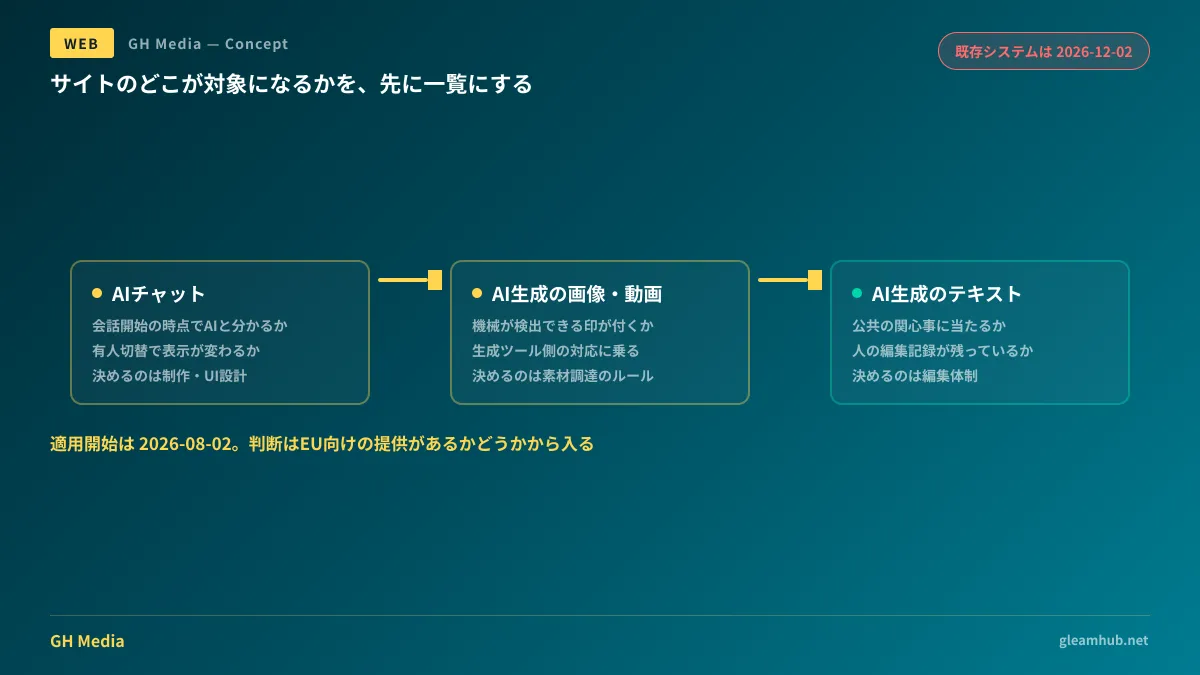
| Implementation area | What to verify | Decision-maker |
|---|---|---|
| AI chat | Ensuring AI identity is clear before conversation starts, and indicators update upon human handoff | Development and UI design |
| AI-generated images and videos | Verifying whether generative tools support compliant marking | Asset procurement policy leads |
| AI-generated text articles | Evaluating relevance to public interest and maintaining human editorial audit trails | Editorial team |
Handling disclosures in estimates and contracts
From a project ordering perspective, clients must recognize that treating compliance as an afterthought significantly inflates refactoring costs. Adjusting chatbot label positions is trivial, but retrofitting watermarks on generated assets can require regenerating entire asset libraries. Replacing every existing AI-generated image across an active website costs far more than accounting for guidelines during initial production.
When planning new builds or redesigns, confirming during requirements definition whether your service reaches the EU saves substantial costs. If not, the inquiry ends there; if it does, asset procurement rules can be established from day one.
Ultimately, determining organizational applicability involves formal legal assessments. This article outlines verification points for production and operations teams; consult legal counsel for definitive compliance determinations.
What to do next
Audit your active websites to compile an inventory of pages hosting AI chatbots or utilizing AI-generated assets. When agency handovers have occurred, companies often lack this inventory entirely. Without it, determining regulatory exposure is impossible.
Once cataloged, prioritize actions based on whether your services reach the EU. If so, the December 2 deadline may apply, making an inventory audit of generated assets your first priority. If not, integrating procurement guidelines into your next website redesign will be sufficient.
If you need assistance auditing AI implementations on existing sites or designing production workflows that govern AI-generated assets, GleamHub offers advisory services covering custom development, AI, and automation. Because required actions vary based on your operating regions and tooling, contact us for specialized guidance via our contact form.
Sources
- Guidelines on transparency obligations for providers and deployers of certain AI systems — European Commission
- Article 50: Transparency Obligations for Providers and Deployers of Certain AI Systems — EU Artificial Intelligence Act
- The EU AI Act’s Transparency Rules: A Practical Guide to Article 50 — EU Artificial Intelligence Act
- EU Finalises Transparency Rules for AI-Generated Content — Paul, Weiss
- Taking the EU AI Act to Practice: The Final Transparency Code of Practice — Bird & Bird


