
Reading an outsourced column article, you may sometimes feel the writing is polished but lacks substance. You suspect it was written by generative AI, yet had no way to confirm it.
Asking directly creates friction, and if the contractor denies it, the inquiry ends there. Even when turning to self-proclaimed detection tools, they flag human writing as AI or vice versa, failing to provide reliable grounds for evaluation. As a result, organizations have continued to accept deliverables while harboring doubts they cannot voice.
Now, a factor of a completely different nature has entered the picture: AI providers themselves have begun tagging their own output.
Generators are beginning to tag their own output
In August 2026, Anthropic announced that it would embed imperceptible, machine-detectable signals into text generated by Claude. Explained on August 12 by Thariq Shihipar of the Claude Code team, this applies to all text generated by supported models.
The mechanism works by introducing subtle statistical biases into word choices, allowing the pattern to be detected once a sufficient volume of text accumulates. Human readers cannot discern the difference. Even if text is copied and pasted elsewhere, that bias travels with it.
Files like images follow a separate track, receiving signed metadata based on the C2PA provenance standard. This concept is not new in itself, serving as an extension of the framework explored in Content Provenance via SynthID and C2PA. What is new here is that coverage has expanded to plain text, which was long considered difficult to mark.
Behind this move lies Article 50 of the EU AI Act. This provision mandates transparency for generated or manipulated content, and Anthropic has signed the relevant Code of Practice on transparency. Supported models released in the EU after August 2, 2026, must support machine-readable marking from launch. Crucially, this rollout is not limited to the EU, but applies globally. That means deliverables will carry marks even in domestic Japanese transactions.
Alongside this, a text detection API accessible to users is reportedly planned for release.
What can be known, and what cannot
Because expectations can easily run ahead of reality, let us draw clear boundaries.
| High probability of detection | Difficult to detect |
|---|---|
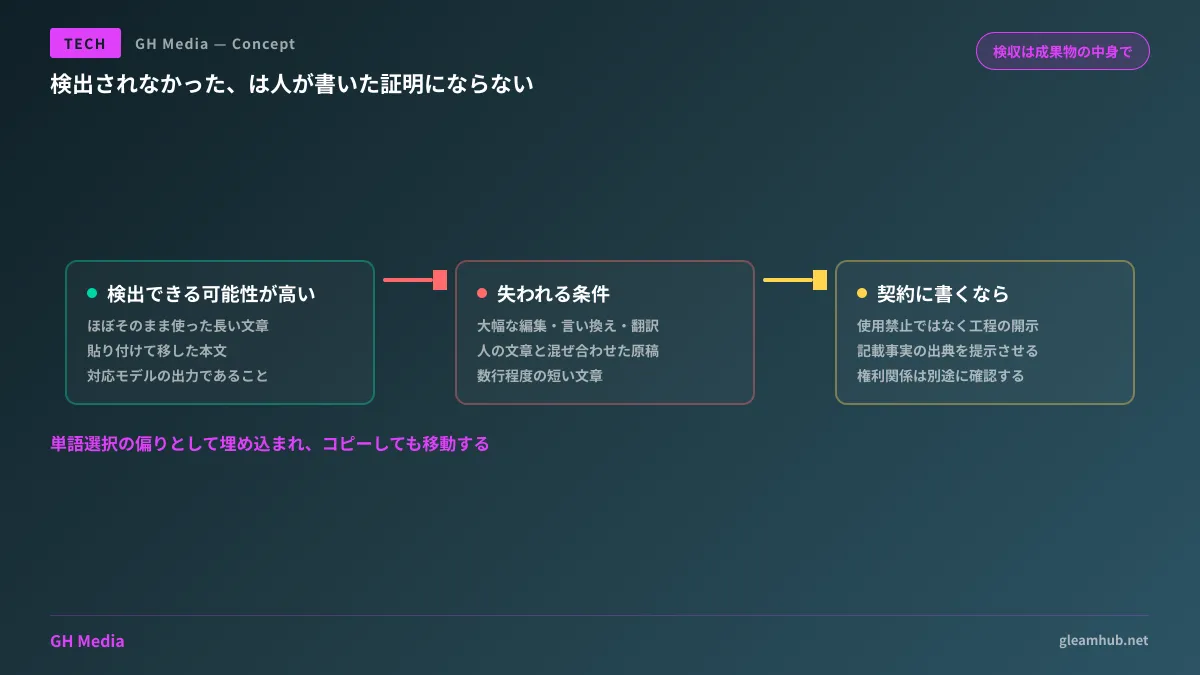
| Substantial text using supported model outputs virtually unchanged | Text that has been heavily edited, paraphrased, or translated |
| Body text moved to another document via copy-and-paste | Drafts blending AI text with human writing |
| Short snippets consisting of only a few lines |
The limitations Anthropic itself points out are that editing, paraphrasing, translation, and mixing with other writing can destroy the watermark, and that very short passages lack sufficient statistical information for detection.
These limitations carry decisive practical consequences. Having humans edit and refine generated drafts is now standard practice. Deliverables that have passed through this workflow are highly likely to have their watermarks diluted or erased entirely. In short, "not detected" does not mean "written by a human."
Furthermore, this applies exclusively to supported Claude models. Using other models or platforms leaves no such mark. Pressuring contractors based solely on detection outputs carries a serious risk of damaging relationships over factual misunderstandings.
Writing "AI prohibited" does not make acceptance checks easier
In response to these developments, some clients are tempted to write "generative AI use prohibited" into their contracts. We receive inquiries about this regularly. However, such clauses rarely function in practice.
The reason, as detailed in the previous section, is that detection limitations prevent verification. A clause whose compliance cannot be verified works solely to the advantage of parties willing to ignore it.
More fundamentally, what actually troubles clients is not that AI was used. It is factual inaccuracies, misspelled company names, faulty numbers, text virtually identical to competitor publications, or logic that collapses under expert scrutiny. These are the real pain points, not the method of generation itself. Banning the tool achieves nothing if low-quality deliverables are simply produced by hand.
Acceptance criteria function much better when focused on the qualities of the deliverable rather than how it was generated. Are facts corroborated? Are sources cited? Does it align with the materials provided? These criteria apply equally whether written by AI or a human, and evaluation failures translate cleanly into actionable revision requests.
How to draft AI usage clauses in agency contracts, complete with specific wording, was outlined in AI Usage Clauses and Deliverable Acceptance with Web Development Agencies. The current watermarking rollout is best viewed as strengthening the foundation for the "mandatory disclosure" approach discussed there.
What commissioning clients actually need to decide
With watermarking introduced, the following points are worth revisiting across your contracts and operational workflows:
Require disclosure rather than prohibiting use. Have contractors declare which phases utilized generative AI (drafting, structuring, translation, proofreading, etc.). Because it is not a ban, vendors can report openly, allowing you to adjust your verification rigor based on the specific phase.
Tie fact-checking accountability to the deliverable itself. Making "ability to provide verifiable sources for stated facts" a requirement functions regardless of the production method. Unsourced statements can simply be routed into standard revision workflows.
Clarify intellectual property terms. Copyright ownership and commercial usability of AI outputs vary based on the specific services and modes of utilization. As summarized in Copyright and Commercial Use of Generative AI Content, this issue must be addressed independently of whether a watermark is present.
Establish internal operational policies at the same time. Text produced internally using AI will carry identical watermarks. Materials submitted to clients, published press releases, and job postings: you must account for the possibility of outbound company documents being classified as "AI-generated." This is not inherently problematic, but whether you are prepared to explain it when asked makes all the difference.
What to do next
Review your current contracts for outsourced writing and content creation, and check whether generative AI is mentioned at all. Most contracts will likely say nothing. In that case, consider whether you can introduce "disclosure" and "source citation" rather than a blanket "prohibition" during the next contract renewal.
Even once detection APIs become available, relying on them as pass/fail gates for acceptance checks is ill-advised. Their detectable scope is inherently limited, and making accusations based on detection outputs carries immense costs if mistaken. Treat them as reference data, and base your acceptance evaluations on the actual substance of the deliverable. Keeping this priority intact is by far the safest approach in practice.
GleamHub provides support for structuring development and creative contracts involving generative AI, as well as formulating internal AI usage guidelines, through our Development, AI, and Automation consultation. Appropriate scopes vary based on industry and data sensitivity, so please contact us individually. Get in touch via Contact Us.
Sources
- Anthropic Implements Invisible Watermarks in Claude Generated Text — gihyo.jp
- Claude Started Watermarking Text, So I Investigated How LLM Watermarking Works — Zenn
- Anthropic’s text watermarks signal new front in AI detection — Axios
- Anthropic To Mark Claude Text & Files Under EU AI Act Code — Search Engine Journal
- EU compliance, delivered globally: Anthropic to watermark Claude’s output worldwide — Euronews


