The day a corporate website launched was its finest state. From then on, it gradually drifts.
Nothing broke. The services listed are outdated. Project achievements stopped updating three years ago. The careers page lists job openings that differ from current hiring needs. Anyone could fix it if they wanted to, but no one in the company has the time to do so. By the time anyone notices, conversations turn to "isn't it about time for a full renewal?" and you find yourself facing another estimate in the millions of yen.
Do you proceed on the premise of repeating this cycle, or adopt a different model? This is the crossroads that defines your contracting approach.
Why rebuilding every three years made sense
A full renewal every few years used to carry its own rationale.
Coordinating with an agency every time you update a website takes effort. Getting an estimate, placing an order, and reviewing work just to fix a single page. Because this back-and-forth cost per instance is non-trivial, companies conclude that ordering in bulk is cheaper. And if bundling it all together, they figure they might as well rebuild everything.
Whether this model remains rational today depends on your purpose for maintaining the website. If it merely needs to exist as a corporate brochure and belongs to an industry with low update frequency, rebuilding once every three years causes no issues.
Conversely, if you expect to generate inquiries through the site, the premises change. A website two years post-launch not only contains outdated content, but also gets pushed down in search rankings by competitors. You end up repeating a three-year cycle where performance peaks right after a redesign and then steadily declines.
What changes when shifting to continuous improvement
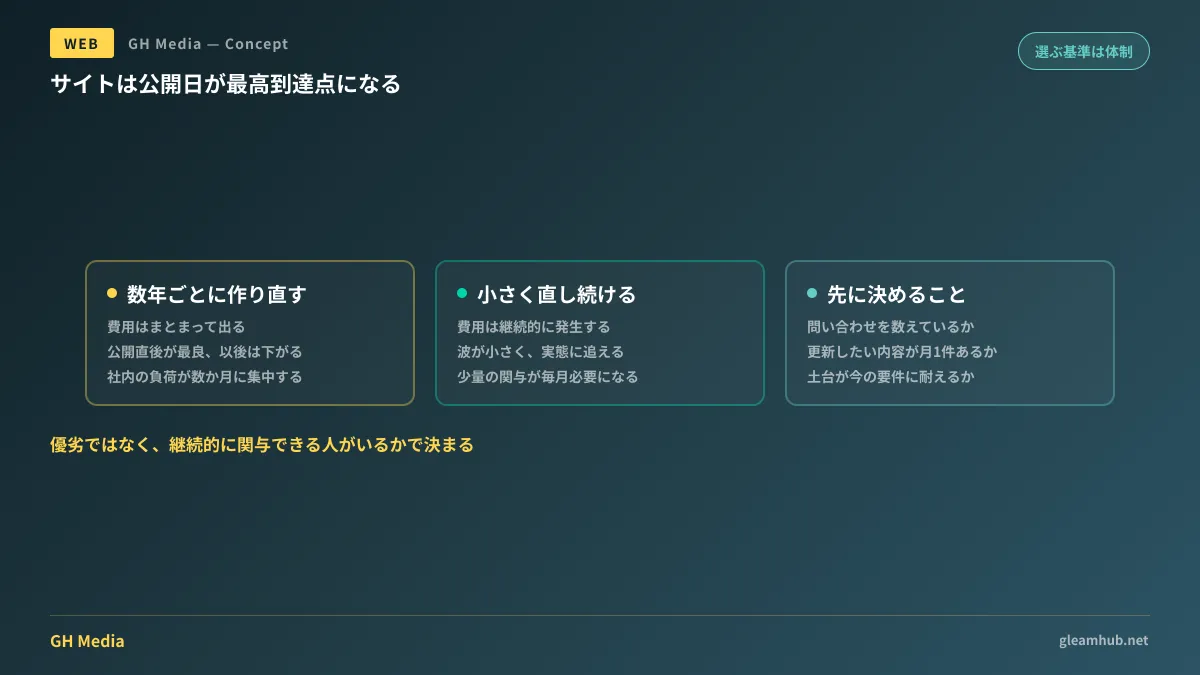
Shifting to continuous small improvements changes how costs occur. Instead of a lump sum of millions of yen flowing out, expenses occur continuously. This does not necessarily mean the total cost will be lower. What changes is the nature of the expense and what you obtain in return.
| Evaluation axis | Rebuilding every few years | Continuous small improvements |
|---|---|---|
| Cost structure | Lump sum every few years | Incurred continuously |
| Site condition | Best right after launch, declines thereafter | Fluctuations are small, updates keep pace with reality |
| Internal involvement | Concentrated during renewal period | Small amounts occur continuously |
| Search visibility | Rankings fluctuate with each rebuild | Accumulated equity is less likely to break |
The third row, "internal involvement," is an easily overlooked item. A full renewal concentrates drafting copy, arranging photography, and internal reviews into a few intense months. During that period, team members must run this alongside their day-to-day work. Switching to continuous improvement eliminates this massive peak, requiring instead a small amount of ongoing involvement each month. At companies that cannot designate a point person, this "small amount" fails to sustain, and progress eventually stalls.
In other words, rather than one approach being inherently superior, it is a choice that depends on whether your company has someone who can stay continuously involved.
Three questions to guide your decision
Which model suits your company can largely be sorted out with the following questions:
Do you track inquiries generated through the website? If you do not track them, you cannot measure effectiveness under a continuous improvement model, making it impossible to evaluate whether the spend is justified. Starting with measurement is the correct first step.
Do you have at least one content update per month? Track records, case studies, announcements, recruitment postings. Companies where these arise continuously are well-suited for ongoing improvements. For companies with movements only a few times a year, maintaining a continuous engagement retains little value.
Can the site's foundation withstand current requirements? This is the single biggest factor. Slow loading speeds, broken layouts on smartphones, or having to contact an agency just to change a single line of text. Under such conditions, the unit cost of work will not decrease no matter how much you try to improve incrementally. Checking how current metrics for page speed and user experience stand gives a strong indication of whether the foundation needs to be rebuilt.
If the third item applies, rebuilding once before transitioning to continuous improvement is the realistic path. Rather than an either-or choice between rebuilding and continuous improvement, it can be treated as a matter of sequence.
How to interpret cost benchmarks
When considering a rebuild, pricing is roughly determined by page volume and architectural scope. GleamHub's published standard guidelines range from 300,000 to 700,000 yen for landing pages, 800,000 to 1,500,000 yen for small-scale corporate sites (5–8 pages), and 1,500,000 to 2,500,000 yen for standard corporate sites (10–15 pages). Formal quotes are provided free of charge.
Costs on the continuous improvement side vary widely depending on what and how much you delegate, meaning they are not suited for flat rate benchmarks. The required workload shifts depending on whether your company supplies copy internally and only outsources publication work, or if you entrust planning from the ground up. This is an area requiring individual estimates based on listed requirements.
Before comparing price tags, check whether the site has been structured such that external contracting is required for every single update. If built in a structure requiring vendor requests for every modification, continuous improvement unit costs will not drop, ultimately leading back to the conclusion that rebuilding everything at once is cheaper. If rebuilding, deciding who will update what over the next three years before building proves effective.
What to do next
Check the date when your current website's content was last updated. It can be copy on the top page or an addition to your project portfolio.
If that date is more than a year ago, the exact same thing will happen even if you rebuild it next time. What should be decided before rebuilding is not the design direction, but who will update what after launch. Undertaking a full renewal without establishing this means you will be looking at the same estimate three years from now.
Evaluating existing websites, determining whether rebuilding or continuous improvement suits your company, and designing post-launch update workflows are available through GleamHub's website production and renewal consultation. Because the optimal setup varies depending on your current site structure and internal resources, please consult with us via our contact form.