

"We're listed on the Long-Term Care Service Information Disclosure System, so do we really need our own website?" Facility operators often wonder this when weighing the necessity of an independent web presence. The disclosure system is a statutory obligation under the Long-Term Care Insurance Act, and virtually all facilities report and publish their information. Anyone searching can locate facilities by checking that registry. That is certainly true.
An independent website does not replace the statutory disclosure system. Instead, it serves as a supplement to convey the workplace atmosphere to job seekers and share current intake availability with care managers. Setting the creation goal around enabling visitors searching by facility name to immediately find required information and contact details delivers the best results.
This article outlines decision-making criteria for care facilities ordering or redesigning a website, highlighting where spending money produces real results.
Certain things cannot be conveyed through the disclosure system
The public disclosure system is designed to help care recipients make informed choices, presenting service offerings and operational metrics in a standardized format. It is very effective for filtering candidates by baseline criteria.
However, all it shows is whether qualifications and conditions match. Once facilities are shortlisted, families of care recipients and care managers want to know entirely different things:
- What kinds of people work there? Do staff stay long-term?
- What does a typical day look like? What is the atmosphere of the facility?
- Who can be contacted, and how, when questions or emergencies arise?
This information is far easier to convey when supplemented with photographs and quotes from staff alongside disclosure figures. That is why people search and visit the facility's dedicated website. Planning becomes much clearer when you view the public disclosure system as "the place to make the shortlist" and your own website as "the place to get chosen."
Three distinct audiences visit, each seeking different information
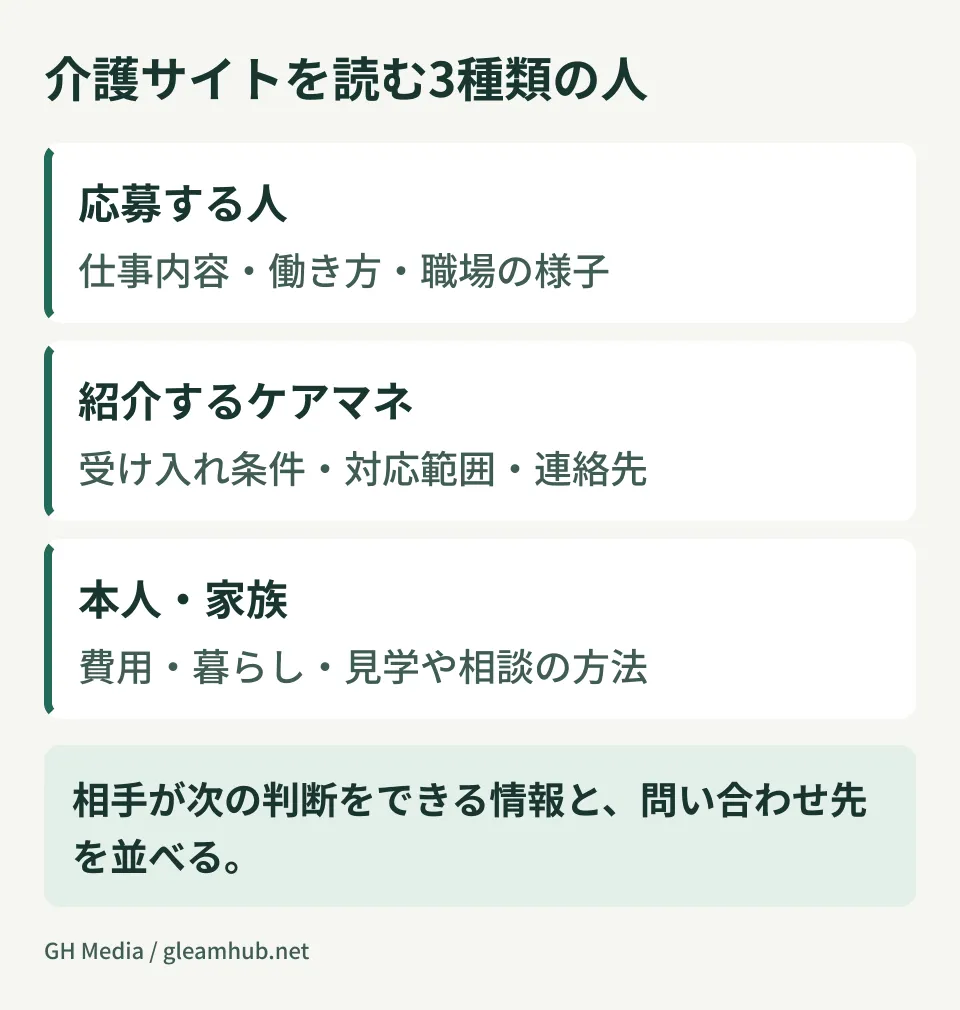
Care facility websites often end up mediocre because they create a single conversion pathway despite having multiple distinct types of readers. In reality, three distinct audiences visit with different objectives.
| Visitor audience | What they come to verify | What you should provide |
|---|---|---|
| Care recipients and their families | Whether they can entrust care with peace of mind, and total costs | Staff portraits and staffing structure, daily schedule, pricing structure, consultation contact details |
| Care managers | Whether candidate criteria and care capacity align as a referral destination | Manageable health conditions, admission feasibility and bed availability, direct contact channels and coordinators |
| Job seekers | Whether they can sustain a career here long-term | Staff testimonials, actual shift schedules, certification support, low barrier to apply |
Cramming all three audiences into a single page produces content that resonates with none of them. Separating three entry pathways from the top page and letting each audience reach completion on dedicated pages yields far better outcomes.
The audience most frequently overlooked is care managers. Care managers at in-home care support providers closely examine equipment, staff composition, and specific care programs when searching for facilities that match their clients. If information is sparse, they will avoid the hassle of calling to confirm and simply pick a competitor. Merely detailing "manageable health conditions" and "direct phone lines for intake coordinators" opens the door to steady referrals.
What works on recruitment pages is not "pretty photos"
When communicating with job seekers who are evaluating multiple workplaces, remember that applicants are comparing several facilities side-by-side. What sets you apart is neither exterior shots of the building nor corporate slogans. It is the concrete reality of working there.
What hesitant applicants genuinely want to know usually boils down to the following:
- Actual shifts: How many night shifts per month? Are preferred days off approved? How much monthly overtime?
- Staffing ratios: How many staff members manage one floor? What happens when someone takes sudden sick leave?
- Onboarding path: What did recruits with no prior experience or certifications learn, and in what sequence?
- Certification support: Are exam fees subsidized? Can training take place during paid working hours?
The third item is particularly effective. At an unfamiliar workplace, people want reassurance that they will not be left to fend for themselves after joining. Featuring senior staff recounting their first few months in their own words directly answers that concern.
Conversely, certain content delivers zero impact even if included: lengthy greetings from executives, generic mission statements indistinguishable from competitors, and overly edited photos. None of these contain information unique to your facility, meaning they offer zero decision-making value to readers.
General guidance on constructing recruitment pages is detailed in Key Points in Recruitment Website Production, which serves as a helpful reference for structural templates.
Certain areas are subject to advertising and disclosure regulations
The long-term care sector is subject to stringent rules regarding promotional statements. Leaving everything entirely to a web agency without understanding these boundaries often necessitates revisions after launch.
- For fee-charging homes for the aged, "misleading representation" is strictly defined by the Japan Fair Trade Commission Notification (Notification No. 3 of April 2004) under the Act against Unjustifiable Premiums and Misleading Representations. Representations that omit clear disclosure of limitations regarding land/building title relationships, physical amenities, private room usage, care services, staffing structure, management fees, and similar factors are subject to regulation. Applicable statutes and advertising rules differ depending on facility classification. Rather than applying rules for fee-charging homes directly to long-term care health facilities or serviced housing for the elderly, always verify the latest guidance from the supervisory local municipality for each facility type, medium, and claim.
A frequent operational stumbling block is phrasing that obscures the actual service provider. Examples include listing care services that the facility itself does not provide as though they were in-house offerings, or publishing services not covered by public insurance without explicitly detailing their content and out-of-pocket fees. Both regularly draw regulatory scrutiny.
A similar caution applies to the medical sector. As noted in Website Production for Medical Clinics and Practices, deciding what not to write is part of production in regulated industries. When selecting a development agency, it is prudent to ask whether they have prior experience in this field.
What to decide before placing an order
Before requesting estimates, deciding on the following three points within your facility will make consultations far smoother:
1. Commit to a single primary goal for the website. Is it recruitment, care manager referrals, or orientation for families of residents? Even if you cover all three, narrow down to one target audience to receive prime visibility on the top page. Without this decision, the agency has no criteria for strategic layout.
2. Secure photography and staff cooperation early. What resonates most on care facility websites are the authentic expressions and words of actual employees, which no agency can generate on its own. Deciding who will appear and scheduling shooting days ahead of time minimizes project delays caused by waiting for assets.
3. Decide who will manage post-launch updates. Bed availability, open job descriptions, and event recaps: sites where these remain a year out of date give visitors the impression that the facility is inactive. First determine who will update the site and at what cadence, and then choose a system that individual can comfortably operate.
General market rates for development costs are outlined in Cost Breakdown Guide for Website Production. For care facilities, costs vary depending on the number of recruitment pages and whether professional photography is included, so establishing your necessary scope beforehand makes quote comparison easier. For agency selection guidance, also refer to How to Choose a Web Development Agency.
What to do next
First, try searching for your facility's name online. If public registry pages and third-party job board listings appear while your own website does not—or if it appears but has remained untouched for years—prospective applicants are making their career decisions right there.
Next, determine which of the three target groups you want to attract most. If it is hiring, your next step is not hunting for a web agency, but deciding which staff members will be featured. Once that is set in motion, the rest of the website content falls into place naturally.
At GleamHub, we accept consultations for new website builds and complete redesigns for care and welfare facilities. For concerns like "We post on job boards but get no applicants" or "We want to increase referrals from care managers," we propose strategies ranging from audience-specific pathway design to navigating regulatory disclosure requirements. Because project pricing varies based on facility scale and desired features, we begin with a customized estimate. Please feel free to reach out via Contact Us.
Sources
- Long-Term Care Service Information Disclosure System — Ministry of Health, Labour and Welfare
- Misleading representation regarding fee-charging homes for the aged — Consumer Affairs Agency
- Compliance of advertisements and representations for fee-charging homes for the aged — Chiba Prefecture
- Addressing talent shortages in the care sector: causes and solutions from current data — MEIKOGLOBAL
- Tips for building websites for nursing care facilities and homes for the aged — ChacoWeb


