Open a corporate website one year after launch, and you will almost always see the same pattern: the latest post in the homepage "What's New" section dates back to right after launch; services that are no longer offered linger in the service overview; the careers page lists last year's openings.
Nobody was cutting corners. There are people who know it should be updated, and there are people capable of updating it. In most cases, however, those two roles belong to different individuals.
Not "broken," but "out of sync"
Websites do not degrade after peaking on launch day because of technical failures. It happens because the company keeps evolving while the website stands still.
Services expand, pricing shifts, and personnel change. Every time organizational reality shifts, the gap between reality and the website grows. The "dated feel" noticed a year later is simply the cumulative effect of these discrepancies.
While this dynamic has long been recognized, it has recently begun to be addressed from a different angle. In August 2026, Smashing Magazine published an article from an active developer's perspective on the concept of autonomous websites, where agents continue optimizing a site after launch. Underlying this is the understanding that all sites peak on launch day and slowly drift out of sync afterward—not because they break, but because nobody has the time to keep them current.
As a diagnosis of the problem, this is spot on. However, automation can only solve the mechanical execution; the actual bottleneck almost always lies further upstream.
Where updates stall is not in execution
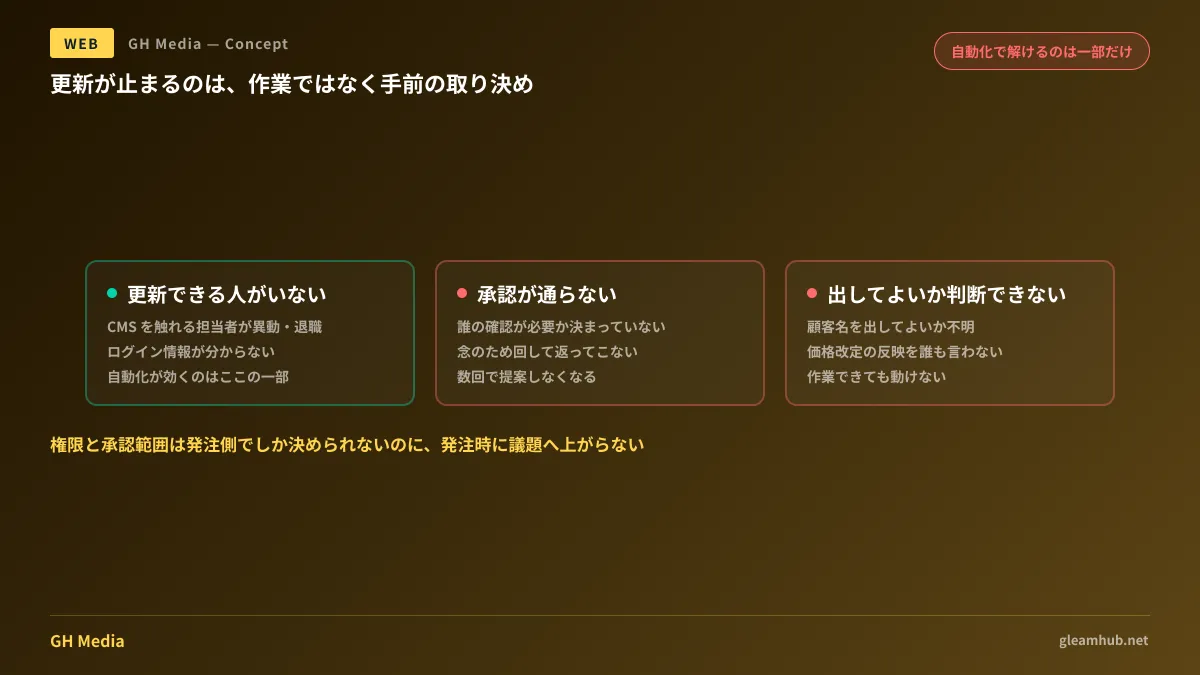
When you ask companies whose site updates have stalled, their bottlenecks almost always fall into three patterns.
First is when nobody inside the company can perform updates. A CMS was installed during development, but only the original project lead knew how to use it, and that person has since transferred. In some cases, it progresses to the point where nobody even knows the login credentials.
Second is when updates can be made, but approvals stall. Who needs to review a single copy change has never been defined, so it gets forwarded to a manager "just in case" and never returns. After experiencing this two or three times, staff stop proposing updates altogether.
Third is when nobody can judge whether an update is permissible. "We want to publish a case study, but don't know if we can disclose the client's name." "We changed our pricing, but nobody has confirmed if it can be reflected on the site." Without a designated decision-maker, staff cannot take action even if they have the technical capability.
None of these can be resolved by automating the work. Automation can only address part of the first scenario; the second and third are issues of internal organizational agreements.
Three points to decide upon ordering
When outsourcing web development, discussions up to launch are hashed out in detail, but post-launch operations tend to end with a casual "what should we do about maintenance?" Deciding the following three points at this stage transforms what happens later:
- Which pages will be updated by whom internally. Assign names, rather than asking for "a setup that allows updating." Update capabilities without designated owners go unused. Conversely, for pages where no owner can be assigned, designing them upfront under the premise that they will not be updated is far healthier.
- What scope of permissions to grant that person. Giving one person full editing permissions across all pages makes them too intimidated to touch anything. Restricting permissions strictly to frequently updated pages results in far more consistent updates.
- What content can be published without approval. Draw clear boundaries: adding news items can be done at the owner's discretion, while pricing or service changes require approval. If this line is not drawn, everything ends up waiting for approval.
None of these three points can be decided by the web design agency. They are decisions that can only be made on the client side, yet rarely make it onto the client's internal agenda.
Set update frequency at a "guaranteed minimum"
A common mistake when deciding is writing down an idealized frequency. Operations planned around "adding case studies twice a month" usually fizzle out within three months. This is not the fault of the staff; carrying a bi-weekly deadline on top of regular duties is simply unrealistic.
Commit to a minimum baseline you can reliably maintain. Even once a quarter, if consistently honored, the drift from operational reality stays minimal. A quarterly update that happens keeps a site fresher than a bi-weekly update that never does.
Furthermore, tying updates to business events rather than calendar dates makes them even less likely to stall: "whenever a new service launches," "whenever pricing is revised," or "whenever 10 closed deals accumulate." Anchoring updates to operational milestones rather than calendar days makes the business justification easier to communicate internally and helps approvals go through smoothly.
A deliberate "no-update premise" is not a bad policy
It is also worth noting that not every page needs continuous updates. Company profiles and business descriptions only need editing when reality actually changes.
The real problem lies in pages built with the expectation of updates that remain untouched. An empty "News" archive or a blog where the latest entry is two years old creates a worse impression than having none at all.
Therefore, if you are considering a site redesign, do not just look at expanding features—keep the option of retiring unsustainable features on the table as well. Closing an unmaintained blog and switching to adding case studies just twice a year is often far better aligned with organizational realities.
Note that this discussion focuses on "keeping content updates running." Maintenance tasks that cause operational incidents if neglected—such as plugin updates or SSL certificate renewals—are a separate matter and are mandatory regardless of update ownership. In addition, planning steps to prevent search traffic drops during a redesign represents another critical agenda item to verify before launch.
What to do next
First, make a list of your website's pages and write down when each was last updated. Pages that have seen no movement for over a year are precisely those that "were intended to be updated but could not be maintained."
Next, for each page, decide whether you will continue updating it or not. If you plan to update it, define the owner, permissions, and approval scope; if not, decide whether to retire it or replace it with static content. Having this inventory ensures post-launch discussions with your development agency will not end with a generic "what should we do about maintenance?"
GleamHub provides website redesign and development consultations covering new corporate site builds, redesigns, and CMS permission modeling that keeps updates sustainable after launch. Because the ideal implementation depends on your current site structure and internal organizational capacity, please consult with us individually. Reach out via our contact page.