
Consider a business that outsourced web development asking with concern: "I heard our site was built with something called Tailwind; are we going to be alright?" The news headline arrived first, leaving the company uncertain about what actually happens to their site.
To get straight to the point, this does not mean live websites will stop working tomorrow. At the same time, it is not a matter of "nothing happened, so ignore it." There are points to verify, and they concern maintenance agreements rather than software licenses.
What happened, ordered by impact
In September 2026, Shopify acquired Tailwind Labs, the developer of Tailwind CSS. Key points are outlined below.
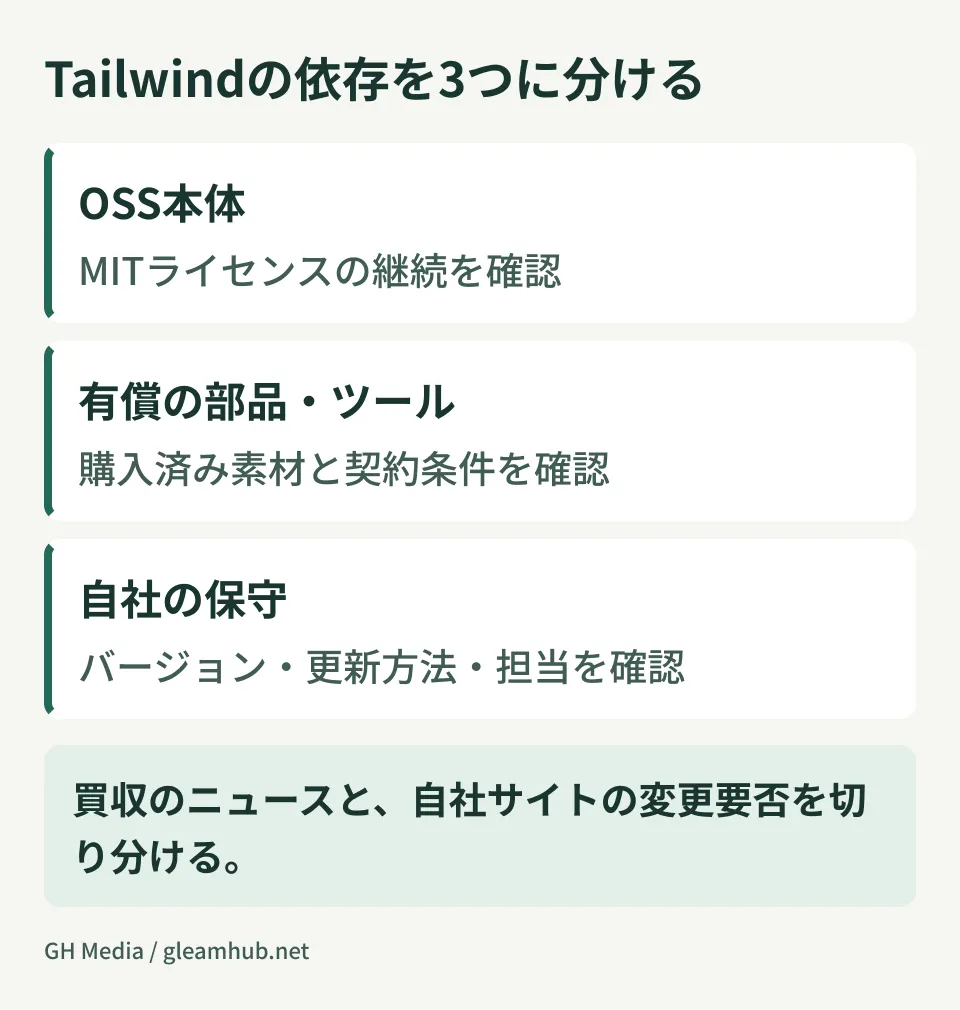
- Core Tailwind CSS remains under the MIT license. Related open-source projects such as Headless UI and Heroicons are also announced to continue under MIT
- The development team joins Shopify intact. There has been no announcement that development is stopping
- New orders for commercial products are suspended. Tailwind Plus and ui.sh ceased accepting new purchases as of September 9, 2026. Existing customers retain access to purchased assets
The third point does not directly disrupt the display of published websites. What needs checking are the terms for new purchases, additional development, or redesigns. The first and second points actually point toward secured long-term continuity.
What kept "free software" running
The official announcement explains a shift in focus from expanding commercial product sales to developing the framework that powers Shopify's production software. Even for free libraries, ongoing development requires funding and dedicated engineers.
What clients need to know is not how to forecast an open-source library's fundraising, but whether they can audit their own website's dependencies when provider structures shift.
What determines site lifespan is maintainers, not licenses
Under an MIT license, existing code can theoretically continue to run even if upstream development ceases entirely. Pages will not vanish.
Problems emerge when surrounding technologies shift: browsers update specifications, external dependencies update, or security patches become necessary. If no one is tracking updates, defects remain unfixed.
That is why the place to check is your own maintenance contract, not the library provider.
| Verification items | What to ask |
|---|---|
| Update ownership | Who monitors updates for libraries in use? |
| Scope of updates | Do maintenance fees cover library version updates? |
| Version pinning | Are versions pinned for externally loaded resources? |
| Handover | If changing development agencies, what is required to rebuild the environment? |
The third item applies beyond Tailwind. Loading external scripts via unpinned URLs means vendor changes immediately land on your production website. The hazards of this architecture were examined in The risks of unversioned CDN imports.
If built using commercial UI kits
If Tailwind Plus components were used during development, the practical realities are as follows.
Assets already in your possession can continue to be used. It has been announced that access to purchased scope will be maintained. Code already integrated into your website will not be retracted.
New purchases are suspended for new customers. This does not mean existing purchasers are barred from building additional pages using already acquired components. Check your current license scope and the terms of transfer if handing over from an agency.
Confirm with your development agency "what was sourced from where." Because this is invisible during initial estimation, asking before commissioning additional pages prevents future situations where agencies claim "matching the existing visual design requires unexpected billable hours."
This is not a prompt to switch frameworks
Hearing this, some ask, "Should we rebuild our site with something else?" However, this event is not a reason to rebuild.
Rebuilding is an undertaking that carries inherent costs and failure risks. Changing URLs degrades search traffic, and visual verification scales with page count. There is little reason to move when neither the license has changed nor development has halted.
Foundational criteria regarding where vanilla CSS suffices are organized in Comparing Tailwind and native CSS and What modern native CSS features can cover. Refer to them as decision inputs for your next new project.
What to do next
Open your website's maintenance contract and verify whether library and plugin updates are included in the scope of work. If not specified, updates are effectively nobody's job.
If unspecified, ask at your next meeting: "Who monitors update announcements, and when will recommendations be proposed?" Clarifying this eliminates the need to inquire every time industry news breaks.
GleamHub provides website development and redesign consultations covering audits of technologies used in existing sites, drafting maintenance contracts that include update tasks, and evaluating whether framework migrations are necessary. Because approaches depend on current architecture and operational setups, please reach out via Contact Us.
Sources
- Tailwind Labs is joining Shopify — Official Tailwind CSS announcement
- Shopify acquires Tailwind Labs, maker of the web’s top CSS framework — Dealroom News
- Tailwind finds “stable, long-term home” with Shopify acquisition — BetaKit
- Shopify Acquires Tailwind Labs: What the Open Source CSS Framework’s New Home Means for Developers — SourceTrail
- Shopify Rescues Tailwind CSS: AI Made It Ubiquitous While Killing Its Revenue — TechTimes


