
There is space against your capacity, yet not one request to visit comes in all month. You are listed on job boards, yet no support staff apply. Running an after-school day service, these two can happen at the same time.
When parents look for a provider, alongside municipal listings and referrals from caseworkers, they search for the provider's name or their area on a smartphone. If the site that comes up is several years out of date, or does not come up at all, the provider quietly drops off the shortlist for a visit. Job seekers take the same route.
Here we lay out the parts that, settled in advance by the commissioning side, make building or rebuilding an after-school day service website go faster. This is the stage before looking for a production company.
The three visitors want different things
People in different positions come through the same entrance to an after-school day service website. Treat them as one group of "users" and every one of them gets a page that only half works.
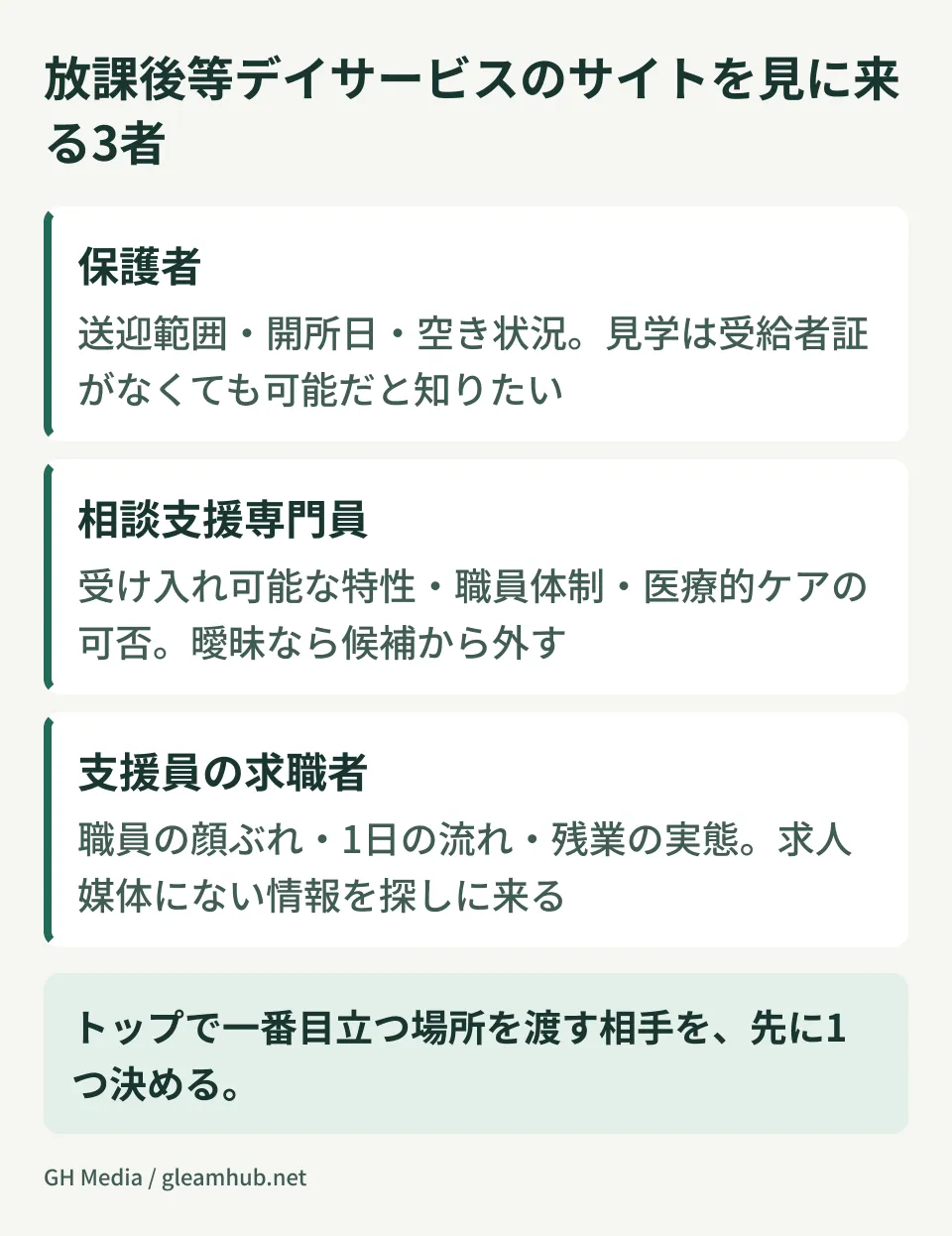
What parents check first is whether their child can attend. The pick-up and drop-off area, the days and hours you are open, how days off school are handled, and whether there is space now. Next they look at what kind of support you provide. If all it says here is "we provide developmental support", there is no way to tell you apart from anywhere else.
Service coordinators come to judge whether the provider suits a child in their care. They need information a step beyond what parents need: the characteristics of the disabilities you accept, your staffing, whether medical care is possible. Because recommending an unsuitable provider causes trouble later, anyone making referrals drops providers whose descriptions are vague.
What support-staff job seekers look at is what the people who work there are like. Those holding childcare worker or child instructor qualifications get plenty of offers from other industries, and pay alone does not move them. Who they would work with, what a day looks like, the reality of overtime and work taken home. A site that does not cover this loses candidates before they apply.
Parents are unsure what is needed before they can start
Using an after-school day service requires a beneficiary certificate. Applying for one requires preparing a support plan for the child with a disability and submitting it to the municipality; this can either be prepared by a consultation support office on request, or submitted as a self-plan the parent writes themselves. It can take one to two months from submitting the paperwork to the decision being granted.
What tends to be overlooked here is that a visit or an enquiry about using the service does not require a beneficiary certificate. Parents considering this for the first time sometimes believe they must not get in touch until they have obtained the certificate. If your site does not say so, no enquiry arrives until their paperwork is finished.
Simply stating "it is fine to start with a visit" and "we can also advise on obtaining a beneficiary certificate" moves the timing of enquiries earlier. Turning the path to starting into a diagram, so that anyone can see where they currently stand, also shortens the explanation over the phone.
Photos, and how specific you can be
What works best on a welfare-sector site is photographs of the facility and the staff. For an after-school day service, however, photographs showing children's faces need care. Decide before production whether to use only photographs for which individual consent was obtained from parents, or to show only backs and hands. If this is not settled, replacements come up just before launch and the schedule stalls.
How you describe your support needs to be specific too. "Support tailored to each individual" is written by every provider, so it gives nobody anything to choose on. Write down to the daily timetable, the activities actually run that day, and the names of the materials and programs you use, and parents can picture how their own child would spend the time.
There is also a direction you must not go in. Guarantees of results such as "improvement is certain" or "this cures X" can fall foul of the Act against Unjustifiable Premiums and Misleading Representations if they give an impression at odds with the facts. Outcomes in developmental support vary widely between individuals, so avoiding assertions and describing your actual activities and staffing ends up building more trust.
Do not make the careers page a copy of the job board
If you also want to recruit support staff through the site, pasting in the listing you already run on a job board has little effect. Job seekers look at the terms on the board and then search for your name and come to the site. They are here for information the board does not carry, so lining up the same thing adds nothing.
What is worth adding is closer to the felt experience of working there: how many staff there are and their range of experience, who the child development support manager is, whether training is provided, and what support staff actually do within the flow of a day. A short comment from a member of staff themselves gets read more than anything else.
Photographs and staff cooperation are the parts a production company cannot supply, so deciding in advance who will appear and when the shoot takes place reduces delays spent waiting on material. This way of sequencing the work is laid out in the same structure in Websites for nursing care providers.
Two things to settle before requesting a quote
1. Choose one audience for the most prominent spot on the home page. Visit requests, or recruitment. Even if you carry both, give the first thing people see to one of them. The period when you want to fill places and the period when you want to add staff are usually offset. It is fine to decide by which is more pressing now.
2. Decide who updates it after launch. Availability, photos from events, recruitment terms. A site where this is a year out of date gives visitors the impression of a provider that is not active. Decide who updates it first, then choose a system that person can handle.
For a sense of typical production costs, see the guide to website production cost ranges. For an after-school day service, the figure moves with the number of sites you run, whether photography is involved, and whether you build a separate careers page. On choosing a production company, see also How to choose a web production company.
What to do next
First, search for "your municipality name + after-school day service" and see where your own provider appears. If the top results are all other providers and portal sites, that is where parents finish comparing.
Then check whether your site says that a visit is possible without a beneficiary certificate. If it does not, adding that is the fastest thing that will help.
At GleamHub we take enquiries about new builds and rebuilds for after-school day services and other disability and child welfare providers. We propose everything from the path designed for each reader through to how photographs are handled and the cautions around representations. Costs vary with the size of the provider and the features you want, so we quote individually. Please get in touch via Contact.
Sources
- The path to using child development support and after-school day services — City of Kyoto
- After-school day service guidelines — Children and Families Agency
- Representation regulations (Act against Unjustifiable Premiums and Misleading Representations) — Consumer Affairs Agency
- What is a beneficiary certificate? Its types and how it differs from a rehabilitation certificate — AIAI VISIT
- Key points for attracting users to after-school day services: using the web to grow attendance — Shop Owner Support
- Six ways to win users for an after-school day service — Kaipoke