In a repository with automatic dependency updates, one day only the AI features start returning errors. Tracing the cause reveals that the SDK's major version went up and the version sent to the API changed too. If you maintain systems that use the Claude API, this situation could happen this October.
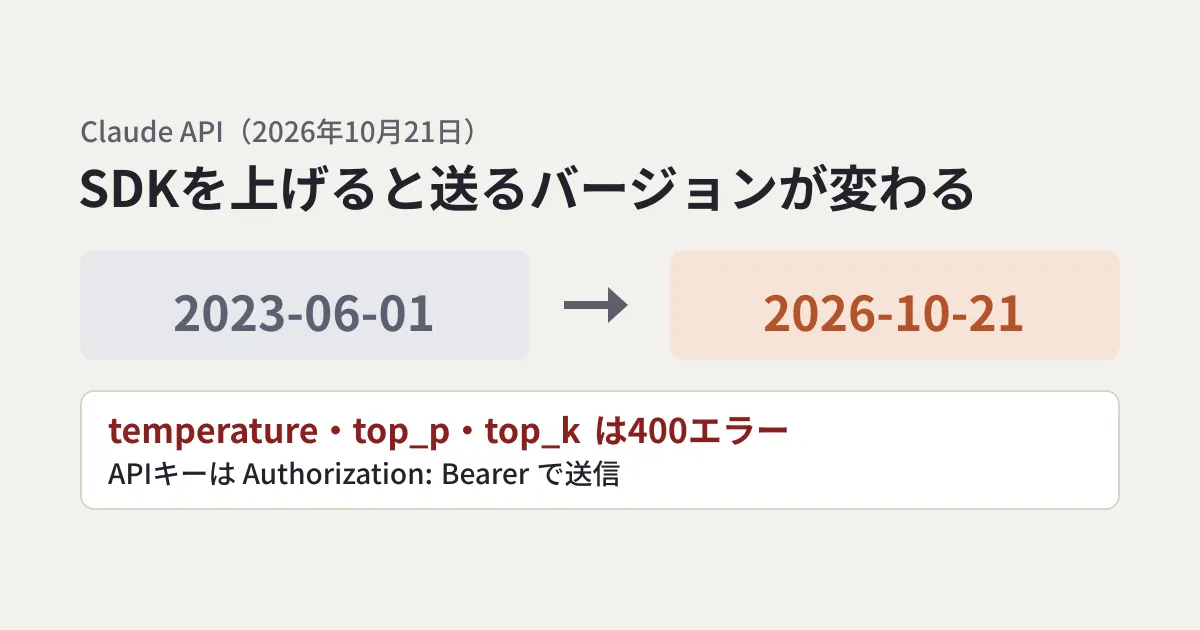
On October 21, 2026, Anthropic released a new Claude API version, 2026-10-21. On the same day, new major SDK versions that send this version by default (Python SDK 2.0.0, TypeScript SDK 1.0.0, and others) and the CLI were also released. In this article, we sort out which of the changes listed in the official migration guide are likely to affect internal systems and apps built through custom development, and show the results of running the Python and TypeScript SDKs in the editorial team's test environment (Linux).
What switches over
Until now, the SDKs sent every request with anthropic-version: 2023-06-01. The new major versions change this to 2026-10-21. The migration guide lists the first version in each language that sends 2026-10-21.
| Language | First version that sends 2026-10-21 |
|---|---|
| Python | anthropic 2.0.0 |
| TypeScript | @anthropic-ai/sdk 1.0.0 |
| Go | 2.0.0 (the module path changes to /v2) |
| Java / C# / PHP / Ruby | 3.0.0 / 13.0.0 / 1.0.0 / 2.0.0 |
As of October 27, 2026, the latest versions are Python 2.3.0 and TypeScript 1.3.0. Both contain feature additions and fixes released by October 23, and as far as the CHANGELOGs show, none of them relate to the changes covered in this article.
If you call the API over HTTP without an SDK, it stays at 2023-06-01 until you change the header value yourself. On Amazon Bedrock, 2026-10-21 can be used only with Claude 4.7 and later models. The migration guide says that if you call older models on Bedrock, you should stay on your current SDK version (or the version you are currently sending). The migration guide asks that you release the update to the new version together with the fixes listed below.
Changes likely to break things
From the migration guide's "Breaking changes" and "SDK and CLI changes", here are the ones most likely to have an impact.
Sending temperature, top_p, or top_k returns a 400 error. With 2026-10-21, sending any of these three parameters results in an error. The same applies even if you send the default values.
In
2026-10-21, a request that sendstemperature,top_p, ortop_kreturns a 400 error, even at the parameter’s default value.
Claude 4.7 and later models already accept only the default values, so their output does not change. On the other hand, processes that lowered temperature to stabilize output on models that accept other values, such as Claude Sonnet 4.6, lose that effect. The guide says there is no replacement setting.
API keys are sent with Authorization: Bearer. The new SDKs and CLI send the API key with Authorization: Bearer <key> instead of the X-Api-Key header. The Claude API itself accepts either, but if your internal proxies, gateways, log masking, or test stubs read X-Api-Key, those need to be fixed.
One credential per client. Passing both an API key and an auth token results in ValueError in Python and TypeError in TypeScript. Setups that sent both a token for a gateway and a key for the API behind it need to be reworked using the alternative described in the migration guide.
In addition, two other cases also return a 400 error: putting a document block directly in a assistant message, and adding citations to a text block in a user message. In the Admin API, some field names change, such as the API key's workspace_id being removed and replaced by scope. The SDK and CLI license changed from MIT to Apache 2.0 starting with the new versions. If you track dependency licenses in a register, update that entry too.
What we confirmed by running it in a test environment
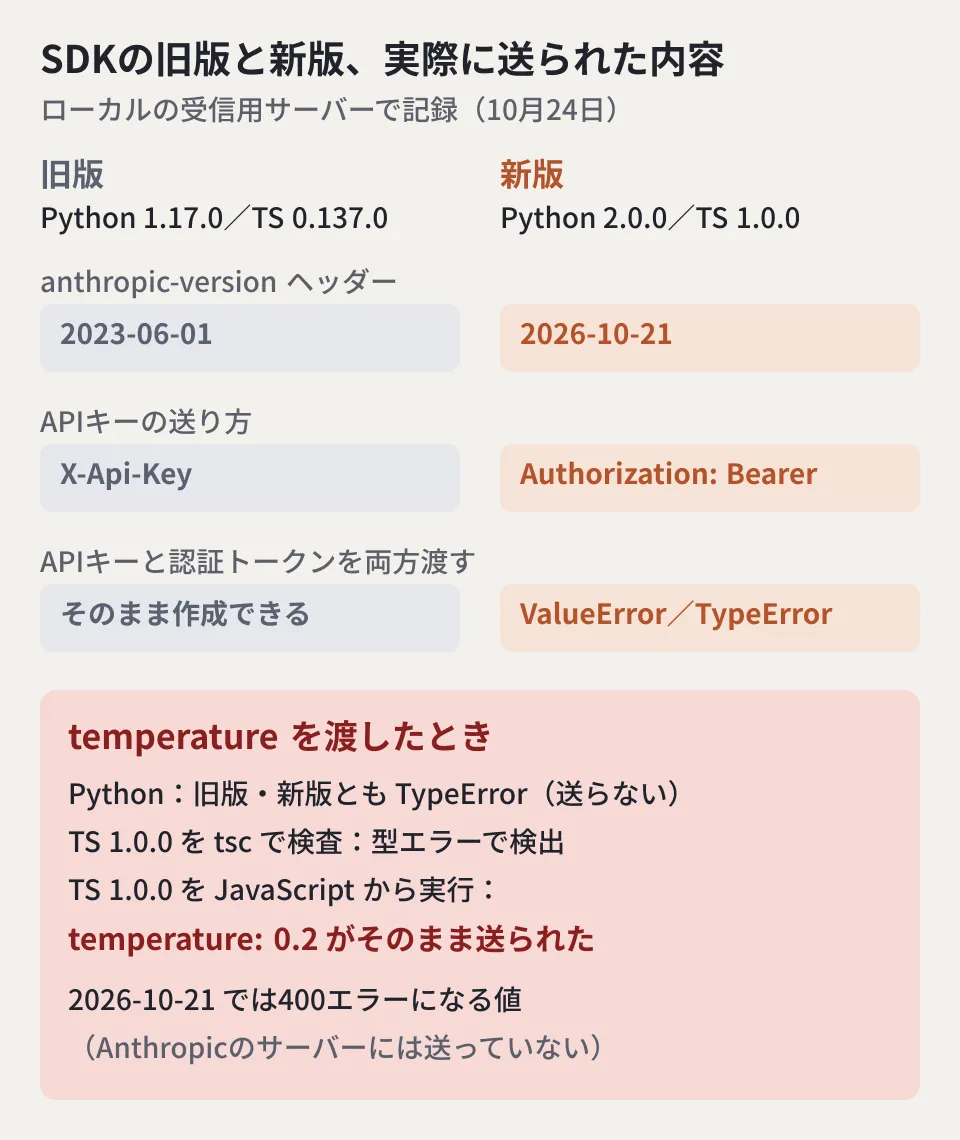
On October 24, 2026, we installed old and new versions of the Python and TypeScript SDKs in the editorial team's test environment (Linux), sent requests to a locally hosted receiving server, and recorded what was actually sent. The API key was a dummy, and we did not connect to Anthropic's servers.
Here is what we found.
- Version and auth header: Python 1.17.0 and TypeScript 0.137.0 sent
anthropic-version: 2023-06-01andX-Api-Key, while Python 2.0.0 and TypeScript 1.0.0 sent2026-10-21andAuthorization: Bearer. This matches the migration guide's description - Two credentials: When both an API key and an auth token were passed, Python 2.0.0 raised
ValueErrorand TypeScript 1.0.0 raisedTypeError. With the old versions, both could be created without errors - Handling of temperature differs by language: In Python, passing
temperatureto either 2.0.0 or 1.17.0 resulted inTypeError(unexpected argument), and nothing was sent. In TypeScript 1.0.0, type checking (tsc 5.9.3) reported an error thattemperaturedoes not exist. However, when the same call was run from JavaScript,temperature: 0.2was put into the body as is and sent
The third point needs care. TypeScript types protect only code that goes through type checking. In processes written in JavaScript, or processes that spread values read from configuration files and pass them in, temperature will continue to be sent even after upgrading the SDK, and you will only notice when the API returns a 400 error.
Steps to check before upgrading
From here on is the editorial team's own analysis.
- Identify which versions you are using: Use
package-lock.jsonorrequirements.txtto find cases where@anthropic-ai/sdkis below 1 oranthropicis below 2. Also check whether automatic updates (such as Dependabot) are set to bump major versions - Search for the three parameters, including temperature: Search the entire repository for
temperature,top_p, andtop_k. Include JavaScript files and places where values are read from configuration or databases and passed in - Find components that read headers: Find places in internal proxies, gateways, log masking, and test stubs that handle
x-api-key, and make them supportAuthorizationas well - Run the new version through staging: The migration guide asks you to test with
2026-10-21before release. Check for 400 errors and for changes in output tendencies (in processes that lowered temperature) - Keep processes you cannot fix right away on the old version: For processes that rely on a non-default
temperature, one option, as the guide notes, is to keep just those processes on2023-06-01
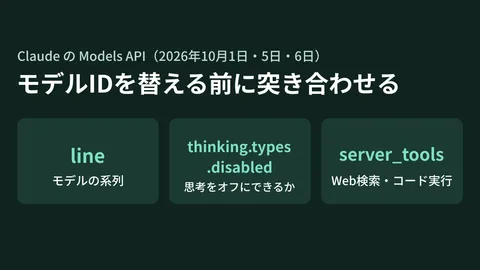
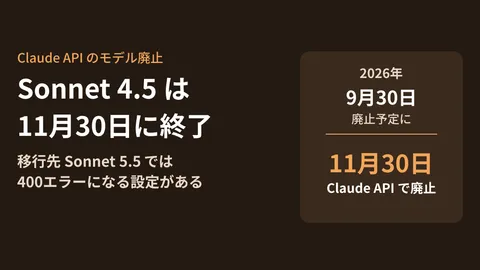
If you are reviewing this together with a model switch, also see What to check in the Models API before switching Claude models and Claude Sonnet 4.5 ends November 30: migration checkpoints. If you route internal AI calls through a gateway, check where headers are handled in the setup described in Should you put a gateway in front of internal AI?.
Scope of verification
On October 24, 2026, we opened the Claude Platform release notes and the migration guide "Migrating to API version 2026-10-21" directly on platform.claude.com, and checked the release dates and licenses of each version on PyPI and npm (document research). Before publication, on October 27, 2026, we reopened these along with the API versions page and the CHANGELOGs of both SDKs, confirming that their contents had not changed and checking the later versions (up to Python 2.3.0 and TypeScript 1.3.0). We also installed
anthropic1.17.0 and 2.0.0 on Python 3.11.17 and@anthropic-ai/sdk0.137.0 and 1.0.0 on Node.js 22.22.0 in the editorial team's test environment (Linux), sent requests to a local receiving server, and recorded the contents (hands-on testing). We did not connect to Anthropic's servers and have not verified 400 error responses, changes in output, the behavior of Go, Java, C#, PHP, Ruby, or the CLI, or calls via Amazon Bedrock or Google Cloud.
For maintaining systems with built-in AI or planning SDK updates, contact us through Development, AI, and automation consultations.