If you have built the Claude API into internal inquiry handling or document creation, every time a new model comes out you need to decide whether simply changing the ID is enough. When an update lowers prices, the temptation to switch quickly is even stronger.
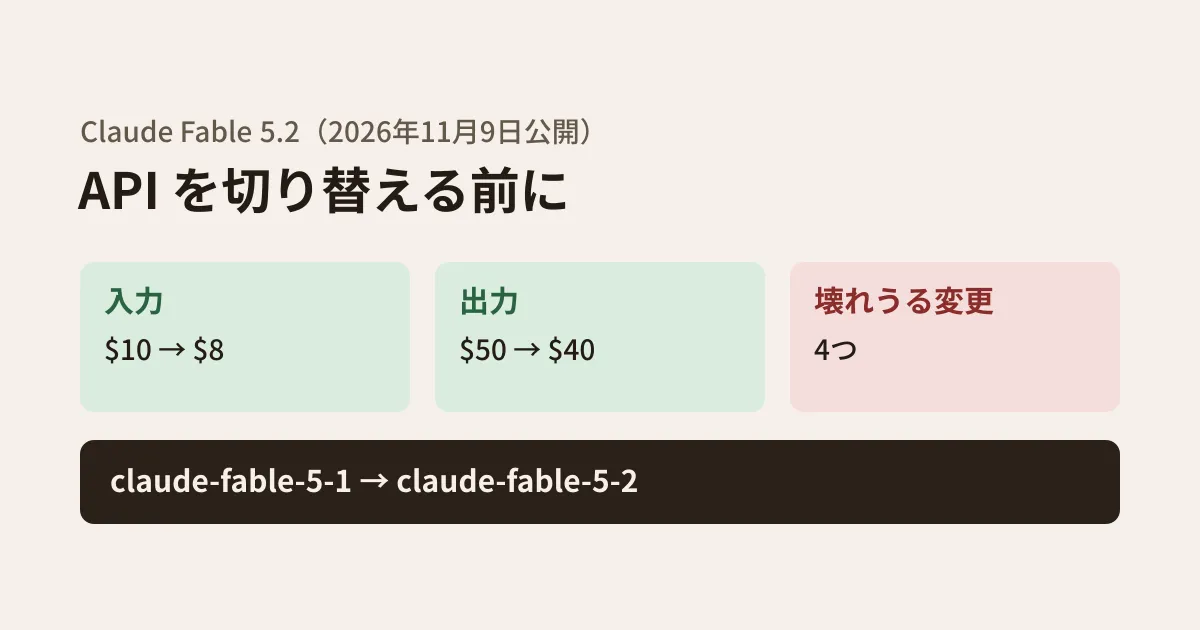
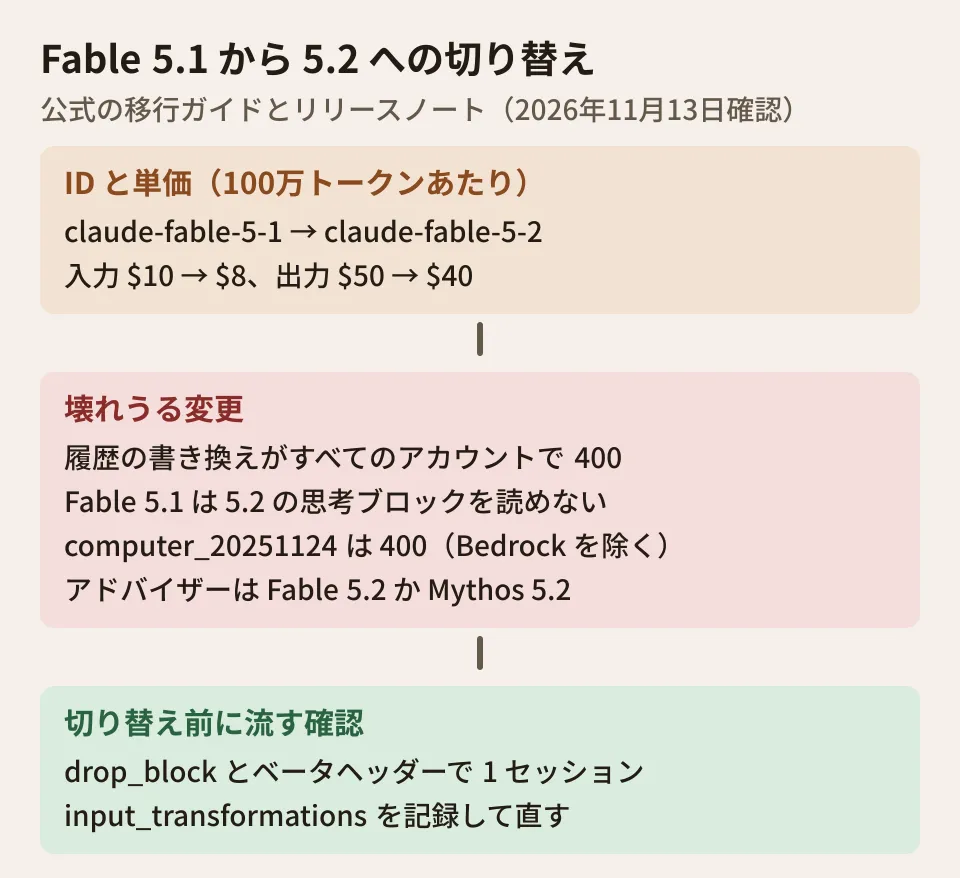
Anthropic released Claude Fable 5.2 on November 9, 2026. The API model ID is claude-fable-5-2, and pricing dropped from Fable 5.1's $10 per million input tokens and $50 per million output tokens to $8 for input and $40 for output. The official migration guide describes migrating from Fable 5.1 as "mostly drop-in", while listing four changes that can break code. In this article, we summarize these four changes and the checks to run before switching.
Model ID and pricing
The main values listed on the model page (Claude Fable 5.2), What’s new and the pricing page in the official documentation are as follows.
| Item | Claude Fable 5.2 | Claude Fable 5.1 |
|---|---|---|
| Claude API ID | claude-fable-5-2 | claude-fable-5-1 |
| Input / output (per million tokens) | $8 / $40 | $10 / $50 |
| Cache reads | $0.20 (0.025 times the base input price) | $0.25 (likewise 0.025 times) |
| Batch processing | Input $4 / output $20 | Input $5 / output $25 |
| Context / max output | 1M / 128K tokens | 1M / 128K tokens |
| Thinking | Adaptive and always on. Default effort is high | Adaptive and always on |
The Amazon Bedrock ID is global.anthropic.claude-fable-5-2 or us.anthropic.claude-fable-5-2, available only on the bedrock-runtime endpoint. On Google Cloud, Microsoft Foundry and Claude Platform on AWS, it is claude-fable-5-2. Retirement is stated as "Not sooner than November 9, 2027".
The migration guide's checklist also says that Fable 5.2's rate limits are separate from the limits shared by Fable 5.1 and Fable 5. Check your organization's limits before moving production traffic. Note that, like Fable 5.1, Fable 5.2 is not eligible for Priority Tier.
Four changes that can break your code
The migration guide lists the following four "Breaking changes" for migrating from Fable 5.1.
1. Code that rewrites history returns 400 on all accounts. Fable 5.2's thinking blocks can verify that the preceding system, tools and conversation history have not changed (the prefix check). According to the November 9 release notes, on Fable 5.1 this check returns an error by default only for accounts created on or after August 31, 2026, whereas Fable 5.2 and Mythos 5.2 perform the check regardless of when the account was created. The announcement also says "preserved thinking now applies to all accounts".
Note that the prefix check page, as we checked it on November 13, describes the result when no setting is specified as "400 error" for Fable 5.2 and "Possible 400 error" for Fable 5.1 (in some cases no error occurs and blocks that failed the check reach the model as they are), and does not mention the account creation date condition. According to both sources, requests that succeeded on Fable 5.1 can return the following error on Fable 5.2.
messages.5.content.0: Invalid `signature` in `thinking` block. The block is bound to a different conversation. Remove the block, or set `thinking.block_binding.prefix_mismatch_behavior` to "drop_block". That setting requires the `thinking-binding-controls-2026-08-01` value in the `anthropic-beta` header.According to the guide, resending the same request does not make this error go away. However, for Message Batches items, unless prefix_mismatch_behavior is specified, the request does not return 400 and the API drops the affected blocks instead. There is no impact if Claude Code, claude.ai, Claude Managed Agents or the Claude Agent SDK manages the history. The guide also says there is no impact if your own code builds messages, does not change system or tools mid-conversation, does not modify, reorder or delete past messages, and sends assistant responses back exactly as returned.
2. Fable 5.1 cannot read Fable 5.2's thinking blocks. On the Claude API and Google Cloud (Google managed), when you move a conversation from Fable 5.1 to Fable 5.2, the prior thinking carries over. On the other hand, only Fable 5.2 and Mythos 5.2 can read Fable 5.2's thinking blocks; even Opus 5.5 cannot. So when a conversation moves from Fable 5.2 to another model through router switching, retries or fallback to another model on refusal, the API drops the blocks that model cannot read. The request succeeds and the dropped blocks are not billed, but the first turn after switching runs without thinking, which can increase cost and latency.
3. The old computer use tool computer_20251124 returns 400. Outside Amazon Bedrock, you need to replace it with the computer_toolset_20260801 tool set. On Amazon Bedrock, Fable 5.2 also accepts the old tool.
4. Restrictions on advisor tool combinations. With the beta advisor tool, if Fable 5.2 is the executor, the advisor must also be Fable 5.2 or Mythos 5.2, or the request returns 400.
Also check the constraints that are unchanged from Fable 5.1. Thinking is always on, and specifying thinking: {"type": "disabled"} or budget_tokens returns 400. Forcing a specific tool with tool_choice (any, tool) also returns 400; the guide recommends using auto with strict tool use (strict: true) or JSON output instead. Fable 5.2 requires 30-day data retention and cannot be used under zero data retention agreements unless Anthropic explicitly approves it.
Differences in how prompts take effect
The migration guide lists three points where behavior changes even without code changes.
- Even with an instruction like "answer directly without thinking", in Anthropic's testing the model did not stop thinking at effort
mediumor higher (Fable 5.1 usually followed this instruction). The guide recommends removing that instruction line and lowering effort instead - In Anthropic's agentic coding products, the model was observed launching subagents to check its own work at
xhighormax. Subagents can account for a large share of a session's cost - Because thinking tokens also count toward
max_tokens, with a smallmax_tokensthe response can stop atstop_reason: "max_tokens"after thinking without producing any body text
The first and third points compound each other. Processing that fit within a small max_tokens on Fable 5.1 by instructing it to "answer without thinking" may stop with an empty body on Fable 5.2. If you have processing that returns short answers, such as classification or tagging, try increasing max_tokens or lowering effort.
Checks to run before switching (migration guide steps)
From the migration guide's checklist, the steps for systems that build messages themselves are as follows.
- Add the beta header
thinking-binding-controls-2026-08-01, setthinking.block_binding.prefix_mismatch_behaviorto"drop_block", and run one session of your usual conversations - Record
input_transformationsin the responses and fix everyprefix_binding_mismatchitem - Decide the production
prefix_mismatch_behavior: the default"error", or"drop_block"as a stopgap until the fixes are done. The guide advises against using"drop_block"for long, since dropping blocks can increase output tokens. Once decided, monitor for 400 errors orinput_transformationsitems - When replaying saved conversations, send them from the account that created them (or an account linked to it). If sent from another account, Fable 5.2's thinking blocks are dropped
- Retune effort with your own evaluations and re-establish cost and latency baselines
The guide says to also run the prefix check test against the model you currently use (Fable 5.1 or Opus 5.5) before moving production traffic.
If you do not pin the server's tool list with the MCP connector, a tool list that changes from request to request counts as a "rewrite" for Fable 5.2's thinking blocks. The guide says to run this check against claude-fable-5-2 as well.
Even if the unit price drops by 20%, the amount you are billed will not necessarily go down if the amount of thinking increases. What we checked when switching models in the past is summarized in our article on Claude Sonnet 5.5, and how to aggregate usage costs by model and by user is covered in our article on the Claude usage cost aggregation API.
Scope of verification
On November 12, 2026, we reviewed Anthropic's announcement of Claude Fable 5.2 and Mythos 5.2 (published November 9, revised November 11), along with the model list on platform.claude.com, the Claude Fable 5.2 model page, What's new, and the migration guide. On November 13, we rechecked the same materials and also reviewed the release notes, the pricing page, the prefix check page, and the rate limits page (documentation review). We did not call the API to verify anything (such as how 400 errors and
input_transformationsactually appear, or the amount of thinking tokens). Prices are the official figures in US dollars and do not include exchange rates or taxes.
GleamHub accepts consultations on development, AI and automation, including building generative AI into business systems and planning the verification of model switches. What needs to be checked depends on how you use it, so please reach out via our contact form.
References
- Anthropic — Claude Fable 5.2 and Claude Mythos 5.2
- Claude Platform Docs — Claude Fable 5.2
- Claude Platform Docs — What’s new in Claude Fable 5.2
- Claude Platform Docs — Claude Fable 5.2 and Claude Mythos 5.2 migration guide
- Claude Platform Docs — Models overview
- Claude Platform Docs — Release notes
- Claude Platform Docs — Pricing
- Claude Platform Docs — Prefix checks on thinking blocks