In Java business systems built with Spring Boot, the Spring Security version is determined by Boot's dependency management (spring-boot-dependencies). If you do not specify the Spring Security version yourself, it does not change unless you upgrade Boot. With this update, keeping that assumption may mean the fixes do not reach you.
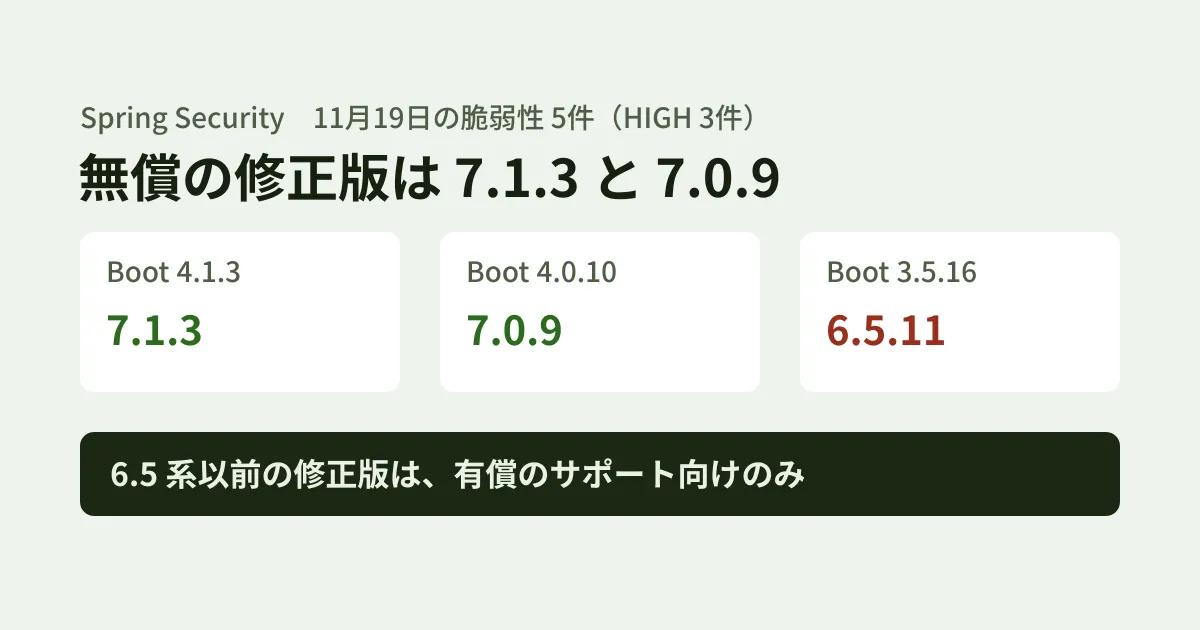
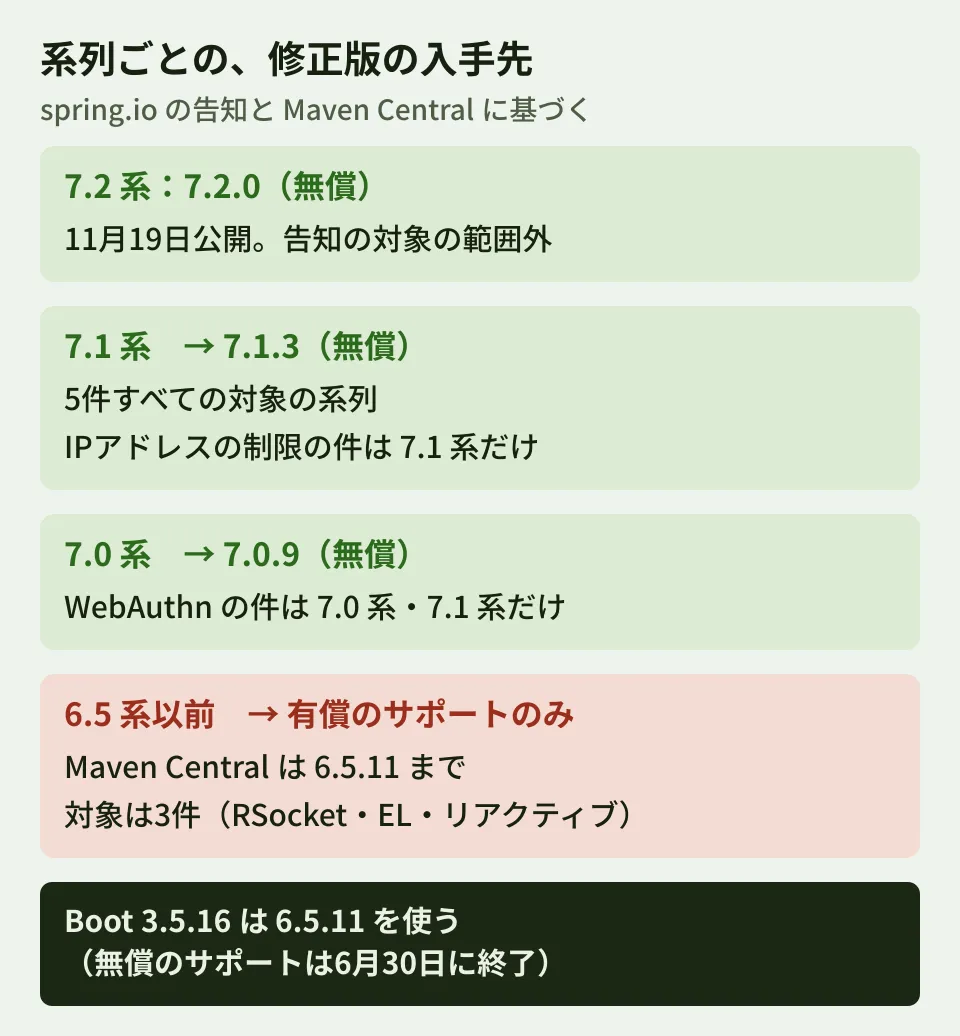
On November 19, 2026, Spring announced five vulnerabilities in Spring Security. In the "Fix version" field of each advisory, the only fixed releases distributed for free (OSS) are 7.1.3 and 7.0.9. 6.5.13, 6.4.20, 5.8.29 and 5.7.27 are marked "Enterprise Support Only", meaning they are for paid support customers. On the same day, 7.2.0, the first release of a new series, was also published to Maven Central. The 7.2 series is not within the affected range of the advisories, and comparing GitHub tags shows that the fix commits for all five are also included in 7.2.0.
Checking Maven Central, the Spring Security version used by 3.5.16 (June 25), the latest in the Spring Boot 3.5 series, is 6.5.11, which falls within the affected range of three of the five. According to spring.io's support period data, free (OSS) support for the Boot 3.5 series ended on June 30, 2026, and paid support runs until June 30, 2032. This article summarizes the conditions for the five issues and shows what teams staying on Boot 3.5 need to decide.
The five issues and when they apply
The severity in the advisories and the conditions under which each applies are summarized below.
| CVE | Severity | Affected feature | Conditions (from the advisories' Preconditions and other fields) |
|---|---|---|---|
| CVE-2026-59333 | HIGH | IP address restrictions | Setups that restrict client IPs with hasIpAddress() or similar and receive a mix of IPv4 and IPv6. 7.1 series only |
| CVE-2026-59330 | HIGH | WebAuthn (passkeys) | Authentication with the default Webauthn4JRelyingPartyOperations. 7.0 and 7.1 series only |
| CVE-2026-59331 | HIGH | RSocket authentication | Setups that use the default converter for RSocket Basic authentication |
| CVE-2026-59273 | MEDIUM | ELRequestMatcher | Setups that data-bind untrusted input to properties of this type |
| CVE-2026-59329 | LOW | Reactive login | WebFlux's formLogin() and similar. Responses are faster for nonexistent usernames |
IP address restrictions (CVE-2026-59333)
According to the advisory, when comparing the client address with a configured address range (CIDR), IpAddressMatcher and similar compared only the leading bytes without checking whether the address was IPv4 or IPv6. As a result, an address of the other type could be judged a match if its leading bytes happened to align.
The advisory's condition is a setup in which addresses of a different type from the configuration arrive, through any of the following: IPv4-mapped IPv6 addresses, settings that accept both IPv4 and IPv6, or a proxy that translates between the two. If you restrict an admin screen to internal IPs only, check whether this condition applies. Only 7.1.0 to 7.1.2 are affected, and the issue is fixed in 7.1.3.
WebAuthn(CVE-2026-59330)
A WebAuthn authenticator increments its signature count (counter) each time it is used. If the count has not increased or has gone backward, the authenticator may have been cloned, so the specification's approach is to reject it. According to the advisory, Spring Security's default implementation did not correctly pass the previously stored count to the verification component, so this check was not working.
The condition is that the attacker already has a clone of the victim's authenticator. The advisory positions this check as a "defense-in-depth control" (one layer of defense in depth). For internal systems that have adopted passkeys, this is a reason to raise the priority of the update.
The remaining three
The RSocket issue (CVE-2026-59331) lets a single crafted authentication frame make the server allocate an extremely large amount of memory. If you do not use RSocket, it does not apply.
The ELRequestMatcher issue (CVE-2026-59273) is that SpEL (the Spring Expression Language) expressions were evaluated in an unrestricted evaluation context. According to the advisory, Spring's data binding automatically finds this type's converter by naming convention, so if untrusted input is bound to properties of this type, the input can be evaluated as an expression. The advisory revised its CVSS score and description on November 23.
The reactive login issue (CVE-2026-59329) is that no password check is performed for nonexistent usernames, so valid usernames can be inferred from differences in response time.
Mapping to Spring Boot versions
The Spring Security versions specified by spring-boot-dependencies on Maven Central are as follows (release dates are Maven Central's Last-Modified, in UTC). The end dates of free support are based on spring.io's support period data.
| Spring Boot | Public | Spring Security | These fixes | Free support for the series |
|---|---|---|---|---|
| 4.2.0 | November 19 | 7.2.0 | Included (outside the affected range) | Until December 31, 2027 |
| 4.1.3 | November 19 | 7.1.3 | Included | Until July 31, 2027 |
| 4.0.10 | November 19 | 7.0.9 | Included | Until December 31, 2026 |
| 3.5.16 | June 25 | 6.5.11 | Not included | Ended on June 30, 2026 |
On Maven Central, the last 6.5 release of spring-security-core is 6.5.11; 6.5.12 and 6.5.13 are not available. 6.5.11 falls within the advisories' affected range (6.5.0 to 6.5.12). If you use Boot 4.0 or 4.1, upgrading Boot within the same series brings in the fixes. However, free support for the 4.0 series lasts only until December 31, 2026. If you use Boot 3.5 on free releases, there is no publicly available way to fix this within the same series.
Decisions for teams on Boot 3.5 (editorial summary)
First, check whether any of the five apply to your apps.
- The IP address restriction and WebAuthn issues do not affect 3.5 (the 6.5 series). Both affect only the 7.0 and 7.1 series.
- If you do not use RSocket, CVE-2026-59331 does not apply. Check whether
spring-boot-starter-rsocketis among your dependencies. - Search for any configuration properties that receive
ELRequestMatcher. Ifgrep -rn "ELRequestMatcher" srcfinds nothing, the issue is unlikely to apply. - If you have not built login with WebFlux, CVE-2026-59329 does not apply.
The three that can apply to 3.5 (the 6.5 series) are RSocket, ELRequestMatcher and reactive login. Note that as of November 24, the five are not listed in the GitHub Advisory Database. Check without waiting for notifications that rely on this database, such as Dependabot.
If none apply, there is little need to rush to Boot 4 because of these five. However, since free support for the 3.5 series has already ended, fixed 6.5 releases in future advisories are also expected to be for paid support only (editorial view). According to each spring-boot-dependencies on Maven Central, Boot 3.5.16 specifies Spring Framework 6.2.19 and Jakarta Servlet 6.0.0, while Boot 4.0.10 specifies Spring Framework 7.0.11 and Jakarta Servlet 6.1.0. Migrating Boot involves a major framework version change. As a target, the 4.1 or 4.2 series is a better candidate than the 4.0 series, whose free support ends on December 31, 2026. A realistic approach is to use this review as an opportunity to estimate the timing and scope of the migration.
If some apply and you cannot migrate right away, choose between obtaining fixed releases through paid support and changing your code so it does not use the affected features (the default converter for RSocket authentication, binding to ELRequestMatcher).
Scope of verification
On November 24, 2026, we checked the spring.io security advisories (CVE-2026-59273, 59329, 59330, 59331 and 59333, all published on November 19, 2026) and the list of security advisories; the version list for
spring-security-coreon Maven Central and whether a POM exists for each version;spring-security.versionand Last-Modified in the POMs ofspring-boot-dependencies4.2.0, 4.1.2, 4.1.3, 4.0.9, 4.0.10 and 3.5.14 to 3.5.16; spring.io's support period data for Spring Boot and Spring Security; and the spring-security releases on GitHub (7.1.3 and 7.2.0) along with a comparison of tags (desk research). We have not reproduced the issues or compared behavior before and after the update.
We have also covered how to approach updates for Java business systems in the article on Java 27's monthly security updates. For adopting and operating passkeys, see also the article on Android passkeys.
GleamHub accepts consultations on development, AI and automation, including maintenance of business systems built with Spring Boot and estimates for migrating to Boot 4. Please reach out via our contact form.
References
- CVE-2026-59333: Spring Security IP Address CIDR Matching Ignores Address Family(spring.io)
- CVE-2026-59330: WebAuthn Signature Counter Check Fails to Detect Cloned Authenticators(spring.io)
- CVE-2026-59331: Spring Security RSocket Basic Authentication Decoder Enables Denial of Service via Unbounded Allocation(spring.io)
- CVE-2026-59273: Spring Security ELRequestMatcher allows Remote Code Execution via unrestricted SpEL evaluation(spring.io)
- CVE-2026-59329: Spring Security Reactive Authentication Timing Attack Enables Username Enumeration(spring.io)
- Security Advisories(spring.io)
- Spring Boot support periods (spring.io)
- Spring Security 7.1.3 release (GitHub)
- spring-security-core(Maven Central)
- spring-boot-dependencies(Maven Central)