Some setups run an SFTP server for file exchange or an internal bastion server in a lightweight Alpine Linux container. The packages inside a running container stay old unless the image is rebuilt.
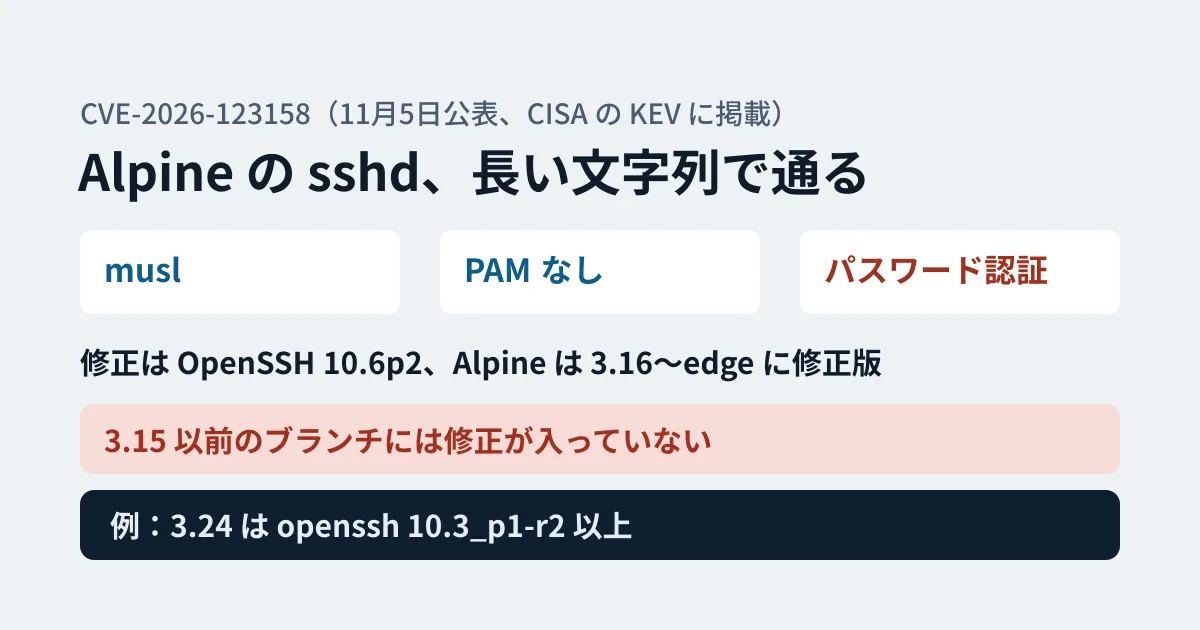
CVE-2026-123158, disclosed on November 5, 2026, may affect sshd in this kind of setup. According to the NVD description, on Linux sshd that uses the musl C library and runs without PAM, depending on account settings, an arbitrary password of 256 to 1024 characters can be accepted for login (257 to 1024 bytes according to Alpine's advisory). Alpine Linux is given as an example. On November 9, the US CISA added this vulnerability to its Known Exploited Vulnerabilities (KEV) catalog. In this article, we use Alpine's advisory, OpenSSH's release notes and repository, and the NVD and CISA records to lay out the affected conditions, the fixed versions, and what to check.
Consequence
The NVD description (the same text is also imported into GHSA-4fcc-vm97-gx3x in the GitHub Advisory Database) is as follows.
sshd in OpenSSH before 10.6p2 on Linux, when musl libc is used without PAM, lacks a workaround for a password authentication bypass (related to misinterpretation of whether a string is intended to be a password hash). For some configurations of accounts, any password between 256 and 1024 characters succeeds.
The CVSS 3.1 rating is AV:N/AC:H/PR:N/UI:N/S:U/C:H/I:H/A:H (8.1, HIGH). The assessment is that it can be attacked over the network without prior authentication, and although the conditions are hard to meet (AC:H), the impact on confidentiality, integrity, and availability is high in every case if they are met. Alpine's advisory, on the other hand, states that on a machine where the conditions are met, it works "in a single connection, every time, with no retries needed."
In CISA's KEV record, the date added is November 9, 2026. The remediation deadline for US federal agencies was November 12.
How it works
According to Alpine's advisory, sshd built without PAM hashes the submitted password with crypt() (a C library function that turns a password into a hash for storage) and compares it with the value stored in /etc/shadow and similar files. For accounts whose stored value is too short to extract a salt (the random value at the start of the hash), sshd borrows the salt of another account. For input longer than 256 bytes, musl's crypt() returns the string * as an error marker. Because the stored value for accounts with no password set is also *, the "hashes" match and the login succeeds.
The description of the OpenSSH fix (commit "avoid password authn bypass", November 5, 2026 in the author's local time) reads: "This bypass affects some configurations and runtime configurations. We do not consider the root cause to be within OpenSSH but we are well equipped to avoid it." In other words, the cause lies outside OpenSSH, but OpenSSH avoids it on its side. The fix makes the password-checking function (sys_auth_passwd) refuse to treat a match as valid when the stored value is shorter than 4 characters. Accounts with short values such as * no longer pass the check.
Conditions for being affected
Alpine's advisory states that you are affected if all of the following apply.
- You use Alpine's
openssh-server(built without PAM). Even withopenssh-server-pam, which has PAM, you are affected ifUsePAM no(not affected ifUsePAM yes) PasswordAuthenticationisyes(OpenSSH's default unless changed)- There is an account whose password field is
*. Since around Alpine 3.16,rootin the base image has beenroot:*. This also includes key-only users created withadduserwithout a password, users coming from a directory service via musl-nscd, and thealpineuser in the official tiny-cloud images - There is at least one local account with a password hash starting with
$5$or$6$
root cannot log in with a password as long as OpenSSH's default PermitRootLogin prohibit-password is kept. However, if an attacker gets in through another account that can become root via doas or similar, the result is the same.
Alpine's advisory lists the following as examples of systems that are not affected: sshd is not running in the container, PasswordAuthentication no is set, openssh-server-pam is used with UsePAM yes, there is no account with a hash starting with $, and cloud images configured with cloud-init (where PasswordAuthentication no is written). Locked accounts with ! in the password field cannot log in with either a password or a key.
OpenSSH's mailing list announcement states that non-Linux systems, Linux with glibc, and Linux that verifies passwords through PAM are not affected by this vulnerability.
If you cannot update right away, OpenSSH's announcement advises disabling password authentication or stopping SSH, and Alpine's advisory advises setting PasswordAuthentication no and restarting sshd. Alpine's advisory states that either updating or this setting closes the hole.
Fixed version
Portable OpenSSH added a workaround in 10.6p2 (tag V_10_6_P2, November 5, 2026). The release notes state: "This release contains a critical security workaround that affects Linux systems that use the musl libc and PAM disabled." As of November 20, no newer version has been released.
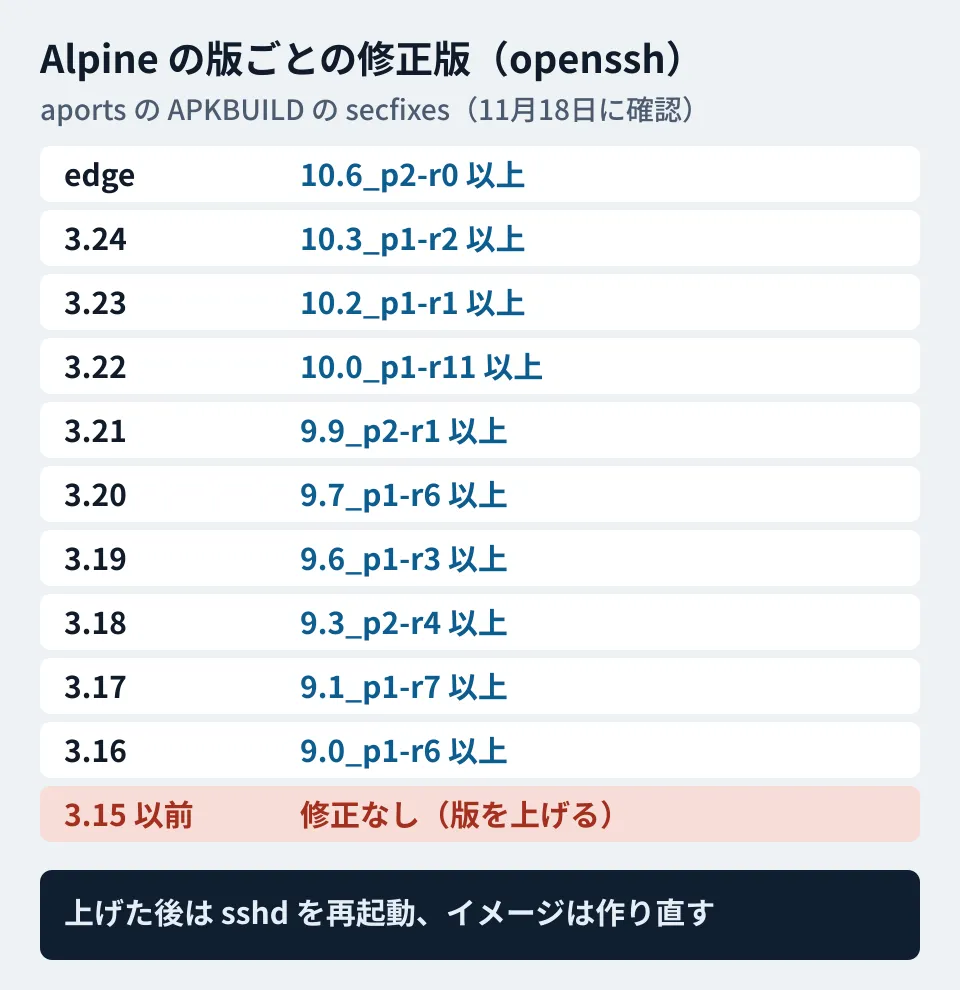
Alpine records in its advisory and package definitions (secfixes in main/openssh/APKBUILD of the aports repository) that CVE-2026-123158 was fixed in the following versions (checked on November 20, 2026).
| Alpine version | Fixed openssh package |
|---|---|
| edge (development branch) | 10.6_p2-r0 |
| 3.24 | 10.3_p1-r2 |
| 3.23 | 10.2_p1-r1 |
| 3.22 | 10.0_p1-r11 |
| 3.21 | 9.9_p2-r1 |
| 3.20 | 9.7_p1-r6 |
| 3.19 | 9.6_p1-r3 |
| 3.18 | 9.3_p2-r4 |
| 3.17 | 9.1_p1-r7 |
| 3.16 | 9.0_p1-r6 |
3.21.10, 3.22.8, 3.23.8, and 3.24.4, released on the same day, November 5, include the fixed package. Tags for these versions (such as alpine:3.24.4) are also available for the official images on Docker Hub. According to Alpine's advisory, support for 3.21 ended on November 1, 2026, and 3.16 through 3.20 no longer receive regular updates. Even so, this time Alpine has shipped fixes back to 3.16.
openssh in the 3.15 branch remains at 8.8_p1-r1 and does not include this fix. The range Alpine's advisory checked for impact is 3.16 and later, and it does not say whether 3.15 and earlier are affected. Either way, there is no fixed package, so the safest course for images based on 3.15 or earlier is to upgrade to a version that is still supported (editorial suggestion).
Steps to check containers (editorial suggestion)
- Find images that include sshd. List the containers that start sshd, such as SFTP, bastion, Git servers, and CI workers. Inside a running container,
apk info -v | grep opensshshows the version. - Check the Alpine version. Check the version with
cat /etc/alpine-releaseand compare it against the fixed versions in the table above. If it is 3.15 or earlier, switch the base image to a version that is still supported. - Rebuild the image, then replace the container. Even if you run
apk upgradeinside a running container, the change is lost the next time it starts unless you rebuild the image. If theRUN apk add openssh-serverline in the Dockerfile has not changed, the build cache may reuse the old layer as is. Rebuild from the base image withdocker build --pull --no-cacheand check the version inside the resulting image. - Restart sshd. Even after upgrading the package on a virtual machine or physical server, the running sshd remains the old version. Alpine's advisory advises restarting it with
rc-service sshd restartafter updating. - Reconsider whether password authentication is needed. If key authentication is enough, set
PasswordAuthentication no. Alpine's advisory procedure has you first confirm that you can log in with a key and keep your current session open, then after the change confirm withsshd -T | grep -i passwordauthenticationthat the effective value isno. If port 22 does not need to be reachable from outside, also narrow who can reach it. - Review login records. Alpine's advisory says to check the sshd lines in
/var/log/messagesfor "Accepted password for" on accounts without a password (alpine,root, and key-only users). It also asks you to review use ofdoasand recently created users, files, andauthorized_keys, and to treat the system as compromised if you cannot say for certain that no such logins occurred. In containers, where sshd sends its logs depends on the setup, so first confirm where they go.
We covered how to approach server OS updates in our article on Ubuntu 26.04.1, and how to check the components inside containers in our article on certifi.
What we have not verified
- We did not reproduce the issue in a container or verify the fixed version (Docker cannot run in this environment).
- The scale and methods of exploitation. We confirmed the listing in CISA's KEV catalog, but this article does not include the number of cases or the targets.
- Whether Alpine 3.15 and earlier are affected.
On November 18, 2026, we checked GHSA-4fcc-vm97-gx3x in github/advisory-database (which imports the NVD description), the
V_10_6_P2tag and the fix commit in openssh/openssh-portable, andmain/openssh/APKBUILDin each branch of alpinelinux/aports (the GitHub mirror). On November 20, we checked Alpine's advisory and release announcement, OpenSSH's release notes and mailing list announcement, the NVD record, and CISA's KEV catalog, and added the affected conditions and the exploitation status (all based on documentation research).
GleamHub's development, AI, and automation consultations cover server and container maintenance and how to handle vulnerabilities. Please reach out via our contact form.
References
- Alpine Linux — Security advisory: openssh-server password authentication bypass
- Alpine Linux — Alpine 3.21.10, 3.22.8, 3.23.8 and 3.24.4 released
- OpenSSH Release Notes — 10.6p2
- openssh-unix-dev — urgent security release: 10.6p2
- NVD — CVE-2026-123158
- CISA — Known Exploited Vulnerabilities Catalog(CVE-2026-123158)
- GitHub Advisory Database — GHSA-4fcc-vm97-gx3x(CVE-2026-123158)
- GitHub — openssh/openssh-portable「avoid password authn bypass」(4353fdc)
- GitHub — alpinelinux/aports main/openssh/APKBUILD(3.24-stable)