When you add SAML single sign-on from an IdP (identity provider) to internal business systems or member-facing web apps, the receiving side (the SP) verifies the signature on the incoming response and then reads who has logged in. If "the part whose signature was verified" and "the part that is read" do not match, the SP ends up accepting a response whose signature is valid but whose content is forged.
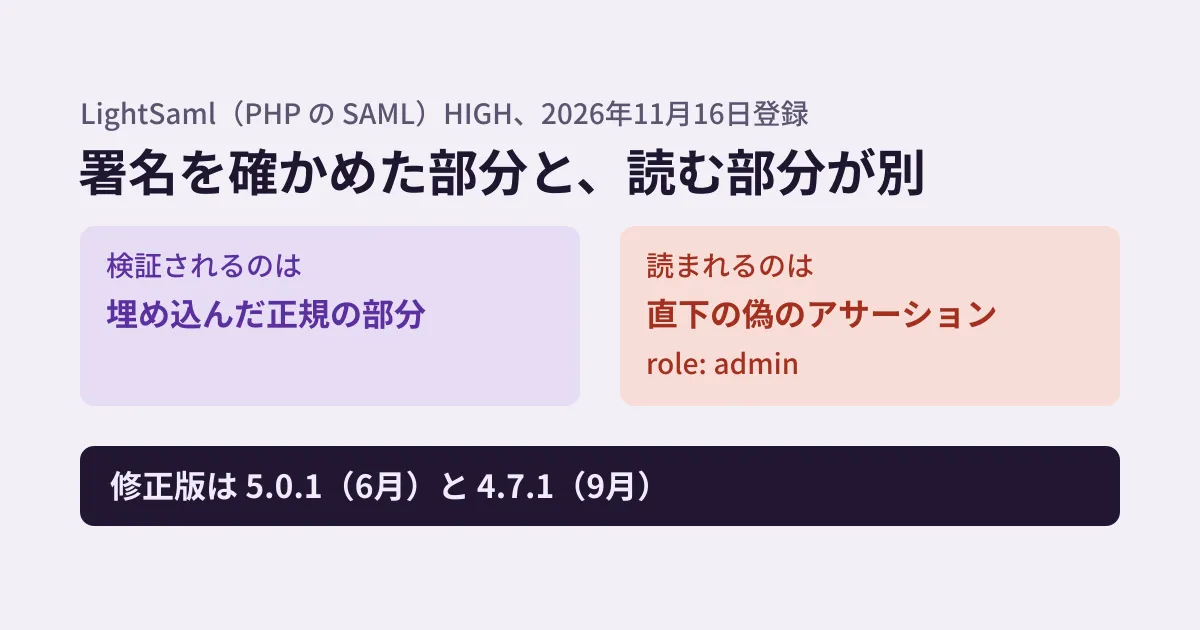
A vulnerability (GHSA-w553-pwx6-3mg9, CVE-2026-63182) that causes this mismatch in LightSaml, a PHP SAML library (Composer package name litesaml/lightsaml), was registered in the GitHub Advisory Database with severity HIGH on November 16, 2026. According to the advisory, an attacker who has a single response from their own legitimate login can get the SP to accept a response with freely rewritten names and attributes as if the IdP had signed it.
The fixed versions are 5.0.1 (June 29, 2026) and 4.7.1 (September 10). In the litesaml/lightsaml repository, a security advisory was published on June 29, the same day as 5.0.1, and the CVE appeared in the NVD on October 30. Registration in the GitHub Advisory Database came after both fixed versions were available. This article explains what happens and how to check whether your systems are affected.
What happens
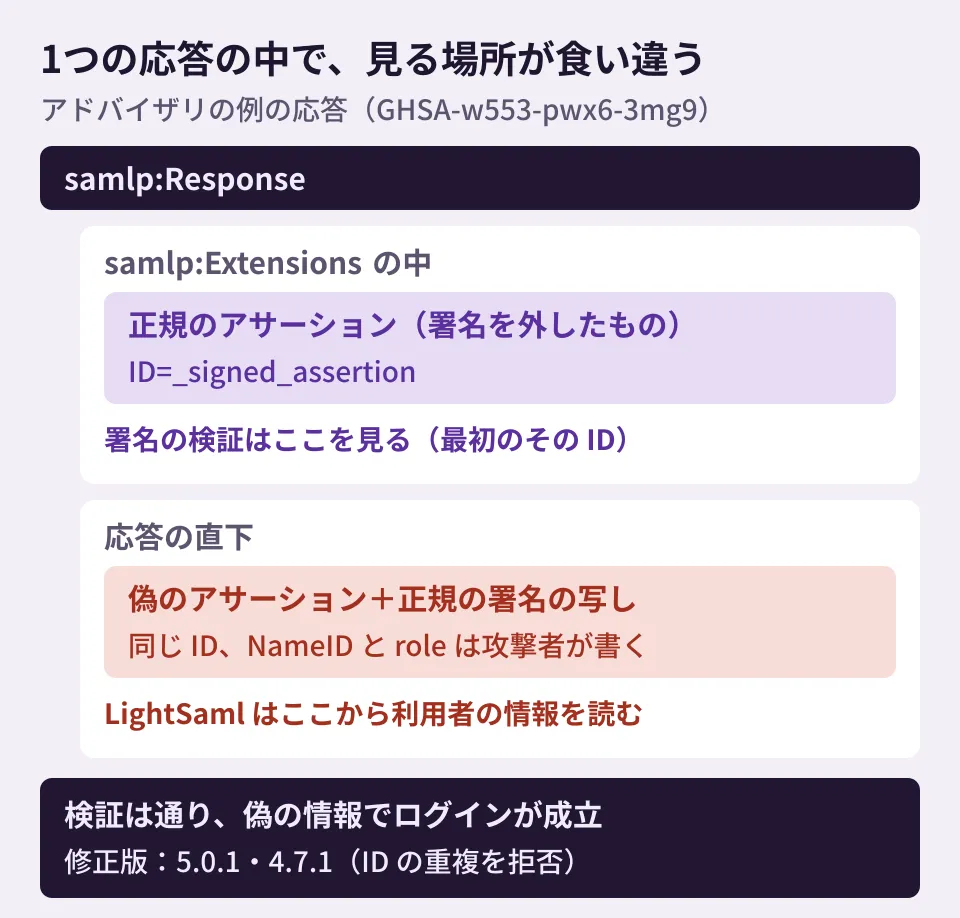
According to the advisory, LightSaml collects the assertions (saml:Assertion) directly under the response (samlp:Response) and verifies each signature with xmlseclibs, the component that handles XML signatures. However, xmlseclibs looked up the ID referenced by the signature (Reference URI="#id") by searching the whole document for "the first element found with that ID."
An attacker can therefore craft a response like the following.
- Take the signed assertion from a legitimate login, remove just the signature, and embed the assertion inside the response's
samlp:Extensions(making it the first element with that ID in the document) - Place a forged assertion with the same ID directly under the response and attach a straight copy of the legitimate signature. The attacker freely writes the forged assertion's name (
NameID) and attributes (for example,roleset toadmin)
Signature verification runs against the embedded legitimate part and passes, while LightSaml reads the user information from the forged assertion directly under the response. The reproduction steps in the advisory (which call LightSaml's signature verification directly) show output in which the forged assertion is "ACCEPTED" and NameID=attacker@evil.com and role are read as admin. The attack works even if the IdP's certificate is pinned on the SP side. There is no need to steal the IdP's key; it is enough for a legitimate user to obtain one response from their own login.
This type of attack is called XML Signature Wrapping (XSW).
Fixed and affected versions
| Release line | Affected versions | Fixed version | Latest in the line as of November 20 |
|---|---|---|---|
| 6.x | Not affected by this issue (6.0.0 has a separate advisory; see below) | 6.0.1 (October 16) for the separate issue | 6.1.0 (October 17) |
| 5.x | 5.0.0 | 5.0.1 (June 29) | 5.1.1 (October 16) |
| 4.x | 4.0.0 or later and earlier than 4.7.1 | 4.7.1 (September 10) | 4.7.2 (October 16) |
The dates are the dates of the tags in the litesaml/lightsaml repository. The fix commits (230e62d for 5.0.1, and 3af82bf for the backport to 4.x) add a check, before signature verification, that “the signature's parent element has the ID it references” and that “the ID appears only once in the document.” The commit description states that duplicate IDs are invalid XML and that this is the premise of XSW.
6.0.0, 6.0.1 and 6.1.0 include the 5.0.1 commit and are also outside the advisory's affected version range. However, 6.0.0 has a separate issue in the repository's security advisories (GHSA-rm7m-7jq4-gw46, severity critical, published October 16). When a signature value cannot be read as base64, xmlseclibs 4.0 returns an error (-1), which 6.0.0 treats as success, so a response whose content has been rewritten passes signature verification even without the IdP's key. The fixed version is 6.0.1. As of November 20, this advisory has not been registered in the GitHub Advisory Database and has no CVE assigned.
Versions before 4.0.0 (3.x and earlier) are not within the GitHub Advisory Database range. On the other hand, the repository's security advisory describes the 5.x line as “5.0.0 and below,” which is not worded to exclude versions before 4.0.0. Neither source settles whether 3.x and earlier are affected, and fixes exist only in 4.7.1 and 5.0.1 or later, so if you are using 3.x or earlier, consider migrating to 4.7.1 or later, or 5.0.1 or later.
Checking whether your systems are affected (editorial suggestion)
From here on are the editorial team's suggestions.
1. Check whether you use it. Even if it is not listed as a direct dependency, it may be pulled in as a dependency of a framework extension or bundle that provides SAML features. Run the following in your PHP project directory.
composer show litesaml/lightsaml
# 何が依存しているかを見る
composer why litesaml/lightsaml
You can also check by searching litesaml/lightsaml for composer.lock. The LightSaml README points to litesaml/saml as a higher-level component. According to the Packagist listings, litesaml/saml 0.4.0–4.0.0 specifies ^5.0 of litesaml/lightsaml as a dependency, and 0.1.0–0.3.2 specifies ^4.2. Both ranges include unfixed versions, so if composer.lock still pins LightSaml at 5.0.0 or at a version before 4.7.1, you are affected (litesaml/saml 5.0.0 and later uses ^6.0 and ^6.1).
2. Upgrade. On 5.x, upgrade to 5.0.1 or later; on 4.x, upgrade to 4.7.1 or later. If you are using 6.0.0, upgrade to 6.0.1 or later because of the separate advisory above. If a library you depend on pins an older line, also check for updates to that library.
3. Test logins after upgrading. The fix rejects “responses with duplicate IDs,” so normal logins from a legitimate IdP should not be affected, but after upgrading, run a login once in a test environment and also check logout and attribute-based permission assignment.
4. Review logs from before the upgrade. If you ran an unfixed version in production, check your login logs for operations performed with permissions the user should not have, or logins with nonexistent usernames. If your logs keep the SAML responses themselves, they can help you look for responses with an assertion inside samlp:Extensions.
We covered setups that use Google Workspace as the IdP for SSO into internal SaaS and business systems in our article on centralizing SSO. The assumption that suspending an account on the IdP side also stops logins on the SP side holds only when the SP correctly verifies signatures. For mechanisms that propagate account creation and suspension from the IdP to each system, see our article on SCIM.
Scope of verification
On November 17, 2026, we checked the GitHub Advisory Database advisory (data from github/advisory-database) and the litesaml/lightsaml repository (tags, and fix commits 230e62d and 3af82bf) (document research). On November 20, we rechecked the GitHub Advisory Database, the security advisories in the litesaml/lightsaml repository, NVD, and the Packagist listings (litesaml/lightsaml and litesaml/saml), and added the separate advisory for 6.0.0 and the dependencies of older litesaml/saml versions. We have not reproduced the issue in a PHP environment or tested logins on the fixed versions.
GleamHub can help with maintaining business systems that use SSO and with planning dependency updates through our development, AI and automation consultations. The approach depends on your setup, so please reach out via our contact form.
References
- GitHub Advisory Database — GHSA-w553-pwx6-3mg9(lightsaml allows Signature wrapping bypass)
- litesaml/lightsaml — fix: reject XML Signature Wrapping attacks in SignatureXmlReader(230e62d、5.0.1)
- litesaml/lightsaml — Backport to 4.x (3af82bf, 4.7.1)
- litesaml/lightsaml — Security advisory GHSA-w553-pwx6-3mg9 (repository, published June 29)
- litesaml/lightsaml — Security advisory GHSA-rm7m-7jq4-gw46 (6.0.0, published October 16)
- NVD — CVE-2026-63182
- litesaml/lightsaml — Repository