
Introduction
"Are no-code and low-code still the main players in the AI agent era?"
To get straight to the point, if you plan to use it continuously in business, it is safer to avoid relying on no-code/low-code.
The reason is simple: what maximizes the performance of AI agents is not GUI operations, but specifications, code, and Git history represented as text.
Based on the actual flow we followed below, this article explains why that conclusion is reached.
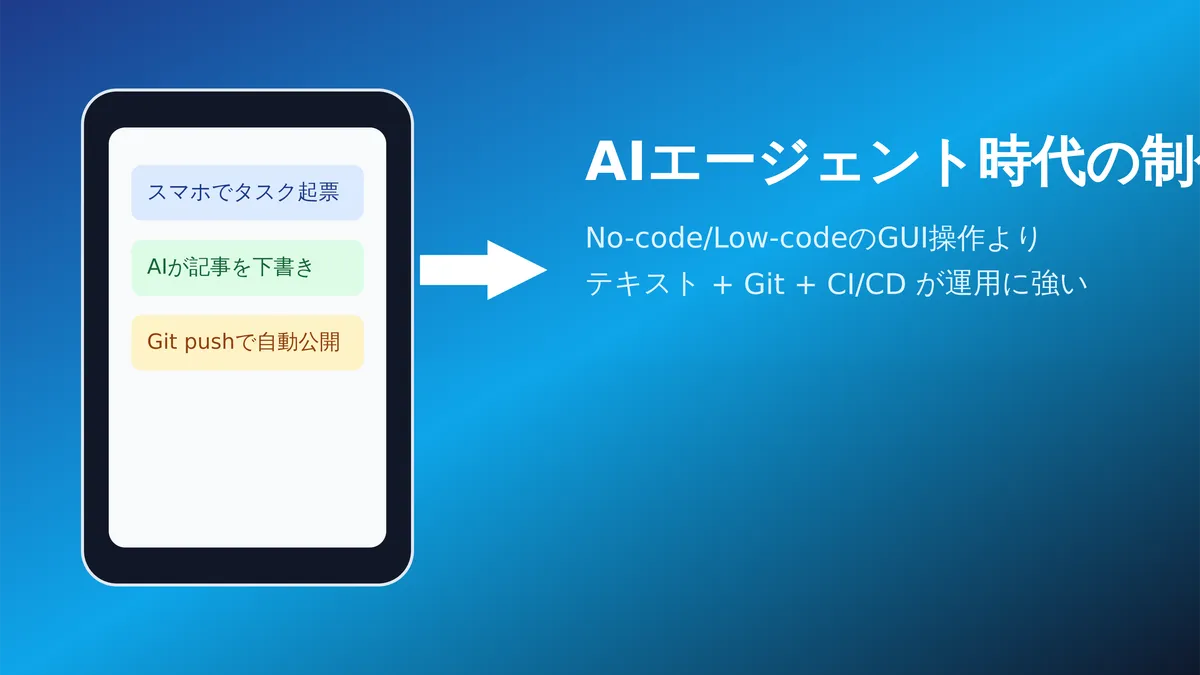
- Create tasks from a smartphone
- AI agent generates and revises drafts for the Astro site
- Commit to Git
- Automated build via Cloud Build
- Publish to production
Conclusion first: 3 reasons why no-code/low-code is disadvantaged in AI agent operations
1. Change history is hard to "turn into assets"
With no-code/low-code, most operations are confined to GUI events.
On the other hand, with a codebase, all of the following are preserved as text:
- Specifications (Markdown)
- Implementation (Code)
- Decision-making (Pull requests)
- Change history (Git)
AI agents read this history to make improvements. The thinner the history in an environment, the lower the reproducibility of improvements becomes.
2. Easily stuck at automation boundaries
No-code is faster for initial prototyping.
However, in the operational phase, the following requirements almost inevitably emerge:
- Exception handling
- Audit logs
- Permission control
- External API integrations
- Multiple environments (development, production)
If you "end up writing code after all," adopting a code-centric approach early on reduces total costs.
3. SEO improvements are difficult at the "structural level"
SEO is not about UI; it is structural optimization.
- Heading hierarchy
- Structured data
- canonical
- Internal link architecture
- Rendering speed (generation strategy)
With a static site generation foundation like Astro, these can be reused at the template and component level. It is also easier to instruct AI agents, facilitating smoother improvement cycles.
Practical example: From smartphone task creation to AI implementation and automated build publishing
In this practical case, operations proceeded along the following workflow:
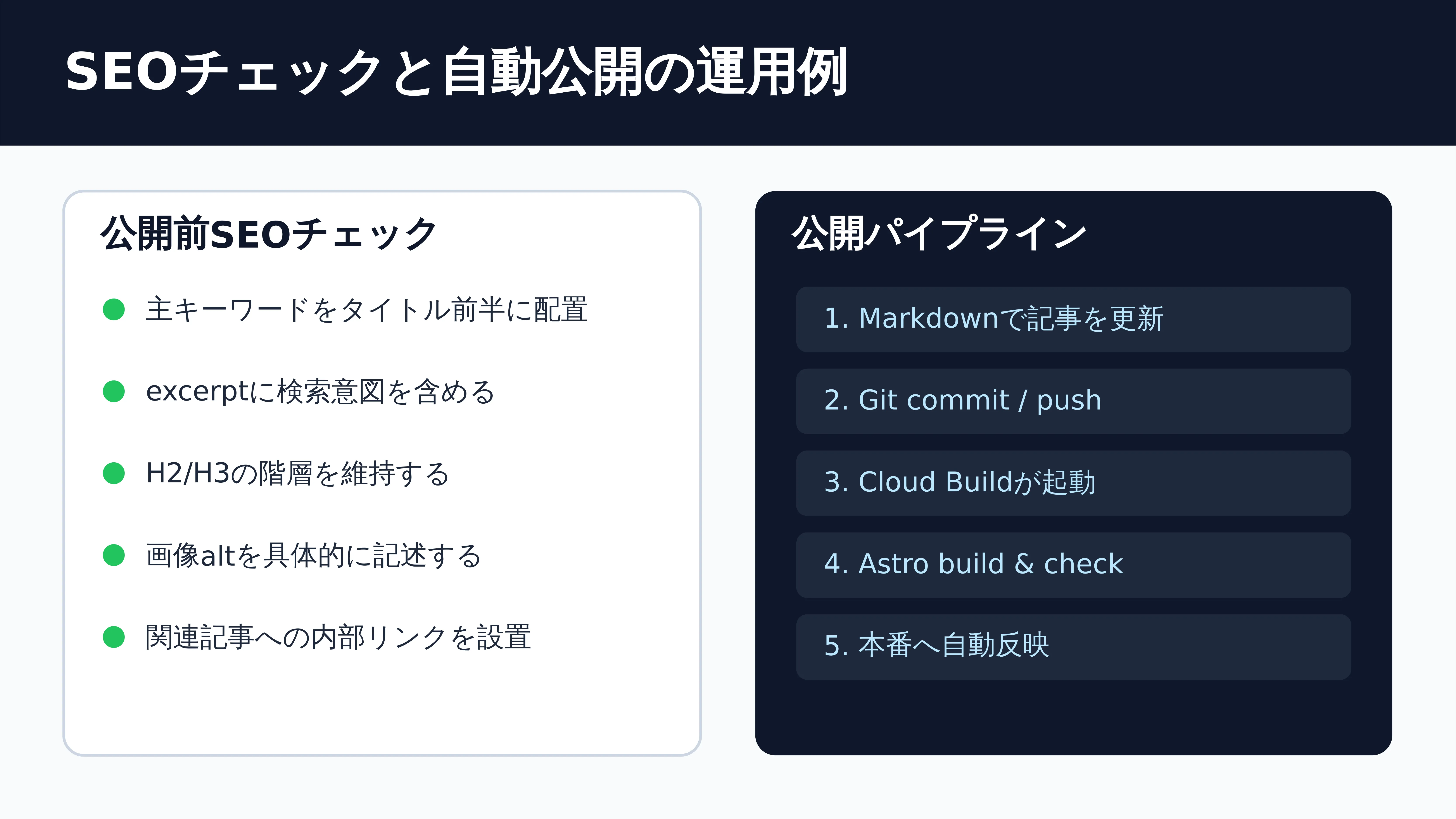
- Create an "Article Draft" task from a smartphone
- Pass requirements (core arguments, structure, keywords) to the AI agent
- Generate the article in
src/content/media/*.md - Trigger Cloud Build upon commit and push
- Publish automatically after a successful Astro build
The strength of this flow is that judgments humans must make (direction, quality checks) and tasks delegated to AI (writing, formatting, iteration) are clearly separated.
Specific conditions when you "should not use" no-code/low-code
We recommend code-centric operations if any of the following apply:
- Feature improvements occur once a month or more
- Two or more people edit the project
- External API integrations are involved
- Organic SEO traffic is the primary strategy
- There is potential for future migration to another system
Conversely, no-code remains effective for short-lived uses like temporary campaign landing pages.
Recommended stack for the AI agent era (minimal configuration)
- Frontend: Astro
- Content: Markdown (Content Collections)
- Version control: GitHub
- CI/CD: Cloud Build
- Operational pathway: Task creation from smartphone (Issues / ChatOps)
With this architecture, everything can be connected with text at the core.
Implementation checklist from an SEO perspective
At a minimum, verify the following prior to publishing:
- Front-load primary keywords in the title
- Reflect search intent in
excerpt - Maintain proper H2/H3 heading hierarchy
- Provide specific
altfor images - Include internal links to related articles
Related articles
- How we automated web production project management with Claude Code
- How to automate media operations with Claude Code × WordPress
- OpenAI Codex "Subagents" explained: Streamlining large-scale development with parallel execution
Frequently asked questions (FAQ)
Q. Should we abandon no-code completely?
No. It is effective if limited strictly to the validation phase. Once it becomes a core business driver, migrating to a code base yields higher long-term productivity.
Q. Can non-engineers operate in a code-centric workflow?
Yes. By establishing a setup where users instruct AI agents in natural language and humans only handle reviews, implementation hurdles drop significantly.
Q. Where should we start first?
The fastest way is to switch just one frequently updated category on an existing site to Markdown management.
Conclusion
In the AI agent era, what matters is not "building fast," but choosing a foundation that sustains continuous improvement.
While no-code/low-code excels at initial velocity, limitations easily surface in revision history, degree of automation freedom, and structural SEO optimization.
Therefore, when business operations are assumed, from the outset:
- Can be managed in text
- Can maintain history via Git
- Can be published through CI/CD
We recommend an architecture satisfying these three conditions.


