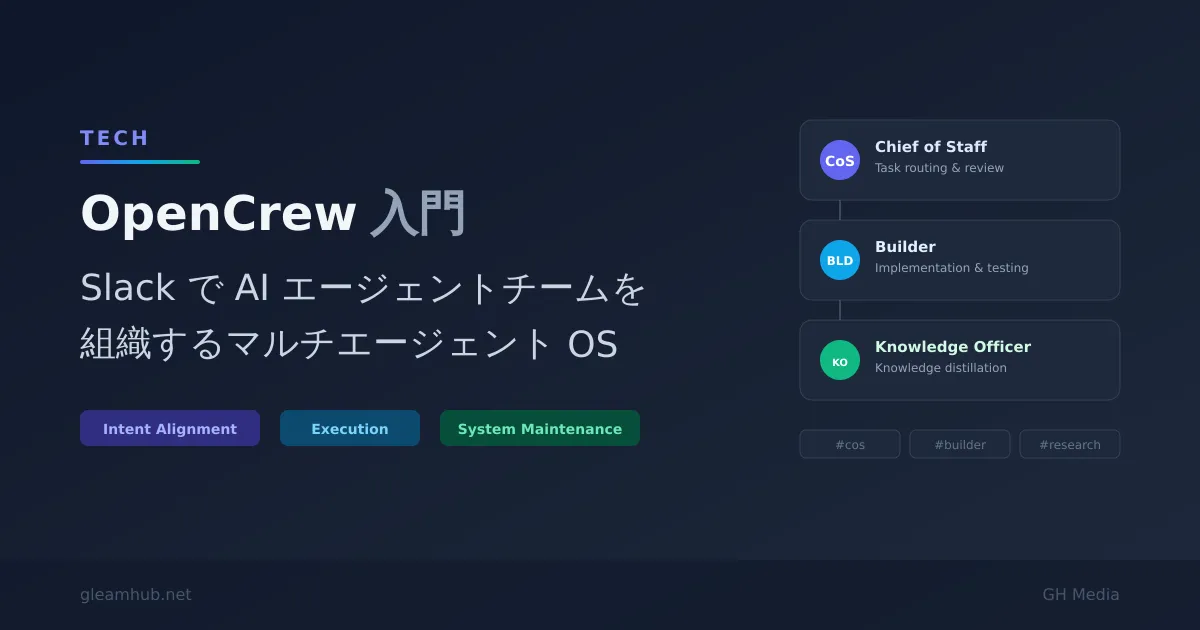
"Using only a single AI agent is already outdated" — entering 2026, multi-agent systems coordinating multiple specialized agents have spread rapidly. However, many frameworks focus on the engineer-centric challenge of "how to orchestrate agents," leaving the decision-maker's challenge of "how to manage an AI team" largely unanswered.
OpenCrew is an open-source project created specifically to solve this latter challenge. Built on OpenClaw (Clawbot), it transforms existing chat tools such as Slack, Discord, and Feishu directly into an "office for an AI team."
What is OpenCrew?
OpenCrew is a multi-agent OS published on GitHub (AlexAnys/opencrew) under the MIT license. It expands a single OpenClaw agent into a team of multiple agents with divided roles.
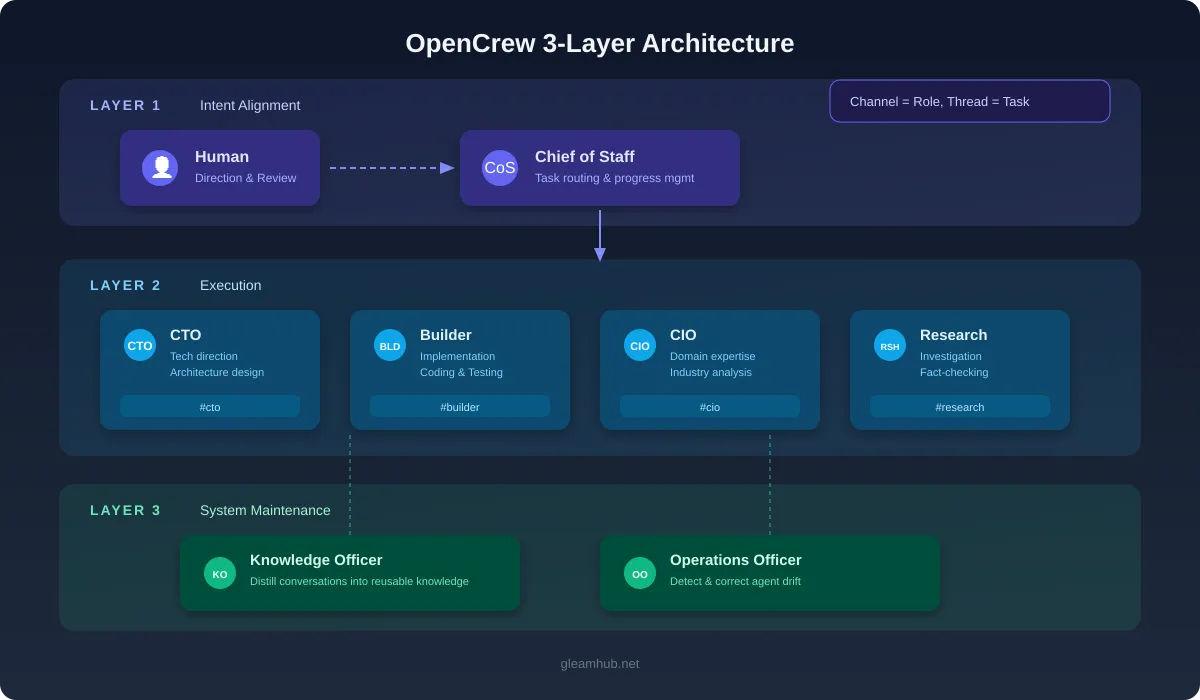
Its defining feature is the design philosophy of "Channel = Role, Thread = Task." A Slack channel represents each agent's "job title," while threads function as individual "tasks." Unread messages indicate "unprocessed work," and in-chat searches serve directly as knowledge base queries. MCP (Model Context Protocol) is utilized for inter-agent communication, standardizing tool integration.
In other words, without needing to build a new UI, teams can use the Slack workspace they already rely on as their multi-agent management dashboard.
Differences from other frameworks
| Item | CrewAI, LangGraph, etc. | OpenCrew |
|---|---|---|
| Primary target | Developers | Decision-makers (executives, managers) |
| Problem addressed | Agent orchestration | AI team management |
| UI requirements | Custom UI or CLI | Uses Slack / Discord as-is |
| Coding | Requires Python / TypeScript | No code required |
| Foundation | Custom runtime | OpenClaw(Clawbot) |
Three-layer architecture
OpenCrew agent teams are structured across three layers that mirror real-world organizational hierarchies.
Layer 1: Intent alignment (direction)
A human (you) pairs with a Chief of Staff (CoS) agent to set direction and review results. The CoS serves as the command center for the entire team, handling task delegation and progress tracking.
Layer 2: Execution
Specialized agents handle day-to-day operations in their respective domains.
| Agent | Role |
|---|---|
| CTO | Technical direction and architectural design |
| Builder | Implementation, coding, and testing |
| CIO | Domain expertise and industry analysis |
| Research | Research, information gathering, and fact-checking |
Layer 3: System maintenance
A meta-layer that preserves quality and consistency across the entire team.
- Knowledge Officer: Distills conversations and task outcomes into structured knowledge
- Operations Officer: Detects and corrects agent drift (deviations from established guidelines)
With this three-layer structure, deciding "what to do," executing "how to do it," and managing knowledge for "how to retain learnings" are cleanly separated.
Controlling autonomy — Autonomy Ladder
When delegating work to AI agents, the most critical factor is drawing the line on how autonomously they operate. OpenCrew defines this as the Autonomy Ladder, spanning four tiers from L0 to L3.
| Level | Name | Behavior | Examples |
|---|---|---|---|
| L0 | Manual | Takes no action without human approval | Sending contracts |
| L1 | Suggest | Proposes actions, but execution is decided by humans | Proposing marketing campaigns |
| L2 | Act & Report | Reports after execution (restricted to reversible actions) | Code refactoring |
| L3 | Full Auto | Fully autonomous (reversible and low-risk operations) | Organizing logs, generating routine reports |
The key principle is to automate reversible operations while requiring human intervention for irreversible ones. This balances agent autonomy with human control.
QAPS task classification
In OpenCrew, all inputs submitted to agents are classified and processed under four QAPS categories.
- Q (Question): Inquiries → returns information only; no execution action
- A (Assignment): Single-step tasks → completed by a single agent
- P (Project): Multi-step complex tasks → decomposed by the CoS and distributed across multiple agents
- S (System): System configuration changes → strictly requires human approval
This classification prevents simple questions from incurring project-level overhead while eliminating the risk of unauthorized critical changes.
Knowledge distillation — preserving organizational memory
An easily overlooked challenge in production multi-agent systems is how to preserve what agents have learned. Raw chat logs are too massive to reuse, yet failing to retain anything causes agents to repeat the same mistakes.
OpenCrew addresses this problem using a three-layer knowledge compression approach.
| Layer | Details | Compression ratio |
|---|---|---|
| Layer 0: Raw | Raw conversation logs (for auditing) | 1x |
| Layer 1: Closeout | Structured task completion summaries (10–15 lines) | Approx. 25x |
| Layer 2: Abstract | Abstracted principles, patterns, and lessons | Approx. 100x |
By enforcing the generation of a 10- to 15-line Closeout (structured summary) upon completing every task, "actionable organizational memory" accumulates organically. Furthermore, Layer 2 extracts abstract principles and patterns from these summaries, enabling past learnings to be applied to new tasks.
Getting started — testing with a minimal configuration
You don't need a large-scale setup to begin with OpenCrew. You can start with a Minimum Viable Setup consisting of just three agents:
- Chief of Staff (CoS) — Task intake and delegation
- CTO — Technical evaluation
- Builder — Implementation
Setup workflow
1. OpenClaw(Clawbot)をインストール
2. Slack ワークスペースに Bot を追加
3. 3つのチャネルを作成(#cos, #cto, #builder)
4. 各チャネルに対応するエージェント設定を配置
5. CoS チャネルにタスクを投げて動作確認
As the team expands, you can scale incrementally by adding agents such as Research, CIO, and Knowledge Officer.
Platform support status
| Platform | Thread support | Status |
|---|---|---|
| Slack | Fully native | Recommendation |
| Discord | Fully native | Stable |
| Feishu | Limited | Experimental |
Conclusion
OpenCrew is a project designed to bring the benefits of multi-agent AI to non-coders as well.
- With its intuitive Channel = Role, Thread = Task design, Slack directly becomes the management console for your AI team
- The Autonomy Ladder enables phased adjustment between agent autonomy and human oversight
- QAPS classification and knowledge distillation automate appropriate task handling and organizational learning
- You can start from a minimal configuration of three agents and scale up as needed
Organizing and managing AI agents as "team members" rather than mere "tools" represents a major paradigm shift for AI adoption in 2026. Combining this with approaches like harness engineering for embedding AI agents into workflows and building AI-driven development workflows allows you to construct an even more robust automation foundation. If you want to take your organization's AI initiatives to the next stage, why not begin by testing a minimal setup?
If you are interested in deploying AI agents across your organization, please contact us. GleamHub also provides implementation support for multi-agent systems.