In 2026, the standard market rates for MVP development are quietly changing
Entering 2026, there is one clear shift we notice whenever startups consult us about "building an MVP": the baseline for timelines and costs has definitively dropped.
Behind this is the rapid, widespread adoption of AI coding tools in professional practice. With Claude Code, Cursor 3, and GitHub Copilot CLI being used routinely in production development, the person-months required to deliver the same quality have visibly decreased. As shown in our 2026 AI Coding Tool Pricing Comparison, looking at tooling costs alone, spending roughly 3,000 to 30,000 yen per month can multiply an engineer's productivity by 1.5 to 2 times today.
On the other hand, just because market rates have dropped does not mean everything can be built cheaply. In fact, our real-world observation is that despite proceeding with the same cost expectations, failure cases where teams "remain unable to transition from an interactive demo to production development and end up failing to raise capital" are actually increasing. Based on these shifting realities, this article outlines the development workflow, cost expectations, and client ordering checklists for MVP development in 2026.
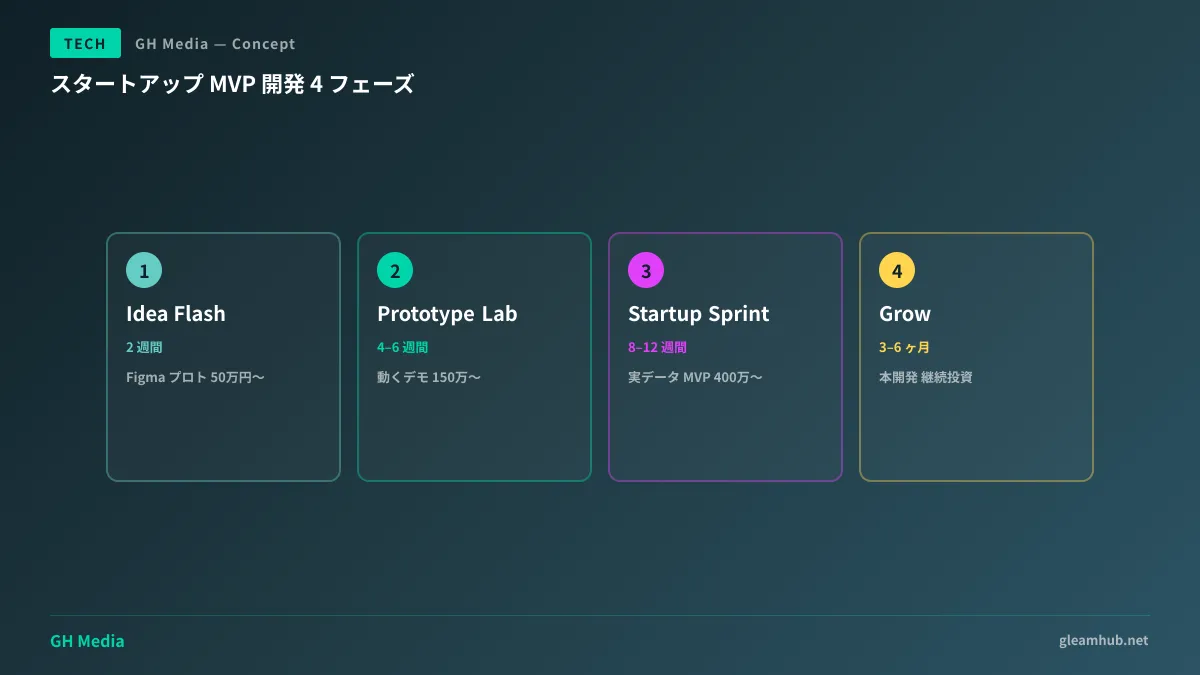
The 2026 four phases and timeline estimates of MVP development
Because the term "MVP" means different things to different people, breaking it down into four distinct phases serves as the baseline for discussion. GleamHub's prototype development service for startups also uses this phasing as its foundation.
| Phase | Goal | Key deliverables | Estimated Timeline |
|---|---|---|---|
| 1. Idea Flash | Turning ideas into tangible, visible form | Figma prototype (5–10 screens), personas, customer journey | 2 weeks |
| 2. Prototype Lab | Allowing users to click through an interface | Interactive demo (no authentication / mock APIs acceptable), landing page, demo video | 4–6 weeks |
| 3. Startup Sprint | An MVP verifiable with real data | Production-grade DB / auth / payments (as needed), analytics tracking | 8–12 weeks |
| 4. Grow | A product used continuously by users | Architecture durable for full development, scalability, team expansion | 3–6 months |
The key takeaway is that investor pitch decks, user validation, and laying the groundwork durable enough for full-scale development are entirely different things. Client requests stating "we want everything at once" almost certainly exceed their budget.
Market rate comparison — a three-way look at no-code, AI coding, and scratch development
To answer the question "So, how much does it cost?", the following table offers a realistic breakdown as of April 2026. While figures naturally shift depending on requirements, it should serve as a helpful first step for decision-making.
| Approach | Suitable Phase | Estimated Cost (Through MVP Completion) | Pros | Important precautions |
|---|---|---|---|---|
| Primarily No-Code (Bubble / STUDIO / Glide) | Idea Flash 〜 Prototype Lab | 300,000–1,500,000 yen | Extremely fast / accessible to non-engineers | Requires an almost complete rewrite when moving to full development |
| Primarily AI Coding (Claude Code / Cursor 3 + small engineering team) | Prototype Lab 〜 Startup Sprint | 1,500,000–5,000,000 yen | Maintains continuity into full development / high architectural flexibility | Quality hinges on precision of requirements definition and acceptance testing |
| Full Scratch (Full-scale development by an experienced team) | Startup Sprint 〜 Grow | 4,000,000–12,000,000 yen | Quality capable of withstanding production operations | Heavy initial cost / difficult to pivot |
Even for the same MVP, the approach you should select depends on which phase you want to reach. If you would like to compare this with cost expectations for websites or landing pages, please also refer to our LP Creation Cost Guide and Complete Guide to Website Production Costs.
Incidentally, while landing pages and websites lean toward quoting prices for individual component elements, MVP development is characterized by the fact that the required investment amount is determined the moment you define "how far you want to learn." Not reversing this order is the single most effective tip for avoiding wasted budget.
How clients should define specifications in 2026
What has changed most drastically in the AI coding era is how specifications are drafted. In April 2026, a practical article on Zenn titled "Specifications worked better when treated as 'disposable'" trended, resonating widely with developers. We explore this topic in detail in Requirements Definition in the AI Agent Era: The Three-Layer Spec, Context, and Harness Architecture.
From the client's perspective, the key takeaways come down to three simple points.
- Write "what you want to learn" before "what you should build": Rather than listing features like "login functionality," "payments," or "dashboard," position your "learning hypothesis" at the very top—such as "determining whether this user will genuinely pay money in this specific scenario."
- Map out all screens and business workflows directly in Figma: Text-only specification documents leave both AI agents and humans confused. Clarifying your thinking to the point where it can be mapped into a clickable Figma prototype is actually the fastest path.
- Agree upfront on what is "designed to be thrown away" versus "designed to remain": Share the baseline assumption with your contractor that code written in Prototype Lab may be rewritten before progressing to Startup Sprint. Leaving this ambiguous leads to disputes.
Regarding the selection of AI coding tools themselves, we have compiled our recommendations in Guide to Choosing Between Cursor 3 and Claude Code.
Three key evaluation points when choosing an outsourcing partner
In 2026, the MVP development outsourcing market is booming in both positive and negative ways. Precisely because anyone can now quickly build "something that runs" using Claude Code, knowing whom to hire has become far more critical.
Point 1: Can they speak to "production development after the MVP"?
Entrusting Startup Sprint and beyond to a firm that has only ever built Idea Flash or Prototype Lab deliverables is risky. Try asking: "With this technology selection, what kind of challenges will emerge after Month 6?" Whether their answer is concrete serves as your initial filter.
Point 2: Are design and engineering in the exact same team?
Rapid iteration between screens and business workflows decisively impacts MVP speed and quality. If designers and engineers belong to separate companies or separate teams, "hand-off and wait" delays will inevitably occur.
Point 3: Can they accompany you through user interviews?
The goal of an MVP is not to "build something that moves," but to "gain learnings." Whether the contractor can partner with you all the way through user interview design and hypothesis verification facilitation determines the return on your invested budget.
Conclusion
- In 2026 MVP development, widespread adoption of AI coding has lowered the baseline for timelines and costs. However, this does not mean "everything becomes cheap."
- Breaking down the process into the four phases of Idea Flash, Prototype Lab, Startup Sprint, and Grow makes the required investment amount and duration clearly visible.
- Choose across the three axes of no-code, AI coding, and full scratch. Selecting different approaches per phase is the practical solution.
- Draft specifications on the premise that they are "disposable," framing them around learning hypotheses and Figma prototypes. Agree upfront on disposable versus enduring architecture.
- Select outsourcing partners based on whether they can speak to what happens after the MVP, whether design and engineering coexist under one roof, and whether they can support user validation.
At GleamHub, we partner with startups on MVP development through three plans: Idea Flash, Prototype Lab, and Startup Sprint. From a Figma prototype in as little as two weeks to MVP architecture durable enough for full-scale development: if you are an entrepreneur thinking "I have an idea, but I'm stuck because I can't build that first working product," please reach out to us.