
Asking an AI "Tell me booking systems suitable for our scale" and turning the three returned companies into candidates—over the past year, many companies have shifted their procurement entry point to this format. It is faster than opening ten search results to compare, and it even comes with a comparison table.
Hardly anyone, however, verifies the sources of that comparison table. AI does not know "good companies"; it simply reads "pages that are easy to cite." And right now, what sits at those citation destinations has become an issue.
210,000 Pages Across Three Sites, All Using the Exact Same Template
One investigation traced the sources used in AI recommendations. What it uncovered were three sites: gitnux.org, wifitalents.com, and worldmetrics.org. Together, these three mechanically generated 215,128 "Best [Software Category] Software" style pages.
While the three sites appear to be independent operations, investigation reveals substantial overlap:
- All domains were registered through the same registrar between December 2023 and May 2024
- They share identical page templates
- DNS is delegated to the same name servers
In effect, they are identical templates churned out by the same system, functioning not just as a corner of search results, but as citation sources for AI.
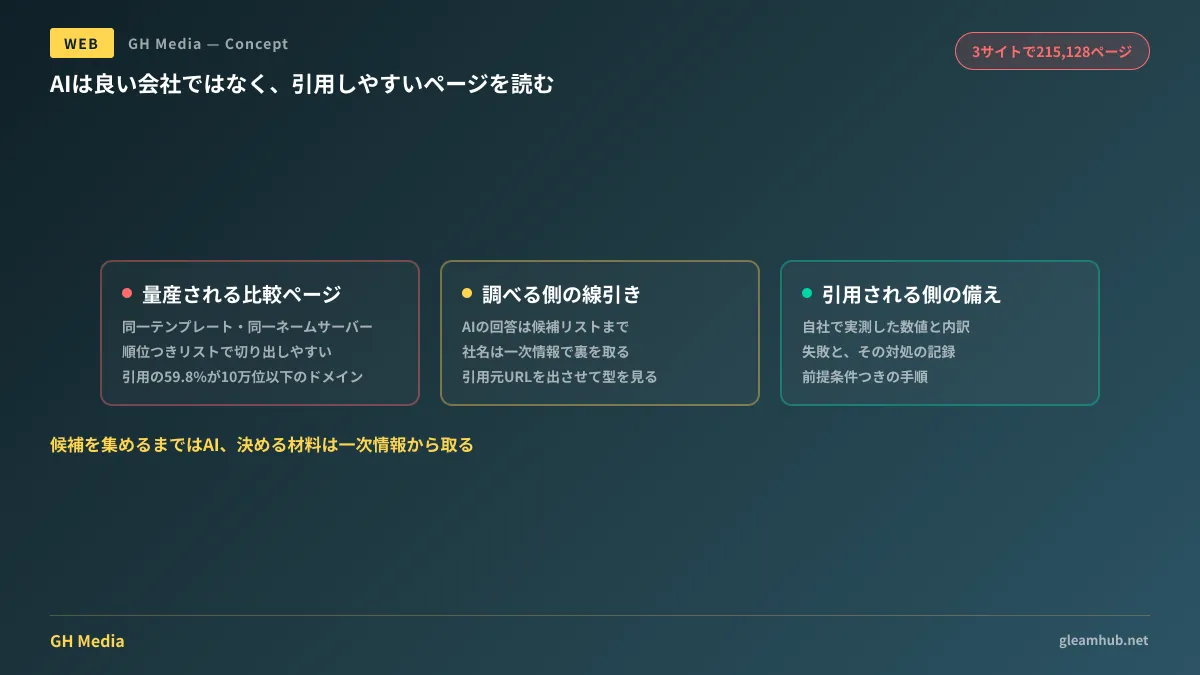
Figures also illustrate the scale. When Perplexity software recommendations were examined across 380 categories, 59.8% of the 7,534 citations pointed to sites ranked below 100,000 in domain popularity. Sites nobody has ever heard of account for more than half of the citations underlying the answers.
Why They Are Read Before Human-Oriented Reputations
It may seem strange: why would unknown pages be cited when reputable comparison media and trade publication articles exist?
The reason lies not in quality, but in format. Mass-produced pages are written in formats optimized for AI to construct answers. The category name appears in the URL, headings match the query, ranked lists are included, and short explanations accompany each entry. While thin for human readers, they are easy for the citing side to extract.
Conversely, highly specialized articles articulate prerequisites and exceptions meticulously. They offer immense value upon reading, but are difficult to parse when prompted to "list the top five." This asymmetry translates directly into citation bias.
Rather than a new phenomenon, this is an extension of the structural pattern observed in how AI Overviews handle source links. The convenience of the answer generator dictates how information is selected.
For Buyers: Limit AI Answers to Candidate Lists
What, then, should researchers do? Demanding people avoid AI is unrealistic, so drawing operational boundaries for its use is the pragmatic path.
Limit AI responses to the candidate gathering phase. Use them as raw material to narrow candidates down to three companies, but never as the material for making a final decision. Simply drawing this distinction virtually eliminates the impact of mass-produced pages.
Re-verify the identified corporate names through non-AI channels. Check corporate registration numbers, physical addresses, case study pages, and publicly available deliverables. Go inspect the primary information published by the company itself, rather than the supporting pages cited by AI.
Ask the AI: "Why these three companies?" Prompt it to list the citation URLs, and you can determine whether they are mass-produced pages within a minute. If only thin comparison articles sharing the same template appear, that answer is weak even as a candidate list.
What you should evaluate in the end remains unchanged from before AI. The principles in what to look for in quote comparisons when choosing a web development firm apply directly. All that has changed is that noise has increased along the channel where candidates are gathered.
For Cited Sites: Do Not Compete by Lining Up Thin Pages
From the standpoint of operating a company website, the question flips: "How can we get cited by AI?"
Imitating mass-produced pages here is a flawed move. Even if you churn out 100 identical template pages, you merely step onto the same playing field as competitors holding 210,000 pages—and that ground could collapse at any moment. The instant AI providers adjust algorithms to downgrade mass-produced sources, your entire investment vanishes.
The realistic path is to publish unique primary information that only your company can provide, formatted so it is easy to extract.
| What to publish | Why mass-produced pages cannot provide it |
|---|---|
| In-house empirical metrics, hours spent, and cost breakdowns | Cannot be generated without source data |
| Actual project failures and how they were handled | Requires real experience and cannot emerge from templates |
| Implementation and migration procedures accompanied by prerequisites | Specifying prerequisites breaks generic templates |
Building on that, structuring guidance for AI—such as how to handle llms.txt—increases the likelihood of being retrieved. Reversing this sequence renders it meaningless: content comes first, format comes second.
What to do next
Pick one of your company's products or services and ask a generative AI: "Give me five recommendations, including the supporting URLs." Open three of the resulting URLs and check whether you can reach their publisher information pages. If more than half cannot be verified, mass-produced pages dominate citations in that domain.
Even if your company is not listed, there is no need to rush into churning out pages. Start by counting how many pieces of "information only your company can provide" shown in the table above currently exist on your site.
Whether you want to overhaul your site's information architecture including traffic driven by AI or organize primary information alongside a site redesign, GleamHub offers guidance through our website development and redesign consultations. Tailored solutions depend on your existing site architecture, so please contact us individually via our inquiry form.
Sources
- Three sites made 215,128 “best software” pages for AI. Perplexity cites them — Trellner Research
- Three sites made 215,128 “best software” pages for AI. Perplexity cites them — Hacker News
- I Analyzed 1,739 AI Citations. Here’s What ChatGPT and Perplexity Actually Cite — Growfusely
- 215K Fake “Best Software” Pages Feed AI Answers (2026) — explainx.ai