
If you inspect the build logs of AI features running within your organization, you will find lines that download files from external sites midway through the build. These include model weights, tokenizers, and occasionally datasets. On days those sources are down, your builds fail too.
In architectures that retrieve public model weights, Hugging Face Hub serves as one of the primary retrieval sources. In setups that consume inference APIs exclusively, the point of dependency lies elsewhere.
On September 3, 2026, NVIDIA announced an agreement to acquire Hugging Face for $12.9303 billion (approximately 2 trillion yen). Hugging Face is the de facto standard channel for model distribution, hosting over 3 million public models, 500,000 datasets, and 1 million applications. This does not mean services will break starting tomorrow. However, because the question of "who owns the distribution pipeline" has now received a definitive answer, it is well worth taking inventory of your company's dependencies.
What is settled and what remains uncertain
Let us separate what has been announced from what is not yet known.
What is settled: NVIDIA agreed to acquire Hugging Face, with the transaction value disclosed at $12.9303 billion. NVIDIA CEO Jensen Huang commented regarding open models that the move will "enhance safety and cybersecurity, accelerate innovation and adoption, and enable sovereignty." They have also indicated a policy of maintaining multi-cloud availability.
What remains uncertain: How operational policies will evolve moving forward. Industry reactions are divided. Some defend the deal, arguing that "NVIDIA has no incentive to close the ecosystem off since hardware sales grow as open ecosystems expand," while others voice caution that "a single company will now have exclusive visibility into model distribution telemetry."
Speculating on which perspective proves correct is unhelpful. Ensuring your systems remain resilient regardless of the outcome is the proper engineering response.
Three forms of dependency and their varying impact
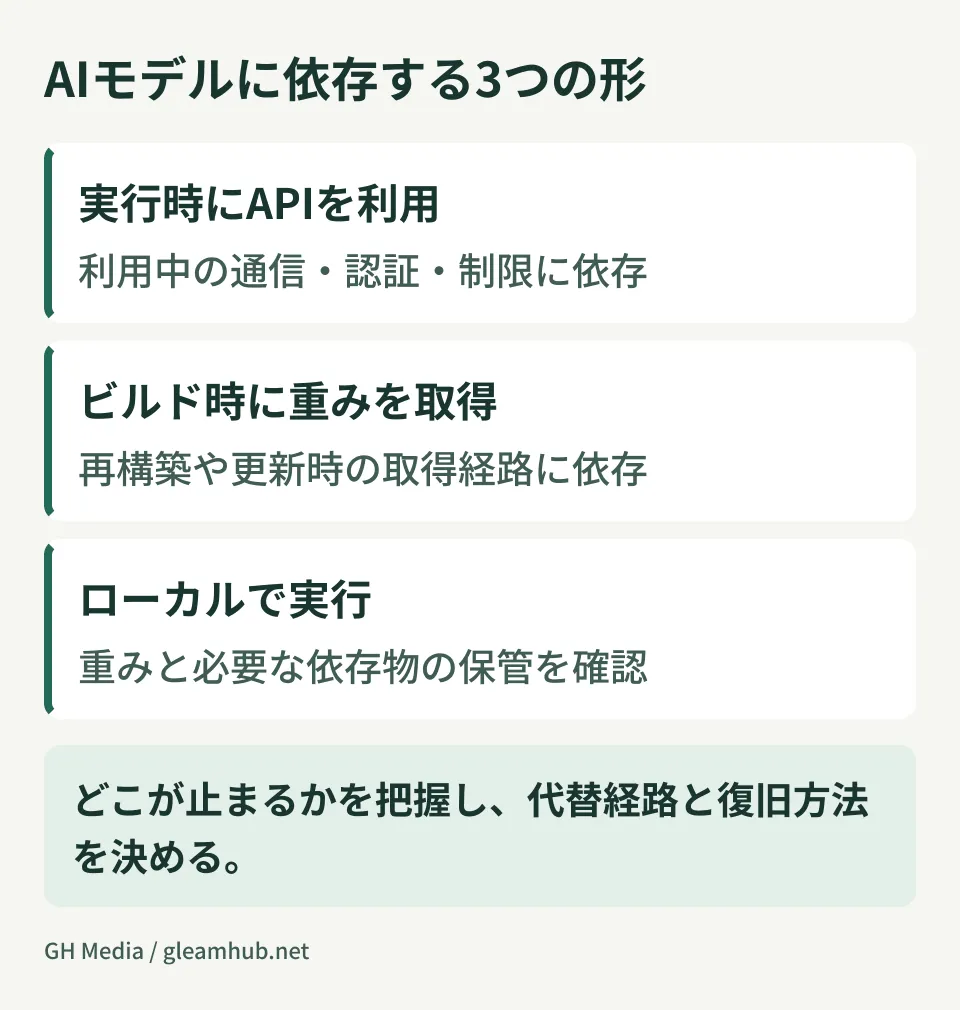
Even when organizations say they "use Hugging Face," the practical impact varies significantly depending on how it is utilized. Identify which category your organization falls into.
| Dependency pattern | What causes failure | Impact |
|---|---|---|
| Fetching from Hub during every build and deployment | Source downtime, specification changes, or newly required authentication | High |
| Fetching initially, then distributing from internal storage thereafter | Affects only the adoption of new models | Medium |
| Calling external services as inference APIs | Runtime API outages, rate limits, or changes to pricing and terms of service | Potentially significant depending on use case |
The first row impacts release time, while the third row impacts production inference. Which is heavier depends on the business impact of an outage and the availability of alternatives. Independent of any acquisition, having CI pipelines dependent on external sites introduces fundamental stability risks. Architectures where builds fail due to temporary network hiccups directly degrade release reliability.
If your setup falls into this row, the required action is clear without waiting to see how the acquisition unfolds: change the pipeline to fetch files only once initially, distributing them from an internal copy thereafter. Review model sizes, fetch frequencies, licenses, and storage costs, and compare this with caching approaches.
Accessing inference APIs in the third row has slightly different characteristics. Because you do not manage model weights yourself, operational overhead is low; however, you must design for retries, secondary providers, and degraded operation modes with limited functionality during outages. If pricing structures or terms of service change, your only options are to accept them without room for negotiation or switch providers. Selecting this setup is fine if you understand that in exchange for operational lightness, you have delegated decision-making authority externally. Still, if you integrate it into core business operations, at least identify potential fallback alternatives in advance.
Three actionable steps you can take right now
Large-scale migrations are unnecessary. The following three measures provide incremental benefits:
- Inventory active models and datasets. Record names, versions (revisions), licenses, and retrieval sources. Many companies lack this inventory, making it impossible to evaluate risk. Creating one takes only a few hours, but its value endures.
- Pin versions. Pulling "latest" can silently alter model outputs. Switching to explicit revision pinning decouples your system's behavior from changes made on the provider's end.
- Replicate weights internally. To the extent licenses permit, store copies of models actively used in your internal storage. This minimizes the risk of temporary upstream outages disrupting redeployments. Ensure associated configurations, tokenizers, and runtimes are also archived, and verify that models can spin up completely offline.
The second and third steps work as a pair. Replicating unpinned versions is meaningless if the next build pulls a different artifact.
Be sure to integrate license reviews into step one. Even with open distribution, commercial use terms and redistribution rights vary across models. The act of replicating weights can itself infringe upon licensing conditions. When building your inventory, noting down at least the license names will prove invaluable later.
Contractual implications for clients and contractors
If you outsource AI feature development, or plan to take on such projects, this discussion directly impacts contract terms.
Key points to review include:
- Do deliverables specify model retrieval sources and pinned versions? Stating merely "retrieved from Hugging Face" makes it impossible to reproduce the exact environment later.
- Is there an agreed-upon process if a model becomes unavailable? Clarify whether swapping in an alternative model falls under ongoing maintenance or requires a separate statement of work.
- Is the client permitted to retain model weights internally? Verify both model licensing terms and contractor agreements.
All three areas are prone to disputes after systems go live. While running smoothly during development, nobody pays attention; however, problems arise years later when requested to "reproduce the exact same environment."
Additionally, shifting away from upstream model supplier dependencies remains an option. For specialized use cases, smaller dedicated models often outperform large general-purpose models, as discussed in When specialization beats scale. For holistic planning that includes data storage locations, refer to Organizing data residency and sovereignty; for architectures running in on-premises environments, consult Evaluating local and edge AI deployments.
What to do next
First, check whether your team can name the models your AI features currently use. If project leads cannot answer immediately, an inventory does not exist. That is where you should begin.
Next, inspect your build logs to see if any lines fetch weights externally. If found, evaluate whether that download can be restricted to an initial fetch only. Regardless of the acquisition's outcome, eliminating build dependencies on the uptime of third-party websites is always worth doing.
At GleamHub, our custom development, AI, and automation consulting services assist with mapping dependencies in in-house and custom AI development, verifying model procurement and licensing, and scoping contract stipulations. Architectural options depend on your data and specific use cases, so please reach out individually via Contact Us.
Sources
- NVIDIA to Acquire Hugging Face — Official NVIDIA Announcement
- NVIDIA agrees to acquire Hugging Face for approx. 2 trillion yen; CEO Jensen Huang highlights importance of open models — ITmedia AI+
- NVIDIA acquires Hugging Face for approx. 2 trillion yen: Addressing open ecosystem lock-in concerns — TechTarget Japan
- NVIDIA to acquire Hugging Face for $12.9303 billion — gihyo.jp
- NVIDIA acquires Hugging Face for $12.9B, moving to secure AI model distribution networks — XenoSpectrum