Your internal systems run on Google Cloud, and you want AI usage fees on the same invoice. Until now, the option for using Claude under those conditions was through Google Cloud's Model Garden (Agent Platform). In October 2026, another option was officially added.
According to Anthropic's release notes (the October 22, 2026 entry) and the official Google Cloud blog (October 23), "Claude Models on Google Cloud (Anthropic managed)", which lets you use the Anthropic-operated Claude API from a Google Cloud project, has become generally available. The existing Google-operated form is called "Google managed". Both are consolidated into Google Cloud billing, but they are quite different underneath. In this article, we use the official documentation to sort out the differences between the two and summarize what to check before choosing.
The biggest difference is who processes the data
The Google Cloud blog explains the difference between the two as follows.
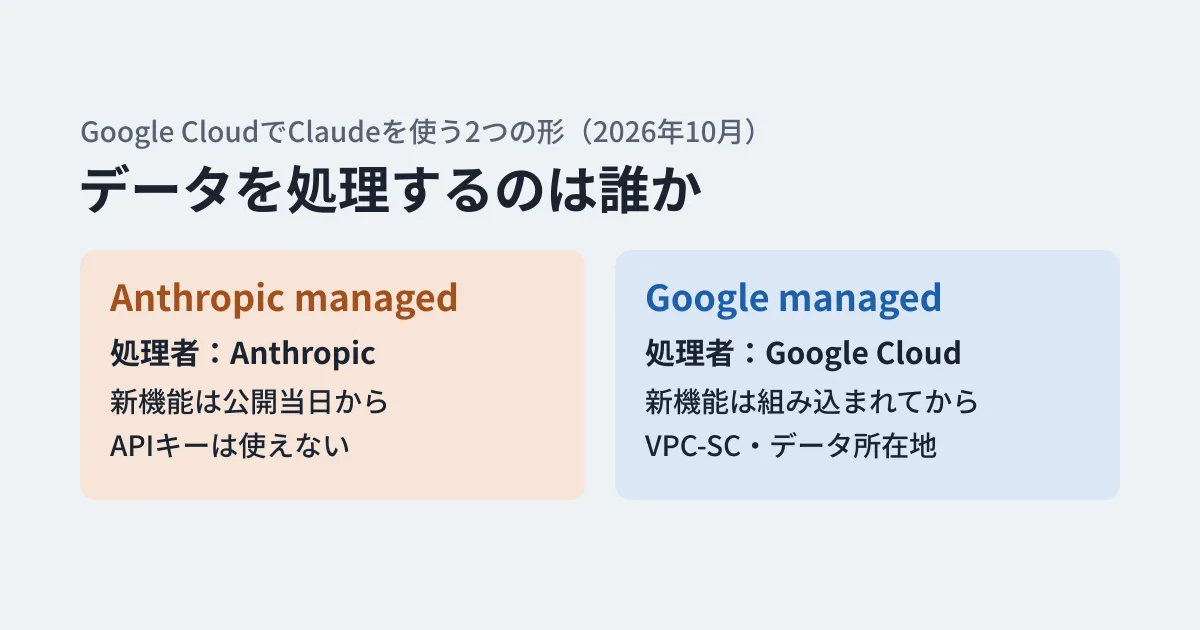
The difference comes down to who acts as your data processor and whether you need access to the new Claude platform features when they launch
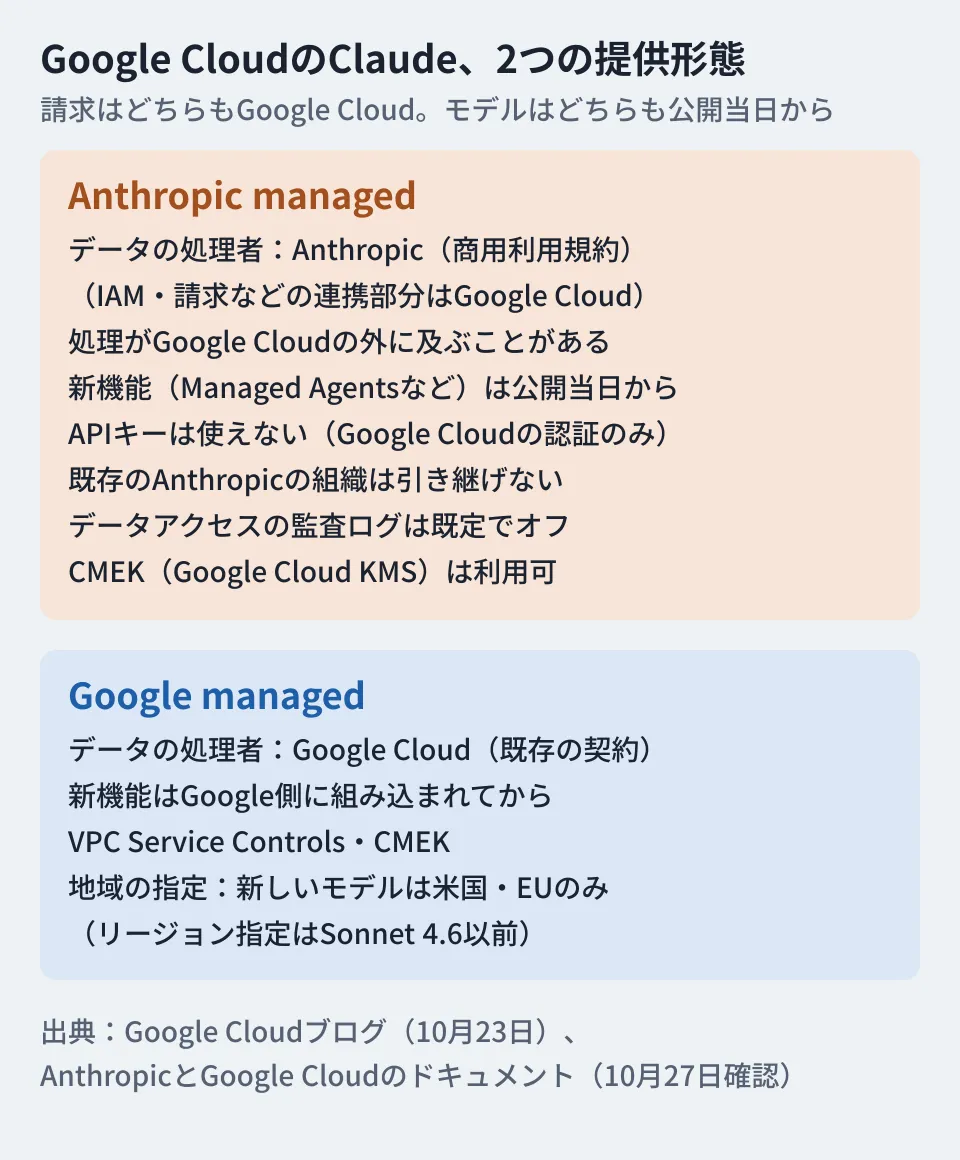
With Anthropic managed, Anthropic is the data processor and Anthropic's Commercial Terms apply. With Google managed, Google Cloud is the processor under your existing Google Cloud customer agreement.
Anthropic's documentation also states the following.
Anthropic is the data processor for Claude Models on Google Cloud (Anthropic managed). Some supporting services, such as Anthropic’s trust and safety systems, process data outside Google Cloud.
Google Cloud's documentation (updated October 26, 2026) goes a little further. Google Cloud and Anthropic are separate processors for their respective parts, and Google Cloud handles the integration parts: IAM authentication, API routing, Cloud Audit Logs, and Marketplace billing. It also says that data storage and inference take place on infrastructure managed by Anthropic and may pass outside Google Cloud.
Data storage and inference occur on Anthropic-managed infrastructure (which may route outside Google Cloud), and subservices may change without notice.
The Google Cloud blog says Anthropic operates it "on Google Cloud infrastructure", so the wording differs between sources. However, both the Anthropic and Google Cloud documentation state explicitly that with Anthropic managed, part of the data processing may extend outside Google Cloud. They say the inference region can be specified per request with inference_geo. If your internal information security rules or customer contracts require that data be processed within Google Cloud, this sentence is what decides the matter. Data retention follows the same policy as the Claude API, and a setting that does not store data (ZDR) is available on application.
Other differences
Here are the operational differences drawn from the documentation and blog.
| Item | Anthropic managed | Google managed |
|---|---|---|
| Operator and data processor | Anthropic (Commercial Terms). Integration parts such as IAM and billing are handled by Google Cloud | Google Cloud (existing customer agreement) |
| New feature | Available on release day | After being integrated on Google's side |
| Request format | Same as the Claude API (/v1/messages, etc.) | Agent Platform prediction endpoint |
| Admin console and permissions | Claude Console (can only be opened at roles/claude.admin) | Google Cloud console, Agent Platform IAM roles |
According to the comparison table in the blog post, the models themselves are available on both from the day of release, at the same price. The difference is when "Claude Platform features" such as Managed Agents, skills, and code execution arrive. With Anthropic managed they become available at release, while with Google managed they become available once they have been built into Google's infrastructure.
As features of Google managed, the blog post lists VPC Service Controls, customer-managed encryption keys (CMEK), and data residency in the US, the EU, and Asia Pacific. However, according to Anthropic's documentation for Google managed, there are two kinds of endpoints that restrict the region: the US (us) and EU (eu) multi-regions, and individual regions, and only Claude Sonnet 4.6 and earlier models can be used in individual regions. To restrict the region with newer models, you must use the US or the EU, and both cost 10% more than global. If processing in Asia Pacific is a requirement, first check whether the model you want to use is supported. The documentation also states that CMEK using Google Cloud KMS keys is available with Anthropic managed as well.
What to check before choosing Anthropic managed
Anthropic's documentation describes several points worth checking when adopting or migrating.
- API keys cannot be used: authentication uses Google Cloud credentials only. Requests carry a Google OAuth access token. Processes built on the assumption of API keys will not work as is. Note that the SDK client for Anthropic managed (
AnthropicGoogleCloud) is described as beta - Existing Anthropic organizations cannot be carried over: setup creates a new Anthropic organization for each project. Existing organizations, including Claude Enterprise organizations, cannot be converted, and API keys, workspaces, Console settings, files, and skills do not move over. ZDR arrangements are not carried over either (Google Cloud's documentation states that HIPAA settings are not carried over as well)
- Permissions are per project: IAM roles are attached to the project, so they apply to every workspace in the same project. If you want separate permissions for each team, the guidance is to use separate Google Cloud projects
- You must turn on request logging yourself: among Cloud Audit Logs, data access logs, which record actions such as sending messages, are off by default. To keep a record of requests, enable data access logs for
claude.googleapis.com - Some things keep running even after permissions are removed: Managed Agents sessions and scheduled runs check permissions when they are created and do not recheck them while running. The documentation says that when you remove the permissions of someone who has left or replace a service account, you should review the sessions and scheduled runs that person created
- Unavailable features: the documentation explicitly states that features such as MCP tunnels cannot be used
Billing goes through Google Cloud Marketplace, and usage is reported as "Claude Consumption Units" (1 unit = $0.01) and appears on your Google Cloud invoice. If you have a Google Cloud spending commitment, usage is drawn down against it in the same way as other Marketplace purchases.
Which to choose
From here on is the editorial team's own analysis.
- If processing data within Google Cloud is a requirement, choose Google managed: Google Cloud is the processor, and there are options for VPC Service Controls and data residency. Plan on the assumption that new features will arrive later
- If you want to use new features such as Managed Agents right away, choose Anthropic managed: because it is called in the same way as the Claude API, existing code written for the Claude API is easier to reuse. However, you need to rewrite authentication from API keys to Google Cloud authentication and confirm internally that Anthropic becomes the data processor
- Before deciding which to use: the documentation says you can tell which one your current code uses by the host it sends requests to (
claude.googleapis.comoraiplatform.googleapis.com) or by the SDK client name (AnthropicGoogleCloudorAnthropicVertex)
The growing number of AI models available on Google Cloud is also an opportunity to think about the "architecture that lets you switch models" discussed in Whether to put a gateway in front of internal AI. For network restrictions in Managed Agents, see Managed Agents web_fetch restrictions and how to fix them, and for how to observe Claude API calls, see OpenTelemetry for the Claude API.
Scope of verification
On October 24, 2026, we checked the Claude Platform release notes and the documents "Claude Models on Google Cloud (Anthropic managed)" and "Claude Models on Google Cloud" (a comparison of the two) by opening them directly on platform.claude.com, and the official Google Cloud blog post "Expanding Claude availability and deployment choice on Google Cloud" (October 23, 2026) by opening it directly on cloud.google.com (document research). On October 27, 2026, before publication, we reopened these and also checked Anthropic's "Claude Models on Google Cloud (Google managed)" and the Google Cloud documentation "Use Claude models on Google Cloud (Anthropic managed)" (docs.cloud.google.com, updated October 26). The editorial team has not set up either offering and has not checked the actual price display, rate limits, or response speed from Japan.
For help choosing an architecture when integrating AI into internal systems, please contact us through consultation on development, AI, and automation.
References
- Expanding Claude availability and deployment choice on Google Cloud(Google Cloud Blog, 2026-10-23)
- Claude Models on Google Cloud (Anthropic managed)(Claude Platform Docs)
- Claude Models on Google Cloud(Claude Platform Docs)
- Claude Models on Google Cloud (Google managed)(Claude Platform Docs)
- Use Claude models on Google Cloud (Anthropic managed)(Google Cloud Documentation)
- Claude Platform release notes(Claude Platform Docs)