
You want to automate visual inspection on a manufacturing line. However, because blueprints and fixtures appear in captured images, permission to upload them to the cloud is denied. At another site, warehouse connectivity is so narrow that image uploads never finish.
As reasons for AI adoption consultations stalling, these two sometimes surface before discussions about accuracy even begin. Although technically solved, progress stops over data storage locations.
The price range for "handling everything on-site" has dropped
On August 25, 2026, Arduino announced the "VENTUNO Q" and opened pre-orders through authorized distributors. It is a compact board capable of executing LLMs directly on-premise.
Looking at its configuration makes it clear what this product is targeting.
- Qualcomm Dragonwing IQ8 processor integrating an 8-core CPU, 40 TOPS NPU, and GPU
- 16GB LPDDR5 memory and 64GB eMMC storage
- STM32H5-series microcontroller handling physical control of motors and other components mounted on the same board
- 160 mm × 100 mm board size, with Ubuntu and Zephyr RTOS pre-installed
Available models are stated to include generative AI models such as Qwen 3, Gemma 4, and Qwen 3 VLM, alongside Whisper for speech recognition, YOLO-X for object detection, and more.
What deserves attention is that the microcontroller resides on the same board. The inference section and the components that physically drive motors and sensors sit on a single board. The entire sequence—evaluating with a camera and halting the line on the spot—is completed without communicating externally.
The dividing line between cloud and on-site deployment
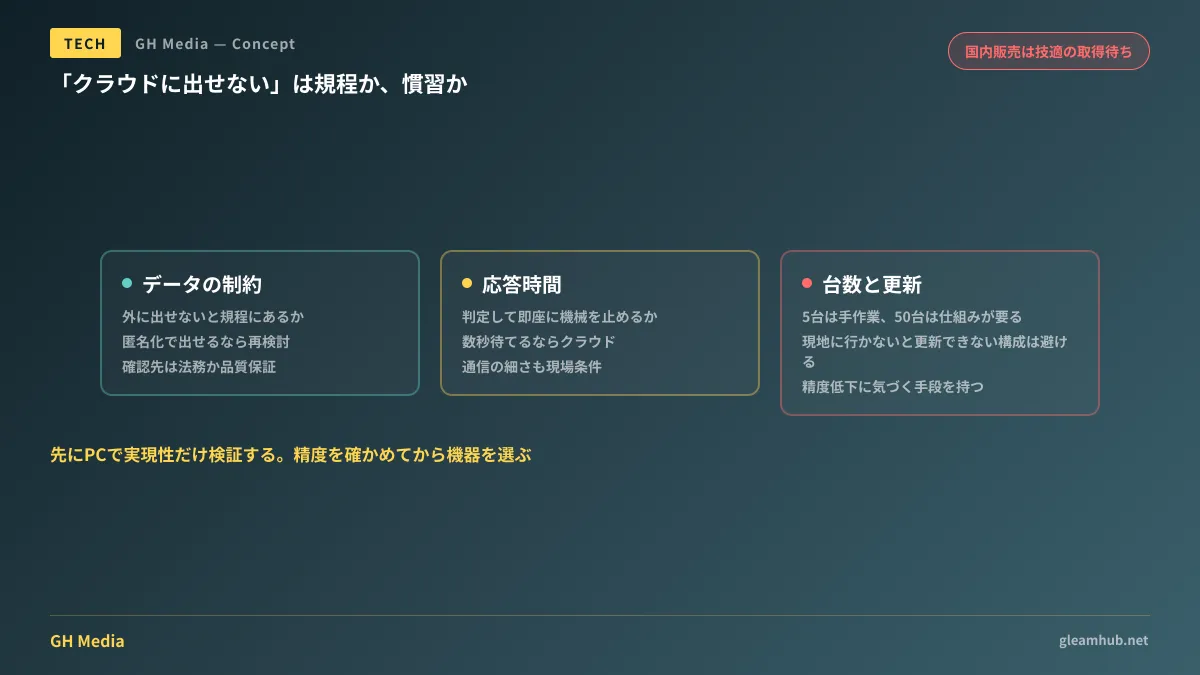
Choosing on-site deployment for the vague reason that "on-premises is safer" usually leads to dead ends in operations. Decision criteria can be narrowed to three.
| Discussion point | Favorable for on-site deployment | Favorable for cloud deployment |
|---|---|---|
| Data | Constraints prohibiting external transfer are explicitly stated in contracts or regulations | Acceptable to send externally, or can be anonymized |
| Response latency | Need to make a determination and stop machinery immediately | Can wait a few seconds |
| Unit count and updates | Few sites, low update frequency | Many sites, frequent model replacements |
The third row is often overlooked. When placed on-site, tasks to distribute updates to all units arise every time the model changes. With five units, manual handling works, but with fifty units, dedicated mechanisms for distribution and monitoring become necessary. That is not an AI topic, but a device management topic.
Verifying beforehand whether "cannot be sent externally" is truly a hard constraint is also essential. There are examples where reading contracts or internal regulations revealed that external processing was actually permitted if anonymized. If the constraint is merely an assumption, the cloud ends up cheaper in total cost. Considerations for the choice of running models locally are summarized in Running Gemma 4 Locally and Deciding Whether to Maintain an Internal LLM Infrastructure.
If using in Japan, check technical conformity status first
When considering use within Japan, domestic sales of this product have not yet started. Switch Science, the authorized distributor, plans to begin sales once preparations, including obtaining technical conformity certification (Giteki), are complete.
Operating a board imported individually from overseas within Japan with wireless features enabled can cause issues under the Radio Act. Even when acquiring units ahead of time for verification purposes, please check the handling of wireless functions. While this issue can be avoided by adopting a wired operating configuration, handling on-site will differ.
In formulating an implementation plan, the sequence is as follows:
- Check domestic sales timing with distributors
- Until then, verify feasibility alone using existing boards with equivalent configurations or available PCs
- Verify "whether necessary accuracy is achieved in the first place" through testing before proceeding to hardware selection
Reversing this order and purchasing equipment first leaves you with unusable boards if sufficient accuracy cannot be achieved.
Who looks after it after placing it on-site?
This is the most frequently missed aspect of implementation planning. Placing AI devices in factories or warehouses means they become network-connected compact computers outside the control of the IT team.
Four points need to be determined:
- Recovery procedures upon failure. Whether backup units will be prepared, or if humans will inspect during downtimes
- Who updates models and the OS, and when. Adopting a configuration that requires physical visits for updates means they will practically never be updated
- Where determination results are logged. If you cannot trace later whether "that day's determination was correct," you cannot isolate causes during defects
- Mechanisms to detect drops in accuracy. When lighting or fixtures change, determinations drift. If left unattended, incorrect determinations will continue to pass silently
The fourth point is the most critical acceptance inspection item across AI features as a whole. The concept of continuously running the same verification set to make comparisons was detailed in Told That "the AI Occasionally Hallucinates," Nobody Can Verify if It Has Been Fixed.
Furthermore, while configurations deploying hardware on-site offer predictable initial costs, they are relatively advantageous during periods when server-side costs are unpredictable. Factors driving up cloud costs were touched upon in Surging Memory Prices Impact Estimates.
What to do next
First, confirm whether "cannot be sent to the cloud" is written in regulations or merely custom. If this changes, both required architecture and costs change substantially. The party to check with is not the IT team, but legal or quality assurance personnel.
From there, test feasibility of the determination on your local PC first. Whether the target evaluation can be performed with dozens of images can be determined without dedicated hardware. Progressing to hardware selection after confirming feasibility ensures equipment does not go to waste.
At GleamHub, we handle on-site AI processing design, separation between cloud and on-premises, and building post-implementation operational structures through our development, AI, and automation consultations. Because architecture varies depending on data constraints and on-site conditions, please share your specific situation via Contact Us.
Sources
- Pre-Orders Begin for "Arduino VENTUNO Q" Microcontroller Board Capable of Executing Local LLMs Directly — gihyo.jp
- Arduino Opens Sales Orders for "Arduino VENTUNO Q" Edge AI Computer Equipped with 40 TOPS NPU and 16GB RAM — Switch Science, Inc.
- Arduino VENTUNO Q — Switch Science
- Arduino "VENTUNO Q" Integrates AI and Machine Control on a Single Board, Supporting Robotics and Quality Inspection — FabScene