You built an internal tool that has Claude help with first-round screening of application documents. You commissioned a development company to build a customer-facing inquiry bot, and it will launch soon. Can you explain, in light of the provider's terms, how far people verify the AI's results in those systems and what should be shown to users?
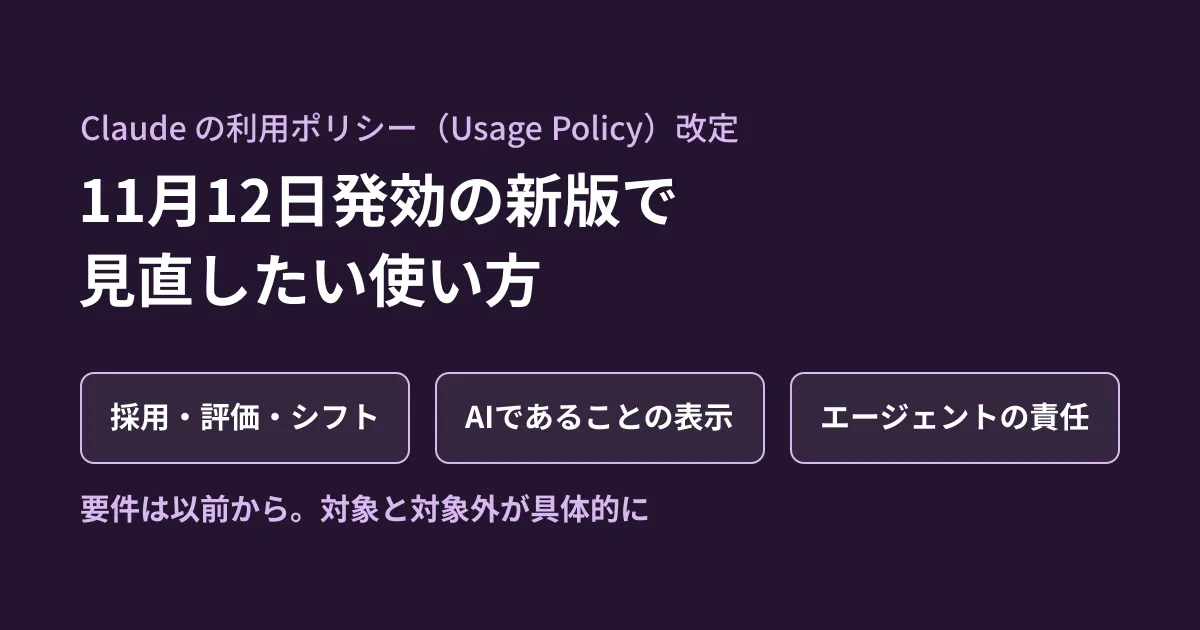
On October 8, 2026, Anthropic published a new version of its Usage Policy, the rules for using Claude. It takes effect on November 12, 2026. In this article, we compare the announcement and the original texts of the old and new versions, and lay out what was rewritten and what has not changed for uses in HR and labor management, customer-facing chatbots, and agents. This is not legal advice, and we have not checked its relationship to Japanese law.
What changed is the wording; the requirements were already there
Regarding the requirements for high-risk use cases, Anthropic states clearly in its announcement that they "have not changed." After explaining that for uses affecting health, legal rights, finances, livelihoods, and the like, it requires a "human in the loop," in which a qualified person reviews the output, as well as disclosure to the person that AI was used, it writes the following.
These requirements haven’t changed with the updated version of our Usage Policy. However, users have often asked us whether a given use case has these requirements, so we’ve rewritten our High-risk Use Case Requirements section to answer that more directly. It now lists which kinds of recommendations are covered and which are not.
The previous version (effective September 15, 2025) also had requirements for human review and for disclosing AI use. Rather than a new obligation suddenly arising on November 12, it is more accurate to read this as uses that were already covered have become easier to identify through the rewrite. The new version states at the outset that its scope includes end users of products and services that incorporate Claude, so organizations using tools brought in from a development company are not exempt either.
Wording differences not mentioned in the announcement
When the editorial team compared the old and new original texts, we also found differences that the announcement does not mention.
- The previous version described high-risk uses as "specific consumer-facing use cases," but the new version says "specific use cases that pose an elevated risk of harm to individuals," without the word "consumer-facing." From the wording, it is now easier to see that HR tools for employees can also be covered
- "Media or professional journalistic content" (uses that automatically generate content and publish it externally), which was in the previous version's list, does not appear among the 11 areas in the new version. The announcement gives no explanation; this is the result of comparing the texts
- A sentence was added stating that the requirements do not replace the laws of each country, and that where there are conflicts or additional requirements, the law should be followed
Uses covered in HR and labor management
The scope of "Employment" in the new version
The new version divides the high-risk areas (High-risk Areas) into 11. The employment item is as follows.
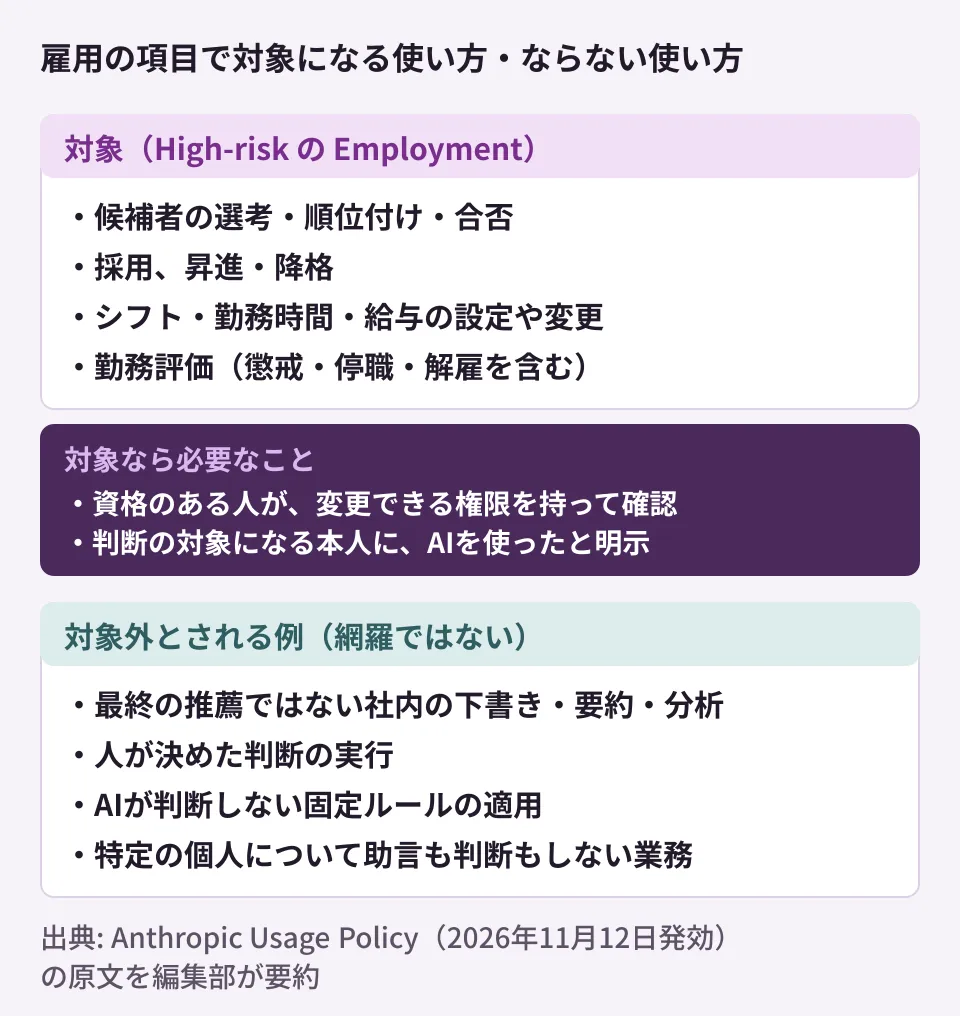
Employment — screening, ranking, advancing, or rejecting candidates; hiring; promoting or demoting; setting or changing shifts, hours, or pay; evaluating a worker’s performance or behavior, including through disciplining, suspending, or terminating a worker.
The previous version, under "Employment and housing," listed decisions on employability, resume screening, hiring tools, and other employment-related decisions. The new version explicitly names setting or changing shifts, working hours, and pay and performance evaluations (including discipline, suspension, and dismissal). Whether these were included in "other" in the previous version is a matter of interpretation, but since Anthropic says the requirements have not changed, the editorial team recommends reviewing them as things that were already covered.
Two things required if a use is covered
When AI produces a recommendation (High-risk AI Recommendation) in the areas above, the new version requires the following.
- Review by a qualified person. Before a recommendation reaches the individual as advice, or before it is used to carry out a decision, a person with the training or experience to evaluate that field, and with the authority to change it, substantively reviews it. Responsibility for the accuracy and appropriateness of the result remains with that person
- Disclosure to the individual. Clearly tell the person receiving advice, or the person subject to a decision, that AI was used. The original text says "Users do not need to identify Anthropic, Claude, or the model used." so there is no need to go as far as naming the model
If you have Claude draft a shift schedule, the person in charge checks it in a state where they can make corrections before finalizing it, and employees are told that AI is used to create it. There is an exception that allows skipping human review for decisions entirely favorable to the individual, but the examples given are things like paying insurance claims or granting public benefits, and employment is not included.
Uses stated to be out of scope
What is useful in practice is that examples of out-of-scope uses are now listed. In the previous version, the only explicitly stated exclusion was roughly wellness advice under the healthcare item. The new version lists the following as uses related to recommendations that do not themselves produce a recommendation (explicitly stated to be non-exhaustive).
- Explaining how laws and systems work without applying them to an individual's circumstances
- Explaining advice or decisions already given by a qualified person so that the individual can understand them
- Internal drafts, research, summaries, and analysis that are not the final recommendation ("Internal drafting, research, summarization, or analysis that is not the ultimate High-risk AI Recommendation delivered.")
- Carrying out decisions made by people, or applying fixed rules or formulas where AI makes no judgment about an individual
- Business operations that neither advise nor decide about a specific individual ("Business operations that do not advise or decide about a specific individual.")
How to think about the boundary (the editorial team's summary)
The following is the editorial team's reading of the original text, not a determination made by Anthropic on individual cases.
- Summarizing interview notes or drafting job postings can be considered close to internal drafting or summarization, as long as it is not a recommendation about a specific candidate
- Sorting applicants by score or proposing pass/fail decisions falls under "screening, ranking." Even in the form of a summary, if it indicates which candidates are better and is used directly for decisions, it should be treated as covered
- Applying a fixed rule, such as calculating paid leave days from years of service, is close to the out-of-scope examples, but it is a different matter if AI decides how the rule is applied
When in doubt, it is easier to sort things out by asking, "Will this output be used as is for a decision about a specific individual?"
Customer-facing chatbots and agents
Disclosing that it is AI
Chatbots and AI agents that interact directly with external users are subject to the following requirements, regardless of whether the use is high-risk.
All consumer-facing chatbots or AI agents that communicate directly with external users must disclose to users that they are interacting with AI rather than a human. This disclosure must be provided at a minimum at the beginning of each chat session or in the product interface. The disclosure does not need to identify Anthropic, Claude, or the model used.
The requirement to "disclose at the start of the chat session" was also in the previous version. What was added is that disclosing it on the product's screen is also allowed, and that it is explicitly stated that there is no need to name Anthropic, Claude, or the model. Pretending to be human was prohibited in the previous version as well.
The checklist the editorial team compiled from the original text is as follows (Anthropic has not stated that it is sufficient).
- A notice such as "AI is responding" appears in the first message at the start, or in an always-visible position such as near the input field
- When handing off to a human agent, users can tell AI responses apart from human responses
- The bot's name, icon, and tone do not mislead users into thinking it is a human representative
- Even on channels other than your own website, such as LINE, the notice is visible on each screen
For designing the notice, see Designing "transparency UI" for AI features in client projects, and if you are starting from considering adoption, see also The complete guide to adding an AI chatbot to a small business website.
Responsibilities of those who build and those who deploy
Regarding agents, the previous version said they "must comply with the Usage Policy" and left examples to a help article. The new version spells out where responsibility lies.
Users are responsible for ensuring that agents they build or deploy, including actions those agents take through tools, browsers, or connected systems, comply with this Usage Policy.
The wording places responsibility on those who build (build) and those who run (deploy), including actions taken in tools, browsers, and connected systems. If you run in-house an agent that you had a development company build, the company that commissioned it can be read as being on the "deploy" side as well. If an agent connected to an applicant tracking system automatically updates applicants' screening status, that may count as a high-risk decision, so you need to decide which actions to allow from the perspective of the Usage Policy as well.
What to check by November 12
As the editorial team's suggestions, here is what companies that use or commission tools incorporating Claude should check before the effective date.
- Identify where Claude's output is used in hiring and screening, shifts, working hours, and pay, and performance evaluation and discipline
- Compare against the out-of-scope examples to see whether each is a recommendation or decision about a specific individual, or stays within internal drafting and summarization
- If covered, write into your business procedures who reviews it, at which stage, and with the authority to make changes
- Decide how to tell applicants and employees about AI use (job postings, notification letters, internal rules, and so on)
- Check the notice at the start or on screen for chatbots on every channel
- If you have a vendor, agree on which party implements and maintains the notices and the restrictions on actions
If your internal AI usage rules are not yet in place, A practical guide to creating AI usage rules and guidelines for small and medium-sized businesses lays out the items to include.
Scope of verification
On October 10, 2026, we directly retrieved three pages, Anthropic's announcement "2026 Usage Policy update" (Oct 8, 2026), the new Usage Policy (Effective November 12, 2026), and the previous version linked from that page (Effective September 15, 2025), and checked the requirements for high-risk uses, the employment item, the out-of-scope examples, and the descriptions of chatbots and agents against the original text (document research). Differences not explained in the announcement (such as the removal of the word "consumer-facing" and of the media and journalistic content item) are the result of the editorial team's comparison of the texts. We have not checked Anthropic's determinations on individual uses, how violations are handled, or the relationship with Japanese law (such as the Act on the Protection of Personal Information and labor-related laws). The approach to the boundary and the checklist are the editorial team's suggestions.
For designing or reviewing tools that build AI into HR or customer support, or designing agent permissions, please contact us through our consultation on development, AI, and automation.