Your internal systems run on Google Cloud, and you mainly use Gemini for AI. Even so, for some uses you want OpenAI's models, but you do not want to add another contract and another invoice. For companies thinking along those lines, Google Cloud's October 21 announcement is worth paying attention to.
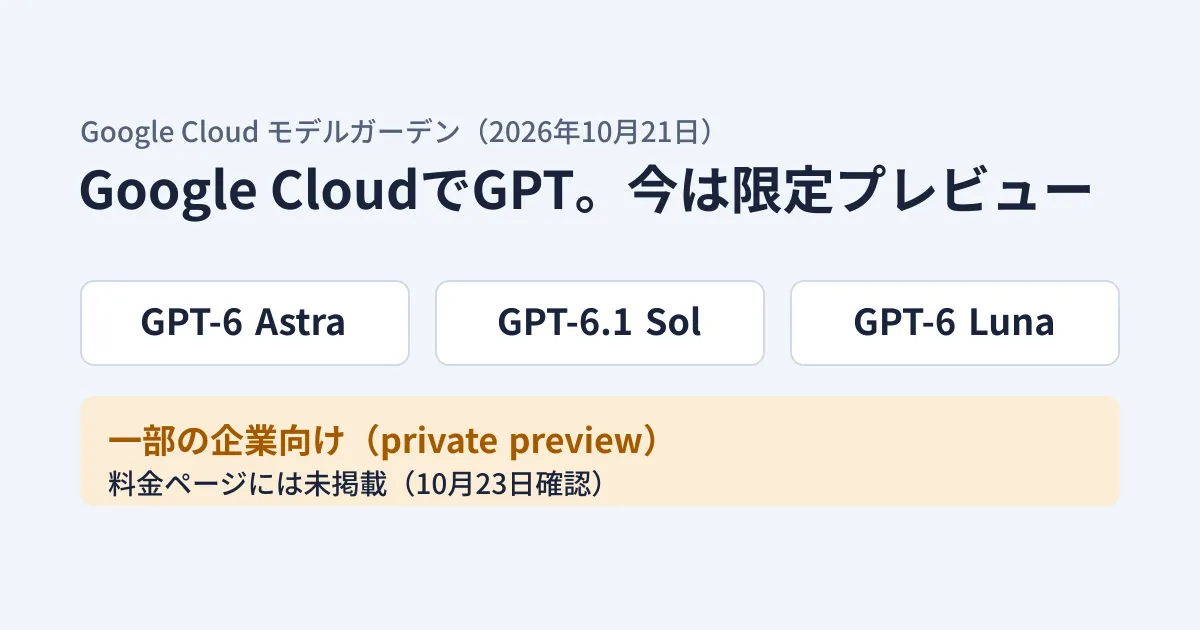
On October 21, 2026 (US time), Google Cloud announced on its official blog that it had begun offering OpenAI's models in its Model Garden. It says this makes it the only hyperscaler to offer all three major closed-source LLMs (Gemini, Claude, and GPT).
Today, we are expanding that foundation by launching OpenAI models in Google Cloud’s model garden.
However, not everyone can use them right away. In this article, based on the official blog, the pricing page, and other sources, we separate what has been settled now from what remains "coming soon."
Only some enterprises can use it so far
According to the blog, the following three models were added.
- GPT-6 Astra: For demanding work such as coding, computer use, professional tasks, and scientific research
- GPT-6.1 Sol: Performance close to Astra at a lower cost (agentic coding, computer use, professional tasks)
- GPT-6 Luna: A fast, cost-efficient model for handling large volumes of everyday tasks
Regarding the availability stage, the blog says the following.
OpenAI’s GPT-6 Astra, GPT-6.1 Sol, and GPT-6 Luna models are rolling out now in private preview to select enterprise customers in Google Cloud’s model garden, with more coming soon.
In other words, it is a private preview for selected enterprises. If you want to use it, you apply through an expression-of-interest form. The form page clearly states that applying does not guarantee access.
Expressing interest and filling out this form does not guarantee access.
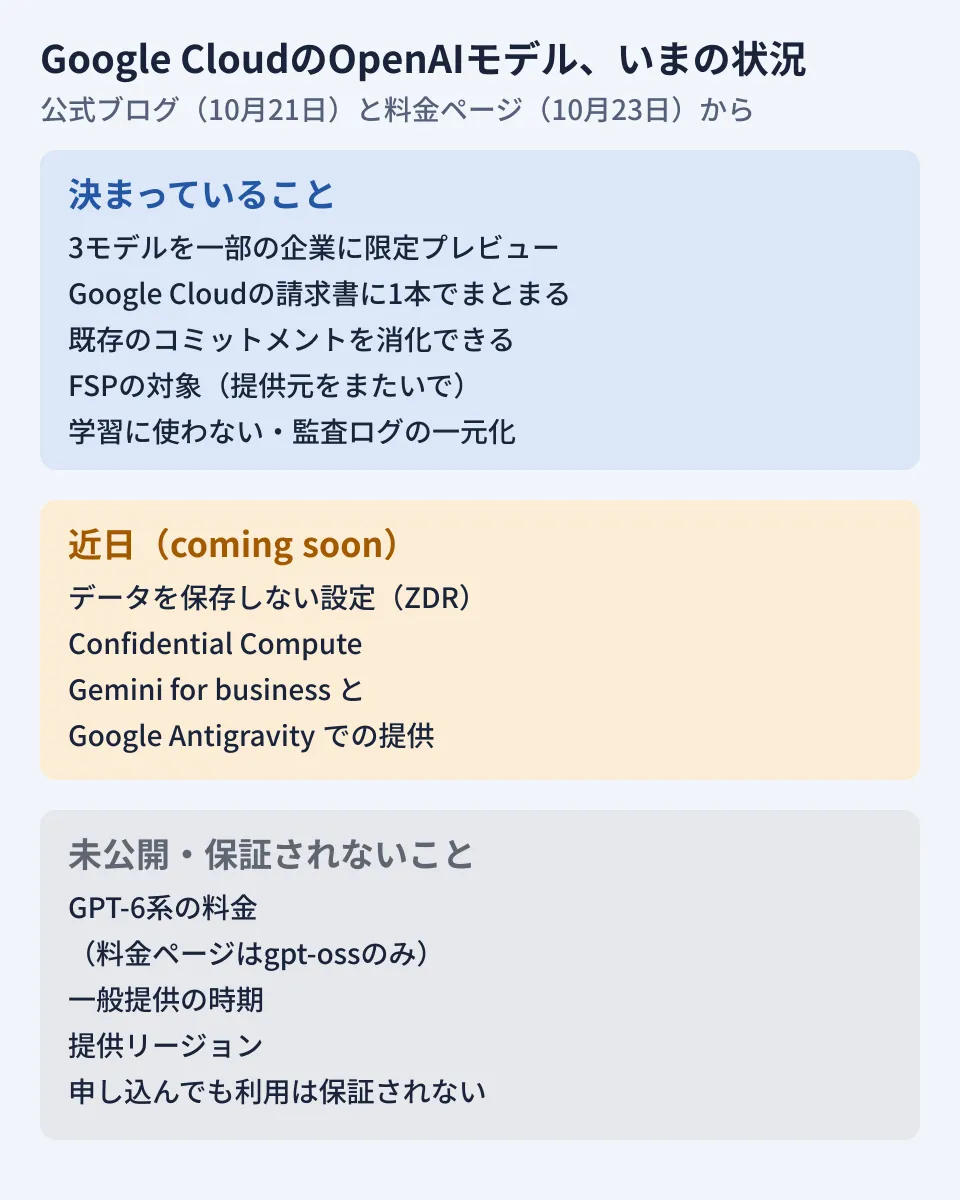
Pricing has not been published yet either. When we checked the generative AI pricing page on October 23 and 27, 2026, the only OpenAI models listed were the open-weight gpt-oss-120b and gpt-oss-20b, and there was no pricing for GPT-6 Astra, GPT-6.1 Sol, or GPT-6 Luna. As of October 27, the Model Garden documentation for OpenAI models and the release notes also had no mention of the GPT-6 series.
What is settled: unified billing and contracts
The blog says that use of OpenAI's models is transacted through Google Cloud Marketplace and handled as follows.
- Usage fees are consolidated into a single Google Cloud invoice
- Usage can be applied toward existing Google Cloud spending commitments
- Eligible for Flexible Savings Plans (FSP) across model providers
FSP is a program that gives you a discount in exchange for committing to a monthly spend. A Google Cloud blog post on August 26, 2026, described FSP for Gemini Enterprise as "a 10% discount for a 1-year commitment and 20% for 3 years." However, this latest blog post does not indicate whether the same discount rates apply as-is to OpenAI's models.
Being able to handle this within your existing Google Cloud contract, billing, and budget management, without signing a separate contract with OpenAI, is a significant difference for companies that place importance on accounting and procurement procedures.
What remains "coming soon"
On the other hand, data handling and some features are marked "coming soon" in the blog.
| Item | What the blog says | As of October 21, 2026 |
|---|---|---|
| Handling of inputs and outputs | Stays within the specified data boundary and is not used to train foundation models | Stated |
| Setting that does not store data (ZDR) | Zero Data Retention option | Coming soon |
| Dedicated infrastructure | Run on dedicated Google Cloud infrastructure | Stated |
| Confidential Compute | Running on confidential computing | Coming soon |
| Auditing and permissions | Running under authenticated identities, VPC Service Controls, and centralized audit logs | Stated |
| Use in other products | Make the models available in Gemini for business and Google Antigravity | Coming soon |
The blog says that in addition to using the models through the API, inference from a local Codex CLI or the desktop app can be connected to Google's platform. The blog does not say which settings are used to connect them.
What companies using Google Cloud can decide now
What follows is the editorial team's analysis. At the private preview stage, it is not yet possible to decide to build these models into production work. Even so, the following steps can be taken now.
- Build so that models can be swapped by use case: The blog emphasizes being able to choose and swap models for each use case. If your internal apps keep model names and API calls in one place, comparing and choosing will be easier once GPT becomes generally available
- Decide your data-handling requirements first: For use cases that handle customer or personal information, decide internally whether a setting that does not store data is mandatory, or whether it is enough that data is not used for training. With ZDR described as coming soon, use cases that require it will have to wait for now
- Decide how you will compare pricing: GPT-6 series pricing has not been published yet. Once it is, compare it with the price of using the OpenAI API directly, including how FSP and commitments apply
- Apply if you want access: If you have a specific use case you want to try, apply through the expression-of-interest form. Access is not guaranteed
How to review costs when new models come out is covered in A cheaper new model will not automatically lower your bill. For the idea of a gateway that centrally manages internal AI use, see Should you put a gateway in front of internal AI?, and for connecting internal screens to Gemini Enterprise, see MCP Apps in Gemini Enterprise.
Scope of verification
On October 23, 2026, we opened and checked the following directly on cloud.google.com: the official Google Cloud blog post "Google Cloud expands model choice and flexibility, bringing OpenAI models to customers" (October 21, 2026), the expression-of-interest form page, the generative AI pricing page (Agent Platform Pricing), and the official blog post of August 26, 2026 explaining FSP (document research). On October 27, 2026, we checked the pricing page and the documentation and release notes for OpenAI models on Gemini Enterprise Agent Platform, and confirmed that there is no mention of the GPT-6 series (the only OpenAI models in the documentation are the two gpt-oss models) and that there has been no announcement changing the availability stage since the October 21 blog post. The editorial team has not called OpenAI models on Google Cloud and has not verified the available regions, performance in Japanese, the API specifications, or how to connect Codex CLI.
For choosing AI models or building them into internal systems, contact us through Development, AI, and automation consultations.
References
- Google Cloud expands model choice and flexibility, bringing OpenAI models to customers(Google Cloud Blog, 2026-10-21)
- Access OpenAI models in Google Cloud’s model garden(Google Cloud)
- Agent Platform Pricing(Google Cloud)
- FinOps for the AI era: New flexible billing and cost controls for agents(Google Cloud Blog, 2026-08-26)
- OpenAI models (Gemini Enterprise Agent Platform documentation)
- Gemini Enterprise Agent Platform release notes(Google Cloud)